no No, not. οὐ, before a vowel with smooth breathing οὐκ, before one with rough breathing οὐχ (but improperly οὐχ ἰδού, Ac 2:7, WH, mg.; cf. WH, Intr., § 409; M, Pr., 44, 244), [in LXX for לֹא, אַיִן, אֵין;] neg. particle, not, no, used generally c. indic. and for a denial of fact (cf. μή ); absol. (accented), οὔ, no: Mt 13:29, Jo 1:21 21:5; οὒ οὔ, Mt 5:37, Ja 5:12. Most freq. negativing a verb or other word, Mt 1:25 10:26, 38, Mk 3:25 9:37, Jo 8:29, Ac 7:5, Ro 1:16, Phl 3:3, al.; in litotes, οὐκ ὀλίγοι (i.e. very many ), Ac 17:4, al.; οὐκ ἄσημος, Ac 21:39; πᾶς... οὐ, c. verb, (like Heb. כֹּל... לֹא ), no, none, Mt 24:22, Mk 13:20, Lk 1:37, Eph 5:5, al.; in disjunctive statements, οὐκ... ἀλλά, Lk 8:52, Jo 1:33, Ro 8:20, al.; c. 2 pers. fut. (like Heb. לֹא, c. impf.), as emphatic prohibition, Mt 4:7, Lk 4:12, Ro 7:7, al. With another negative, strengthening the negation: Mk 5:37, Jo 8:15 12:19, Ac 8:39, al.; making an affirmative: Ac 4:20, I Co 12:15. With other particles: οὐ μή (v.s. μή ); οὐ μηκέτι, Mt 21:19; with μή interrog., Ro 10:18, I Co 9:4, 5 11:22. Interrogative, expecting an affirmative answer (Lat. nonne ): Mt 6:26, Mk 4:21, Lk 11:40, Jo 4:35, Ro 9:21, al. Scroll for more
all All, the whole, every kind of. πᾶς, πᾶσα, πᾶν, gen., παντός, πάσης, παντός, [in LXX chiefly for כֹּל;] all, every. As adj., c. subst. anarth., all, every, of every kind: Mt 3:10 4:23, Mk 9:49, Lk 4:37, Jo 2:10, Ac 27:20, Ro 7:8, Re 18:17, al. mult.; pl., all, Ac 22:15, Ro 5:12, He 1:6, al.; of the highest degree, π. ἐξουσία ( προθυμία, χαρά ), Mt 28:18, Ac 17:11, Phl 2:29, al.; also the whole (though in this sense more freq. c. art.), Mt 2:3, Ac 2:36, Ro 11:26. C. art. (before the art., after the noun, or, denoting totality, between the art. and noun), all, whole: Mt 8:32 13:2, Mk 5:33, Lk 1:10, Ac 7:14, Ro 3:19, Ga 5:14, Eph 4:16, al.; pl., Mt 2:4, Mk 4:13, Ro 1:5, al. As pron., masc. and fem., every one: Mk 9:49, Lk 16:16, He 2:9; seq. rel. pron., Mt 7:24, Ac 2:21, Ga 3:10, al.; c. ptcp. (anarth.), Mt 13:19, Lk 11:4; c. ptcp. (c. art.), Mt 5:22, Mk 7:8, Lk 6:47, Jo 3:8, Ro 1:16, al.; pl., πάντες, absol., all, all men, Mt 10:22, Mk 13:13, Lk 20:38, Jo 1:7 3:26, I Co 8:1, al.; οἱ π. (collectively, as a definite whole), Ro 11:32, I Co 1:17, Eph 4:13, al.; π. οἱ ( ὅσοι ), Mt 4:24, Mk 1:32, Lk 4:40, al. Neut., sing., πᾶν, everything, all: πᾶν τό, c. ptcp., I Co 10:25, 27, Eph 5:13, I Jo 2:16 5:4 (sc. ὄν ); πᾶν ὅ, Jo 17:2, Ro 14:23; collectively, of persons (Westc., in l.), Jo 6:37, 39; c. prep., in adverbial phrases, διὰ παντός, always, Mt 18:10, al.; ἐν παντί, in everything, in every way, II Co 4:8, Phi 4:6, al.; pl., πάτνα, all things: absol., Jo 1:3, I Co 2:10, He 2:8, al.; of certain specified things, Mk 4:34, Lk 1:3, Ro 8:28, I Th 5:21, al.; acc., πάντα, adverbially, wholly, in all things, in all respects, Ac 20:35, I Co 9:25, al.; c. art., τὰ π., all things (a totality, as distinct from anarth. πάντα, all things severally; cf. Westc., Eph., 186 f.), absol.: Ro 11:36, I Co 8:6, Eph 3:9, He 1:3, al.; relatively, Mk 4:11, Ac 17:25, Ro 8:32, al.; πάντα τά, c. ptcp., Mt 18:31, al.; πάντα ταῦτα ( ταῦτα π. ), Mt 6:32, 33, al.; πάντα, c. prep, in adverbial phrases, πρὸ πάντων, above all things, Ja 5:12, I Pe 4:8; ἐν π., in all things, in all ways, I Ti 3:11, I Pe 4:11, al.; κατὰ πάντα, in all respects, Ac 17:22, al. C. neg., πᾶς οὐ ( μή ) = οὐδείς, v.s. οὐ and μή, and cf. M, Pr., 245 f. Scroll for more
the/this/who The, the definite article. ὁ, ἡ, τό, the prepositive article ( ἄρθρον προτακτικόν ), originally a demonstr. pron. (so usually in Hom.), in general corresponding to the Eng. definite article. As demonstr. pron. As freq. in Hom., absol., he ( she, it ), his (etc.): Ac 17:28 (quoted from the poet Aratus). Distributive, ὁ μὲν... ὁ δέ, the one... the other: I Co 7:7, Ga 4:22; pl., Ac 14:4, 17:32, Phl 1:16, al.; οἱ μὲν... ἄλλοι δέ, Mt 16:14, Jo 7:12; οἱ μεν̀... ὁ δέ, He 7:21, 23. In narration (without ὁ μὲν preceding), ὁ δέ, but he: Mt 2:14, Mk 1:45, Lk 8:21, Jo 9:38, al. mult. As prepositive article, the, prefixed, to nouns unmodified: ὁ θεός, τὸ φῶς, etc.; to abstract nouns, ἡ σοφία, etc., to pl. nouns which indicate a class, οἱ ἀλώπεκες, foxes, Mt 8:20, al.; to an individual as representing a class, ὁ ἐργάτης, Lk 10:7; c. nom. = voc. in addresses, Mt 11:26, Jo 19:3, Ja 5:1, al.; to things which pertain to one, ἡ χεῖρ, his hand, Mk 3:1; to names of persons well known or already mentioned; usually to names of countries (originally adjectives), ἡ Ἰουδαία, etc. To modified nouns: c. pers. pron. gen., μοῦ, σοῦ, etc.; c. poss. pron., ἐμός, σός, etc.; c. adj. between the art. and the noun, ὁ ἀγαθὸς ἄνθρωπος, Mt 12:35; the noun foll. by adj., both c. art., ὁ ποιμὴν ὁ καλός, Jo 10:11 (on ὁ ὄχλος πολύς, Jo 12:9, v. M, Pr., 84); before adjectival phrases, ἡ κατ’ ἐκλογὴν πρόθεσις, Ro 9:11. To Other parts of speech used as substantives; neuter adjectives: τ. ἀγαθόν, etc.; cardinal numerals: ὁ εἶς, οἷ δύο, etc.; participles: ὁ βαπτίζων (= ὁ Βαπτιστής, Mt 14:2 ), Mk 6:14; πᾶς ὁ, c. ptcp., every one who, etc.; adverbs: τὸ πέραν, τὰ νῦν, ὁ ἔσω ἄνθρωπος; infinitives: nom., τὸ θέλειν, Ro 7:18, al.; gen., τοῦ, after adjectives, ἄξιον τοῦ πορεύεσθαι, I Co 16:4; verbs, ἔλαχεν τοῦ θυμιᾶσαι, Lk 1:9; and freq. in a final sense, ἐξῆλθεν ὁ σπείρειν, Mt 13:3 (on the artic. inf., v. Bl., § 71). In the neut. to sentences, phrases or single words treated as a quotation: τὸ Ἐι δύνῃ, Mk 9:23; τὸ ἔτι ἅπαξ, He 12:27; τὸ ἀνέβη, Eph 4:9, al. To prepositional phrases: οἱ ἀπὸ Ἰταλίας, He 13:24; οἱ ἐκ νόμου, Ro 4:14; neut. acc. absol., in adverbial phrases, τὸ καθ’ ἡμέραν, daily, Lk 11:3; τὸ κατὰ σάρκα, as regards the flesh, Ro 9:5. To nouns in the genitive, denoting kinship, association, etc.: ὁ τοῦ, the son of (unless context indicates a different relationship), Mt 10:2, al.; τὰ τοῦ θεοῦ, the things that pertain to God, Mt 16:23; τὰ τῆς εἰρήνης, Ro 14:19 (cf. M, Pr., 81 ff.; Bl, §§ 46, 47). Scroll for more
to say (denoting speech in progress), (a) I say, speak; I mean, mention, tell, (b) I call, name, especially in the pass., (c) I tell, command. λέγω, [in LXX very freq., chiefly for אמר; λέγει for נְאֻם, Ge 22:16, al.;] in Hom., to pick out, gather, reckon, recount. In Hdt. and Att., to say, speak, affirm, declare: absol., Ac 13:15 24:10; seq. orat. dir., Mt 9:34, Mk 3:11, Jo 1:29, al.; seq. ὅτι recit., Mk 3:21, Lk 1:24, Jo 6:14, al.; acc. et. inf., Lk 11:18, Jo 12:29, al.; after another verb of speaking, προσφωνεῖν κ. λέγειν, Mt 11:17, al.; ἀπεκρίθη ( ἐλάλησεν ) λέγων ( καὶ λέγει; Dalman, Words, 24 ff.), Mt 25:9, Mk 3:33, 7:28, Lk 24:6, 7, al.; of unspoken thought, λ. ἐν ἑαυτῷ, Mt 3:9, Lk 3:8, al.; of writing, II Co 8:8, Phl 4:11, al.; λέγει ἡ γραφή, Ro 4:3, Ja 2:23, al.; c. acc. rei, Lk 8:8 9:33, Jo 5:34, al.; σὺ λέγεις (a non-committal phrase; Swete, Mk., 359, 369 f.), Mt 27:11, Mk 15:2, Lk 23:3, Jo 18:37; c. dat. pers., seq. orat. dir., Mt 8:20, Mk 2:17, al. mult.; id. seq. ὅτι, Mt 3:9, al.; c. prep., πρός, μετά, περί, etc., Mk 4:41, Jo 11:56, He 9:5, al.; to mean (cl.), Mk 14:71, Jo 6:71, I Co 10:29, al.; to call, name, Mk 10:18; pass., Mt 9:9, Mk 15:7, al (cf. ἀντι-, δια- ( -μαι ), προ-, συλ-λέγω ). SYN.: λαλέω, which refers to the utterance, as λέγω to the meaning of what is said, its correspondence with thought (Tr., Syn., Ixxvi; Thayer, s.v. λαλέω ). Scroll for more
to me ἐγώ, gen, etc., ἐμοῦ, ἐμοί, ἐμέ (enclitic μου, μοι, με ), pl. ἡμεῖς, -ῶν, -ῖν, -ᾶς, pers. pron. I. The nom. is usually emphatic, when expressed as subjc, as in Mt 3:11, Mk 1:8, Lk 3:16, al. But often there is no apparent emphasis, as Mt 10:16, Jo 10:17; ἰδοὺ ἐ. (= Heb. הִנֵּנִי, cf. I Ki 3:8 ), Ac 9:10; ἐ. (like Heb. אֲנִי ), I am, Jo 1:23 (LXX), Ac 7:32 (LXX). The enclitic forms (v. supr.) are used with nouns, adjectives, verbs, adverbs, where there is no emphasis: ἐν τ. πατρί μου, Jo 14:20; μου τ. λόγους, Mt 7:24; ὀπίσω μου, Mt 3:11; ἰσχυρότερός μου, ib.; λέγει μοι, Re 5:5; also with the prep. πρός, as Mk 9:19, al. The full forms ( ἐμοῦ, etc.) are used with the other prepositions, as δι' ἐμοῦ, ἐν ἐμοί, εἰς ἐμέ, etc., also for emphasis, as Lk 10:16, Jo 7:23, Mk 14:7, al. The gen. μου and ἡμῶν are often used for the poss. pronouns ἐμός, ἡμέτερος: τ. λαόν μου, Mt 2:6; μου τῂ ἀπιστιᾳ, Mk 9:24. τί ἐμοὶ καὶ σοί ( = Heb. וָלָךְ מַה־לִי, Jg 11:12, al.), i.e. what have we in common: Mt 8:29, Mk 1:24 5:7, Lk 8:28, Jo 2:4; τί γάρ μοι, I Co 5:2. The interchange of ἐγώ and ἡμεῖς, common in π., appears in Pauline Epp. (v. M, Pr., 86f., M, Th., 131f.). κἀγώ (= καὶ ἐγώ, and I, even I, I also: Mt 2:8, Lk 2:48, Jo 6:56, Ro 3:7, I Co 7:40, al.; κἀγώ... καί, both... and, Jo 7:28. Scroll for more
lord: God Lord, master, sir; the Lord. κύριος, -α, -ον (also -ος, -ον ), [in LXX (subst.) chiefly for יהוה, also for אָדוֹן, בַּעַל, etc.;] having power ( κῦρος ) or authority; as subst., ὁ κ., lord, master; in general: c. gen. rei, Mt 9:38 20:8, Mk 12:9 13:35, Lk 19:33; τ. σαββάτου, Mt 12:8, Mk 2:28, Lk 6:5; c. gen. pers., δούλου, etc., Mt 10:24, Lk 14:21, Ac 16:16, al.; absol., opp. to οἱ δοῦλοι, Eph 6:5, 9, al.; of the Emperor (Deiss., LAE, 161), Ac 25:26; θεοὶ πολλοὶ καὶ κ. πολλοί, I Co 8:5; of a husband, I Pe 3:6; in voc., as a title of respect to masters, teachers, magistrates, etc., Mt 13:27 16:22 27:63, Mk 7:28, Lk 5:12, Jo 4:11, Ac 9:5, al. As a divine title (freq. in π.; Deiss., LAE, 353 ff.); in NT, of God: ὁ κ., Mt 5:33, Mk 5:19, Lk 1:6, Ac 7:33, He 8:2, Ja 4:15, al.; anarth. (Bl., § 46, 6), Mt 21:9, Mk 13:20, Lk 1:17, He 7:21, I Pe 1:25, al.; κ. τ. οὐρανοῦ καὶ τ. γῆς, Mt 11:25; τ. κυριευόντων, I Ti 6:15; κ. ὁ θεός, Mt 4:7, 10 al.; id. seq. ὁ παντοκράτωρ, Re 4:8; κ. σαβαώθ, Ro 9:29; ( ὁ ) ἄγγελος κυρίου, Mt 1:20 2:13, Lk 1:11, al.; πνεῦμα κυρίου, Lk 4:18, Ac 8:39; of the Christ: Mt 21:3, Mk 11:3, Lk 1:43 20:44, al.; of Jesus after his resurrection (Dalman, Words, 330), Ac 10:36, Ro 14:8, I Co 7:22, Eph 4:5, al.; ὁ κ. μου, Jo 20:28; ὁ κ. Ἰησοῦς, Ac 1:21, I Co 11:23, al.; id. seq. Χριστός, Eph 1:2, al.; ὁ κ. ἡμῶν, I Ti 1:14, He 7:14, al.; id. seq. Ἰησοῦς, I Th 3:11, He 13:20, al.; Χριστός, Ro 16:18; Ἰ Χ., I Co 1:2, I Th 1:3, al.; Ἰ. Χ. ( Χ. Ἰ ) ὁ κ. ( ἡμῶν ), Ro 1:4, Col 2:6, Eph 3:11, al.; ὁ κ. καὶ ὁ σωτὴρ, II Pe 3:2; id. seq. Ἰ. Χ., II Pe 3:18; anarth., I Co 7:22, 25, Ja 5:4, al.; κ. κυρίων, Re 19:16; c. prep., ἀπὸ ( κατὰ, πρὸς, σὺν, etc.) κ., Col 3:24, al. SYN: v.s. δεσπότης. Scroll for more
lord: God Lord, master, sir; the Lord. κύριος, -α, -ον (also -ος, -ον ), [in LXX (subst.) chiefly for יהוה, also for אָדוֹן, בַּעַל, etc.;] having power ( κῦρος ) or authority; as subst., ὁ κ., lord, master; in general: c. gen. rei, Mt 9:38 20:8, Mk 12:9 13:35, Lk 19:33; τ. σαββάτου, Mt 12:8, Mk 2:28, Lk 6:5; c. gen. pers., δούλου, etc., Mt 10:24, Lk 14:21, Ac 16:16, al.; absol., opp. to οἱ δοῦλοι, Eph 6:5, 9, al.; of the Emperor (Deiss., LAE, 161), Ac 25:26; θεοὶ πολλοὶ καὶ κ. πολλοί, I Co 8:5; of a husband, I Pe 3:6; in voc., as a title of respect to masters, teachers, magistrates, etc., Mt 13:27 16:22 27:63, Mk 7:28, Lk 5:12, Jo 4:11, Ac 9:5, al. As a divine title (freq. in π.; Deiss., LAE, 353 ff.); in NT, of God: ὁ κ., Mt 5:33, Mk 5:19, Lk 1:6, Ac 7:33, He 8:2, Ja 4:15, al.; anarth. (Bl., § 46, 6), Mt 21:9, Mk 13:20, Lk 1:17, He 7:21, I Pe 1:25, al.; κ. τ. οὐρανοῦ καὶ τ. γῆς, Mt 11:25; τ. κυριευόντων, I Ti 6:15; κ. ὁ θεός, Mt 4:7, 10 al.; id. seq. ὁ παντοκράτωρ, Re 4:8; κ. σαβαώθ, Ro 9:29; ( ὁ ) ἄγγελος κυρίου, Mt 1:20 2:13, Lk 1:11, al.; πνεῦμα κυρίου, Lk 4:18, Ac 8:39; of the Christ: Mt 21:3, Mk 11:3, Lk 1:43 20:44, al.; of Jesus after his resurrection (Dalman, Words, 330), Ac 10:36, Ro 14:8, I Co 7:22, Eph 4:5, al.; ὁ κ. μου, Jo 20:28; ὁ κ. Ἰησοῦς, Ac 1:21, I Co 11:23, al.; id. seq. Χριστός, Eph 1:2, al.; ὁ κ. ἡμῶν, I Ti 1:14, He 7:14, al.; id. seq. Ἰησοῦς, I Th 3:11, He 13:20, al.; Χριστός, Ro 16:18; Ἰ Χ., I Co 1:2, I Th 1:3, al.; Ἰ. Χ. ( Χ. Ἰ ) ὁ κ. ( ἡμῶν ), Ro 1:4, Col 2:6, Eph 3:11, al.; ὁ κ. καὶ ὁ σωτὴρ, II Pe 3:2; id. seq. Ἰ. Χ., II Pe 3:18; anarth., I Co 7:22, 25, Ja 5:4, al.; κ. κυρίων, Re 19:16; c. prep., ἀπὸ ( κατὰ, πρὸς, σὺν, etc.) κ., Col 3:24, al. SYN: v.s. δεσπότης. Scroll for more
to enter I go in, come in, enter. εἰσ-έρχομαι, [in LXX chiefly for בּוֹא;] to go in or into, enter: Mt 9:25, Lk 7:45, al.; seq. εἰς, Mt 10:12, Mk 2:1, al.; seq. διά ( πύλης, θύρας, etc.), Mt 7:13, Jo 10:1, al.; ὑπὸ τ. στέγην, Mt 8:8; c. adv.: ὅπου, Mk 14:14, He 6:20; ὧδε, Mt 22:12; ἔσω, Mt 26:58; seq. πρός, c acc. pers., Mk 15:43, Lk 1:28, Ac 10:3 11:3 16:40 17:2 28:8, Re 3:20; of demons taking possession, Mk 9:25, Lk 8:30 22:3, Jo 13:27; of food, Mt 15:11, Ac 11:8. Metaph., of thoughts, Lk 9:46; εἰς κόπον, Jo 4:38; εἰς πειρασμόν, Mt 26:41, Lk 22:40, 46; of hope as an anchor, He 6:19; βοαί, Ja 5:4; πνεῦμα ζωῆς, Re 11:11; εἰς τ. κόσμον (cf. Wi 2:24 14:14, Jo 18:37 ), Ro 5:12, He 10:5; in counterparts of Jewish Aram. phrases relating to the theocracy (cf. Dalman, Words, 116ff.): εἰς τ. γάμους, Mt 25:10; εἰς τ. χάραν τ. κυρίου, Mt 25:21, 23; εἰς τ. ζωήν, Mt 18:8, 9 19:17, Mk 9:43, 45; εἰς τ. βασιλ. τ. οὐρανῶν, Mt 5:20 7:21, al. (v.s. βασιλεία ); εἰς τ. κατάπαυσιν, He 3:11, 18 4:1 ff.; εἰς τ. δόξαν, Lk 24:26; εἰσ. καὶ ἐξερχ., to go in and out (like Heb. בֹוא וְצֵאת, De 28:6, etc.), of familiar intercourse, Ac 1:21; fig., of moral freedom, Jo 10:9 (cf. ἐπ-, παρ-, συν-εισέρχομαι ). Scroll for more
toward Into, in, unto, to, upon, towards, for, among. εἰς, prep. c. acc., expressing entrance, direction, limit, into, unto, to, upon, towards, for, among (Lat. in, c. acc.). Of place. After verbs of motion; of entrance into: Mt 8:23 9:7, Mk 1:45, Lk 2:15 8:31, al.; of approach, to or towards: Mk 11:1, Lk 6:8 19:28, Jo 11:31 21:6, al.; before pl. and collective nouns, among: Mk 4:7 8:19, 20, Lk 11:49, Jo 21:23, al.; Of a limit reached, unto, on, upon: Mt 8:18, 21:1, Mk 11:1 13:16, Lk 14:10, Jo 6:3 11:32, al.; c. acc. pers. (as in Ep. and Ion.), Ac 23:15, Ro 5:12 16:19, II Co 10:14; elliptical: ἐπιστολαὶ εἰς Δαμασκόν, Ac 9:2; ἡ διακονία μου ἡ εἰς Ἱ., Ro 15:31; metaph., of entrance into a certain state or condition, or of approach or direction towards some end (Thayer, B, i, 1; ii, 1), εἰς τ. ὄνομα, M, Pr., 200. Of direction; after verbs of seeing: Mt 6:26, Mk 6:41, Lk 9:16, 62, Jo 13:22, al.; metaph., of the mind, He 11:26 12:2, al.; after verbs of speaking: Mt 13:10 14:9, I Th 2:9, al. After verbs of rest; in "pregnant" construction, implying previous motion (cl.; v. WM, 516; Bl., §39, 3; M, Pr., 234f.): Mt 2:23 4:13, II Th 2:4, II Ti 1:11, He 11:9, al.; by an assimilation general in late Gk (v. Bl., M, Pr., ll. c.) = ἐν: Lk 1:44 4:23, Ac 20:16 21:17, Jo 1:18 (but v. Westc, in l.), al. Of time, for, unto; accentuating the duration expressed by the acc.: εἰς τ. αἰῶνα, Mt 21:19; εἰς γενεὰς καὶ γ., Lk 1:50; εἰς τ. διηνεκές, He 7:3, al. Of a point or limit of time, unto, up to, until: Mt 6:34, Ac 4:3 25:21, Phl 1:10 2:16, I Th 4:15, II Ti 1:12; of entrance into a future period, εις τὸ μέλλον (v.s. μέλλω ), next (year), Lk 13:9 (but c. ICC, in l.); εἰς τ. μεταξὺ σάββατον, on the next Sabbath, Ac 13:42; εἰς τὸ πάλιν (v.s. πάλιν, II Co 13:2. Of result, after verbs of changing, joining, dividing, etc.: στρέφειν εἰς, Re 11:6; μετας-, Ac 2:20, Ja 4:9; μεταλλάσσειν, Ro 1:26; σχίζειν εἰς δύο, Mt 27:51, al.; predicatively with εἴναι, Ac 8:23. Of relation, to, towards, for, in regard to (so in cl., but more freq. in late Gk., εἰς encroaching on the simple dat., which it has wholly displaced in MGr.; Jannaris, Gr., §1541; Robertson, Gr., 594; Deiss., BS, 117f.): Lk 7:30, Ro 4:20 15:2, 26, I Co 16:1, Eph 3:16, al.; ἀγάπη εἰς, Ro 5:8, al.; χρηστός, Eph 4:32; φρονεῖν εἰς, Ro 12:16; θαρρεῖν, II Co 10:1. Of the end or object: εὔθετος εἰς, Lk 14:34; σόφος, Ro 16:19; ἰσχύειν, Mt 5:13; εἰς τοῦτο, Mk 1:38, al.; ἀφορίζειν εἰς, Ro 1:1; indicating purpose, εἰς φόβον, Ro 8:15; εἰς ἔνδειξιν, Ro 3:25; εἰς τό, c. inf. (= ἵνα or ὥστε; Bl., §71, 5; M, Pr., 218ff.): Mt 20:19, Ro 1:11, I Co 9:18, al. Adverbial phrases: εἰς τέλος, εἰς τὸ πάλιν, etc (v.s. τέλος, πάλιν, etc.). Scroll for more
the/this/who The, the definite article. ὁ, ἡ, τό, the prepositive article ( ἄρθρον προτακτικόν ), originally a demonstr. pron. (so usually in Hom.), in general corresponding to the Eng. definite article. As demonstr. pron. As freq. in Hom., absol., he ( she, it ), his (etc.): Ac 17:28 (quoted from the poet Aratus). Distributive, ὁ μὲν... ὁ δέ, the one... the other: I Co 7:7, Ga 4:22; pl., Ac 14:4, 17:32, Phl 1:16, al.; οἱ μὲν... ἄλλοι δέ, Mt 16:14, Jo 7:12; οἱ μεν̀... ὁ δέ, He 7:21, 23. In narration (without ὁ μὲν preceding), ὁ δέ, but he: Mt 2:14, Mk 1:45, Lk 8:21, Jo 9:38, al. mult. As prepositive article, the, prefixed, to nouns unmodified: ὁ θεός, τὸ φῶς, etc.; to abstract nouns, ἡ σοφία, etc., to pl. nouns which indicate a class, οἱ ἀλώπεκες, foxes, Mt 8:20, al.; to an individual as representing a class, ὁ ἐργάτης, Lk 10:7; c. nom. = voc. in addresses, Mt 11:26, Jo 19:3, Ja 5:1, al.; to things which pertain to one, ἡ χεῖρ, his hand, Mk 3:1; to names of persons well known or already mentioned; usually to names of countries (originally adjectives), ἡ Ἰουδαία, etc. To modified nouns: c. pers. pron. gen., μοῦ, σοῦ, etc.; c. poss. pron., ἐμός, σός, etc.; c. adj. between the art. and the noun, ὁ ἀγαθὸς ἄνθρωπος, Mt 12:35; the noun foll. by adj., both c. art., ὁ ποιμὴν ὁ καλός, Jo 10:11 (on ὁ ὄχλος πολύς, Jo 12:9, v. M, Pr., 84); before adjectival phrases, ἡ κατ’ ἐκλογὴν πρόθεσις, Ro 9:11. To Other parts of speech used as substantives; neuter adjectives: τ. ἀγαθόν, etc.; cardinal numerals: ὁ εἶς, οἷ δύο, etc.; participles: ὁ βαπτίζων (= ὁ Βαπτιστής, Mt 14:2 ), Mk 6:14; πᾶς ὁ, c. ptcp., every one who, etc.; adverbs: τὸ πέραν, τὰ νῦν, ὁ ἔσω ἄνθρωπος; infinitives: nom., τὸ θέλειν, Ro 7:18, al.; gen., τοῦ, after adjectives, ἄξιον τοῦ πορεύεσθαι, I Co 16:4; verbs, ἔλαχεν τοῦ θυμιᾶσαι, Lk 1:9; and freq. in a final sense, ἐξῆλθεν ὁ σπείρειν, Mt 13:3 (on the artic. inf., v. Bl., § 71). In the neut. to sentences, phrases or single words treated as a quotation: τὸ Ἐι δύνῃ, Mk 9:23; τὸ ἔτι ἅπαξ, He 12:27; τὸ ἀνέβη, Eph 4:9, al. To prepositional phrases: οἱ ἀπὸ Ἰταλίας, He 13:24; οἱ ἐκ νόμου, Ro 4:14; neut. acc. absol., in adverbial phrases, τὸ καθ’ ἡμέραν, daily, Lk 11:3; τὸ κατὰ σάρκα, as regards the flesh, Ro 9:5. To nouns in the genitive, denoting kinship, association, etc.: ὁ τοῦ, the son of (unless context indicates a different relationship), Mt 10:2, al.; τὰ τοῦ θεοῦ, the things that pertain to God, Mt 16:23; τὰ τῆς εἰρήνης, Ro 14:19 (cf. M, Pr., 81 ff.; Bl, §§ 46, 47). Scroll for more
kingdom Kingship, sovereignty, authority, rule, especially of God, both in the world, and in the hearts of men; hence: kingdom, in the concrete sense. βασιλεία, -ας, ἡ (< βασιλεύω ), [in LXX chiefly for מַמְלָכָה מַלְכוּת;] prop. abstract, sovereignty, royal power, dominion: Lk 1:33 22:29, Jo 18:36, Ac 1:6, He 1:8, I Co 15:24; λαβεῖν β., Lk 19:12, 15, Re 17:12; δοῦναι τὴν, Re 17:17; ἔχειν β., Re 17:18; ἔρχεσθαι ἐν τ. ( εἰς τὴν ) β., Mt 16:28, Lk 23:42; β. τ. θεοῦ, Re 12:10. By meton., concrete (MM, Exp., x), a kingdom, the territory or people over whom the king rules ( Es 5:3, al.): Mt 4:8 12:25, 26 24:7, Mk 3:24 6:23, Lk 4:5, He 11:33, al.; the royal majesty (cf. our phrase His Majesty ), the king himself ( τ. σπέρμα τῆς β., IV Ki 11:1 ). In LXX ( Wi 6:5, To 13:1, al.), Targ. and NT, of the Messianic rule and kingdom, ἡ β. τ. θεοῦ, τ. οὐρανῶν (Heb. מַלְכוּת שָׁמַיִם, Aram. מַלְכוּתָא דִשׁמַיָּא; v. Dalman, Words, 91-147; Cremer, 132, 658), the kingdom of God (on the equivalence of the two phrases, v. Dalman, op. cit., 93, 218 f.); τ. θεοῦ, Mt 6:33 12:28, al.; τ. οὐρανῶν, Mt 3:2 4:17, al.; τ. Χριστοῦ ( מַלִכוּת דִמְשִׁיחא, Targ. Jon. on Is 53:10 ), Eph 5:5; τ. κυρίου, II Pe 1:11, Re 11:15; τ. Δαυείδ, Mk 11:10; absol., ἡ β., Mt 4:23, Ja 2:5, al. The kingdom is regarded as present: Mt 11:12, Lk 17:21, Ro 14:17, al.; as that which is to be consummated in the future, Mt 6:10, Mk 9:1, Jo 3:5, II Pe 1:11, al. Noteworthy phrases are: ζητεῖν τὴν β., Mt 6:33; δέχεσθαι, Mk 10:15; κλρονομεῖν, Mt 25:34; διδόναι, Lk 12:32; παραλαμβάνειν, He 12:28; αὐτῶν ( τοιούτων ) ἐστὶν ἡ β., Mt 5:3, 10 19:14, Mk 10:14, Lk 18:16; διὰ τὴν β., Mt 19:12; ἕνεκεν τῆς β., Lk 18:29; εὐαγγελίζεσθαι, κηρύσσειν, διαγγέλλειν τὴν β., Lk 4:43 9:2, 60; ἤγγικεν ἡ β., Mt 3:2, Mk 1:15; κλεῖς τῆς β., Mt 16:19; κλείειν τὴν β., Mt 23:14; υἱοὶ τῆς β., Mt 8:12 13:38 (cf. Cremer, 132, 658). Scroll for more
the/this/who The, the definite article. ὁ, ἡ, τό, the prepositive article ( ἄρθρον προτακτικόν ), originally a demonstr. pron. (so usually in Hom.), in general corresponding to the Eng. definite article. As demonstr. pron. As freq. in Hom., absol., he ( she, it ), his (etc.): Ac 17:28 (quoted from the poet Aratus). Distributive, ὁ μὲν... ὁ δέ, the one... the other: I Co 7:7, Ga 4:22; pl., Ac 14:4, 17:32, Phl 1:16, al.; οἱ μὲν... ἄλλοι δέ, Mt 16:14, Jo 7:12; οἱ μεν̀... ὁ δέ, He 7:21, 23. In narration (without ὁ μὲν preceding), ὁ δέ, but he: Mt 2:14, Mk 1:45, Lk 8:21, Jo 9:38, al. mult. As prepositive article, the, prefixed, to nouns unmodified: ὁ θεός, τὸ φῶς, etc.; to abstract nouns, ἡ σοφία, etc., to pl. nouns which indicate a class, οἱ ἀλώπεκες, foxes, Mt 8:20, al.; to an individual as representing a class, ὁ ἐργάτης, Lk 10:7; c. nom. = voc. in addresses, Mt 11:26, Jo 19:3, Ja 5:1, al.; to things which pertain to one, ἡ χεῖρ, his hand, Mk 3:1; to names of persons well known or already mentioned; usually to names of countries (originally adjectives), ἡ Ἰουδαία, etc. To modified nouns: c. pers. pron. gen., μοῦ, σοῦ, etc.; c. poss. pron., ἐμός, σός, etc.; c. adj. between the art. and the noun, ὁ ἀγαθὸς ἄνθρωπος, Mt 12:35; the noun foll. by adj., both c. art., ὁ ποιμὴν ὁ καλός, Jo 10:11 (on ὁ ὄχλος πολύς, Jo 12:9, v. M, Pr., 84); before adjectival phrases, ἡ κατ’ ἐκλογὴν πρόθεσις, Ro 9:11. To Other parts of speech used as substantives; neuter adjectives: τ. ἀγαθόν, etc.; cardinal numerals: ὁ εἶς, οἷ δύο, etc.; participles: ὁ βαπτίζων (= ὁ Βαπτιστής, Mt 14:2 ), Mk 6:14; πᾶς ὁ, c. ptcp., every one who, etc.; adverbs: τὸ πέραν, τὰ νῦν, ὁ ἔσω ἄνθρωπος; infinitives: nom., τὸ θέλειν, Ro 7:18, al.; gen., τοῦ, after adjectives, ἄξιον τοῦ πορεύεσθαι, I Co 16:4; verbs, ἔλαχεν τοῦ θυμιᾶσαι, Lk 1:9; and freq. in a final sense, ἐξῆλθεν ὁ σπείρειν, Mt 13:3 (on the artic. inf., v. Bl., § 71). In the neut. to sentences, phrases or single words treated as a quotation: τὸ Ἐι δύνῃ, Mk 9:23; τὸ ἔτι ἅπαξ, He 12:27; τὸ ἀνέβη, Eph 4:9, al. To prepositional phrases: οἱ ἀπὸ Ἰταλίας, He 13:24; οἱ ἐκ νόμου, Ro 4:14; neut. acc. absol., in adverbial phrases, τὸ καθ’ ἡμέραν, daily, Lk 11:3; τὸ κατὰ σάρκα, as regards the flesh, Ro 9:5. To nouns in the genitive, denoting kinship, association, etc.: ὁ τοῦ, the son of (unless context indicates a different relationship), Mt 10:2, al.; τὰ τοῦ θεοῦ, the things that pertain to God, Mt 16:23; τὰ τῆς εἰρήνης, Ro 14:19 (cf. M, Pr., 81 ff.; Bl, §§ 46, 47). Scroll for more
heaven Heaven, (a) the visible heavens: the atmosphere, the sky, the starry heavens, (b) the spiritual heavens. οὐρανός, -οῦ, ὁ, [in LXX chiefly for שָׁמַיִם (hence, often pl., οἱ οὐ., v. infr.);] heaven; of the vault or firmament of heaven, the sky and the aerial regions above the earth: opp. to ἡ γῆ, He 1:10, II Pe 3:5, 10; ὁ οὐ. καὶ ἡ γῆ, i.e. the world, the universe, Mt 5:18, Mk 13:31, Lk 10:21, Ac 4:24, Re 10:6, al.; ἀπ’ ἄκρων οὐ. ἕως ἄ. αὐτῶν (on the absence of art. aft. prep., v. Bl., § 46, 5), Mt 24:31; ὑπὸ τὸν οὐ., Ac 2:5, Col 1:23; ὑψωθῆναι ἕως τοῦ οὐ., fig., Mt 11:23, Lk 10:15; σημεῖον ἐκ τοῦ οὐ., Mt 16:1, Mk 8:11, al.; αἱ νεφέλαι, Mt 24:30, al.; τὰ πετεινὰ τοῦ οὐ., Mt 6:26, Mk 4:32, al.; οἱ ἀστέρες τοῦ οὐ., Re 6:13, al.; pl. ( οἱ ) οὐ. (Bl., § 32, 5), Mt 3:16, Mk 1:10, Jo 1:32, II Pe 3:7, 13 al. Of the abode of God and other blessed beings: of angels, Mt 24:36, Mk 12:25, Ga 1:8, Re 10:1, al.; of Christ glorified, Mk 16:[19], Lk 24:51, Ac 3:21, Ro 10:6, al.; of God, Mt 5:34, Ro 1:18, al.; ὁ Πατὴρ ὁ ἐν τοῖς οὐ. (Dalman, Words, 184 ff.), Mt 5:16 6:1, al.; θησαυρὸς ἐν οὐ., Mt 6:20, Mk 10:21, al. By meton., of the inhabitants of heaven: Re 18:20 (cf. Re 12:12, Jb 15:15, Is 44:23 ); as an evasive reference to God, characteristic of later Judaism (Dalman, Words, 204 ff.): Mt 21:25, Mk 11:30, Lk 15:18, Jo 3:27, al.; ἡ βασιλεία τῶν οὐ. (= τοῦ Θεοῦ; v.s. βασιλεία ). Scroll for more
but But, except, however. ἀλλά ( ἀλλ’ usually bef. α and υ, often bef. ε and η, rarely bef. ο and ω, never bef. ι; Tdf., Pr., 93 f.; WH, App., 146), adversative particle, stronger than δέ; prop. neuter pl. of ἄλλος, used adverbially, with changed accent; hence prop. otherwise, on the other hand (cf. Ro 3:31 ); opposing a previous negation, but: οὐ (μὴ)... ἀ., Mt 5:15, 17 Mk 5:39, Jo 7:16, al.; rhetorically subordinating but not entirely negativing what precedes, οὐ... ἀ., not so much... as, Mk 9:37, Mt 10:20, Jo 12:44, al.; with ellipse of the negation, Mt 11:7-9, Ac 19:2, I Co 3:6 6:11 7:7, II Co 7:1, Ga 2:3, al.; in opposition to a foregoing pos. sentence, ἀ. οὐ, Mt 24:6, I Co 10:23; οὐ μόνον... ἀ. καί, Jo 5:18, Ro 1:32, al.; elliptically, after a negation, ἀ. ἵνα, Mk 14:49, Jo 1:8 9:3, al.; = εἰ μή (Bl., §77, 13; M, Pr., 241; but cf. WM, §iii, 10), Mt 20:23, Mk 4:22. Without previous negation, to express opposition, interruption, transition, etc., but: Jo 16:20 12:27, Ga 2:14; before commands or requests, Ac 10:20 26:16, Mt 9:18, Mk 9:22, al.; to introduce an accessory idea, II Co 7:11; in the apodosis after a condition or concession with εἰ, ἐάν, εἴπερ, yet, still, at least, Mk 14:29, I Co 9:2, II Co 4:16, Col 2:5, al.; after μέν, Ac 4:17, Ro 14:20, I Co 14:17; giving emphasis to the following clause, ἀλλ’ ἔρχεται ὥρα, yea, etc., Jo 16:2; so with neg., ἀλλ’ οὐδέ, nay, nor yet, Lk 23:15. Joined with other particles (a practice which increases in late writers; Simcox, LNT, 166), ἀ. γε, yet at least, Lk 24:21, I Co 9:2; ἄ ἤ., save only, except, Lk 12:51, II Co 1:13; ἀ. μὲν οὖν, Phl 3:8 (on this usage, v. MM, VGT, s.v.). Scroll for more
the/this/who The, the definite article. ὁ, ἡ, τό, the prepositive article ( ἄρθρον προτακτικόν ), originally a demonstr. pron. (so usually in Hom.), in general corresponding to the Eng. definite article. As demonstr. pron. As freq. in Hom., absol., he ( she, it ), his (etc.): Ac 17:28 (quoted from the poet Aratus). Distributive, ὁ μὲν... ὁ δέ, the one... the other: I Co 7:7, Ga 4:22; pl., Ac 14:4, 17:32, Phl 1:16, al.; οἱ μὲν... ἄλλοι δέ, Mt 16:14, Jo 7:12; οἱ μεν̀... ὁ δέ, He 7:21, 23. In narration (without ὁ μὲν preceding), ὁ δέ, but he: Mt 2:14, Mk 1:45, Lk 8:21, Jo 9:38, al. mult. As prepositive article, the, prefixed, to nouns unmodified: ὁ θεός, τὸ φῶς, etc.; to abstract nouns, ἡ σοφία, etc., to pl. nouns which indicate a class, οἱ ἀλώπεκες, foxes, Mt 8:20, al.; to an individual as representing a class, ὁ ἐργάτης, Lk 10:7; c. nom. = voc. in addresses, Mt 11:26, Jo 19:3, Ja 5:1, al.; to things which pertain to one, ἡ χεῖρ, his hand, Mk 3:1; to names of persons well known or already mentioned; usually to names of countries (originally adjectives), ἡ Ἰουδαία, etc. To modified nouns: c. pers. pron. gen., μοῦ, σοῦ, etc.; c. poss. pron., ἐμός, σός, etc.; c. adj. between the art. and the noun, ὁ ἀγαθὸς ἄνθρωπος, Mt 12:35; the noun foll. by adj., both c. art., ὁ ποιμὴν ὁ καλός, Jo 10:11 (on ὁ ὄχλος πολύς, Jo 12:9, v. M, Pr., 84); before adjectival phrases, ἡ κατ’ ἐκλογὴν πρόθεσις, Ro 9:11. To Other parts of speech used as substantives; neuter adjectives: τ. ἀγαθόν, etc.; cardinal numerals: ὁ εἶς, οἷ δύο, etc.; participles: ὁ βαπτίζων (= ὁ Βαπτιστής, Mt 14:2 ), Mk 6:14; πᾶς ὁ, c. ptcp., every one who, etc.; adverbs: τὸ πέραν, τὰ νῦν, ὁ ἔσω ἄνθρωπος; infinitives: nom., τὸ θέλειν, Ro 7:18, al.; gen., τοῦ, after adjectives, ἄξιον τοῦ πορεύεσθαι, I Co 16:4; verbs, ἔλαχεν τοῦ θυμιᾶσαι, Lk 1:9; and freq. in a final sense, ἐξῆλθεν ὁ σπείρειν, Mt 13:3 (on the artic. inf., v. Bl., § 71). In the neut. to sentences, phrases or single words treated as a quotation: τὸ Ἐι δύνῃ, Mk 9:23; τὸ ἔτι ἅπαξ, He 12:27; τὸ ἀνέβη, Eph 4:9, al. To prepositional phrases: οἱ ἀπὸ Ἰταλίας, He 13:24; οἱ ἐκ νόμου, Ro 4:14; neut. acc. absol., in adverbial phrases, τὸ καθ’ ἡμέραν, daily, Lk 11:3; τὸ κατὰ σάρκα, as regards the flesh, Ro 9:5. To nouns in the genitive, denoting kinship, association, etc.: ὁ τοῦ, the son of (unless context indicates a different relationship), Mt 10:2, al.; τὰ τοῦ θεοῦ, the things that pertain to God, Mt 16:23; τὰ τῆς εἰρήνης, Ro 14:19 (cf. M, Pr., 81 ff.; Bl, §§ 46, 47). Scroll for more
to do/make: do (a) I make, manufacture, construct, (b) I do, act, cause. ποιέω, -ῶ, [in LXX for a great variety of words, but chiefly for עשׂה;] to make, produce, create, cause: c. acc. rei, Mt 17:4, Mk 9:5, Jo 9:11, Ac 9:39, Ro 9:20, al.; of God as Creator (c. acc. pers. also), Mt 19:4, Mk 10:6, Lk 11:40, Ac 4:24, He 1:2, al.; like Heb. עשׂה, absol. = ἐργάζομαι, to work, Mt 20:12 (cf. Ru 2:19; so AV, but v. infr.), Re 13:5, R, mg. (but v. infr.); σκάνδαλα, Ro 16:17; εἰρήνην, Eph 2:15, Ja 3:18; ἐπίστασιν, Ac 24:12; συστροφήν, Ac 23:12; c. acc. rei et dat. pers., Lk 1:68, Ac 15:3; with nouns expressing action or its accomplishment, forming a periphr. for the cogn. verb: ὁδόν π. (cl. ὁ ποιεῖσθαι ), to go on, advance, Mk 2:23; πόλεμον, Re 11:7, al.; ἐκδίκησιν, Lk 18:7, 8; ἐνέδραν, Ac 25:3; κρίσιν, Jo 5:27, Ju 15; ἔργα, Jo 5:36, al.; σημεῖα ( τέρατα καὶ σ. ), Jo 2:23 and freq., Ac 2:22, al.; so also mid. ποιεῖσθαι: μονήν, Jo 14:23; πορείαν, Lk 13:22; κοινωνίαν, Ro 15:26; of food, to make ready, prepare: δεῖπνον, Mk 6:21, al.; δοχήν, Lk 5:29 14:13; γάμους, Mt 22:2; of time, to spend (cl.): ὥραν, Mt 20:12, RV (but v. supr. and cf. McN, in l.); μῆνας, Re 13:5, R, txt. (cf. Swete, in l.; but v. supr.); ἐνιαυτόν, Ja 4:13; c. acc. seq. ἐκ, Jo 2:15, al.; c. acc. et acc. pred., Mt 3:3 12:16, Mk 1:3 3:12, Jo 5:11, al.; c. adv., καλῶς, Mk 7:37; ἑορτὴν π. (Dem., Ex 23:16, al.), Ac 18:21, Rec.; πάσχα, Mt 26:18; to make or offer a sacrifice (Plat., Xen., al.; Jb 42:8, III Ki 11:33; so some understand τοῦτο ποιεῖτε, Lk 22:19, but v. Abbott, Essays, 110 ff.); seq. ἵνα (WM, 422 f.; M, Pr., 228), Jo 11:37, Col 4:16, Re 3:9. to do, perform, carry out, execute: absol., c. adv., καλῶς π., Mt 12:12, I Co 7:37, 38, Ja 2:19; id. seq. ptcp. (cl.; v. M, Pr., 228), Ac 10:33, Phl 4:14, II Pe 1:19, III Jo 6; οὕτως, Mt 24:46, Lk 9:15, al.; ὡς ( καθώς ), Mt 1:24 21:6, al.; ὁμοίως, Lk 3:11; ὡσαύτως, Mt 20:5; c. ptcp., ἀγνοῶν ἐποίησα, I Ti 1:13; c. acc. rei: τί interrog., Mt 12:3, Mk 2:25, Lk 6:2, al.; τοῦτο, Mt 13:28, Mk 5:32, Lk 22:19 (WH om.; v. supr., ref. to Abbott, Essays ), Ro 7:20, al.; with nouns expressing command or regulation: τ. νόμον (not as in cl., to make a law), Jo 7:19, Ga 5:3 (cf. in LXX, Jos 22:5, I Ch 22:12, al.); τ. ἐντολάς, Mt 5:19; similarly with other nouns expressing conduct: τ. δικαιοσύνην, Mt 6:1, al.; τ. ἀλήθειαν, Jo 3:21, al., etc.; c. dupl. acc., Mt 27:22, Mk 15:12; c. acc. rei et dat. pers. (commod., incomm.; rare in cl.), Mt 7:12, Mk 5:19, 20, Lk 1:49, Jo 9:26, al. SYN.: πράσσω, q.v. The general distinction between the two words is that between particular action and its habitual performance (cf. Tr., Syn., § xcvi; Westc. on Jo 3:21; ICC on Ro 1:32 ). Scroll for more
the/this/who The, the definite article. ὁ, ἡ, τό, the prepositive article ( ἄρθρον προτακτικόν ), originally a demonstr. pron. (so usually in Hom.), in general corresponding to the Eng. definite article. As demonstr. pron. As freq. in Hom., absol., he ( she, it ), his (etc.): Ac 17:28 (quoted from the poet Aratus). Distributive, ὁ μὲν... ὁ δέ, the one... the other: I Co 7:7, Ga 4:22; pl., Ac 14:4, 17:32, Phl 1:16, al.; οἱ μὲν... ἄλλοι δέ, Mt 16:14, Jo 7:12; οἱ μεν̀... ὁ δέ, He 7:21, 23. In narration (without ὁ μὲν preceding), ὁ δέ, but he: Mt 2:14, Mk 1:45, Lk 8:21, Jo 9:38, al. mult. As prepositive article, the, prefixed, to nouns unmodified: ὁ θεός, τὸ φῶς, etc.; to abstract nouns, ἡ σοφία, etc., to pl. nouns which indicate a class, οἱ ἀλώπεκες, foxes, Mt 8:20, al.; to an individual as representing a class, ὁ ἐργάτης, Lk 10:7; c. nom. = voc. in addresses, Mt 11:26, Jo 19:3, Ja 5:1, al.; to things which pertain to one, ἡ χεῖρ, his hand, Mk 3:1; to names of persons well known or already mentioned; usually to names of countries (originally adjectives), ἡ Ἰουδαία, etc. To modified nouns: c. pers. pron. gen., μοῦ, σοῦ, etc.; c. poss. pron., ἐμός, σός, etc.; c. adj. between the art. and the noun, ὁ ἀγαθὸς ἄνθρωπος, Mt 12:35; the noun foll. by adj., both c. art., ὁ ποιμὴν ὁ καλός, Jo 10:11 (on ὁ ὄχλος πολύς, Jo 12:9, v. M, Pr., 84); before adjectival phrases, ἡ κατ’ ἐκλογὴν πρόθεσις, Ro 9:11. To Other parts of speech used as substantives; neuter adjectives: τ. ἀγαθόν, etc.; cardinal numerals: ὁ εἶς, οἷ δύο, etc.; participles: ὁ βαπτίζων (= ὁ Βαπτιστής, Mt 14:2 ), Mk 6:14; πᾶς ὁ, c. ptcp., every one who, etc.; adverbs: τὸ πέραν, τὰ νῦν, ὁ ἔσω ἄνθρωπος; infinitives: nom., τὸ θέλειν, Ro 7:18, al.; gen., τοῦ, after adjectives, ἄξιον τοῦ πορεύεσθαι, I Co 16:4; verbs, ἔλαχεν τοῦ θυμιᾶσαι, Lk 1:9; and freq. in a final sense, ἐξῆλθεν ὁ σπείρειν, Mt 13:3 (on the artic. inf., v. Bl., § 71). In the neut. to sentences, phrases or single words treated as a quotation: τὸ Ἐι δύνῃ, Mk 9:23; τὸ ἔτι ἅπαξ, He 12:27; τὸ ἀνέβη, Eph 4:9, al. To prepositional phrases: οἱ ἀπὸ Ἰταλίας, He 13:24; οἱ ἐκ νόμου, Ro 4:14; neut. acc. absol., in adverbial phrases, τὸ καθ’ ἡμέραν, daily, Lk 11:3; τὸ κατὰ σάρκα, as regards the flesh, Ro 9:5. To nouns in the genitive, denoting kinship, association, etc.: ὁ τοῦ, the son of (unless context indicates a different relationship), Mt 10:2, al.; τὰ τοῦ θεοῦ, the things that pertain to God, Mt 16:23; τὰ τῆς εἰρήνης, Ro 14:19 (cf. M, Pr., 81 ff.; Bl, §§ 46, 47). Scroll for more
will/desire An act of will, will; plur: wishes, desires. † θέλημα, -τος, τό (< θέλω ), [in LXX chiefly for חָפֶץ, also for רָצוֹן, etc.;] will, objectively = that which is willed: Mt 18:14, Lk 12:47, Jo 5:30, I Co 7:37, I Th 5:18, II Ti 2:26, He 10:10, Re 4:11; θ. τ. θεοῦ, Ac 22:14, Ro 2:18 12:2, Eph 1:9, Col 1:9 4:12, I Pe 4:2; τ. κυρίου, Eph 5:17; pl., of precepts, Mk 3:35, WH, mg., Ac 13:22 (LXX); ἐστιν τὸ θ., c. gen. pers., seq. ἵνα, Jo 6:39, 40, I Co 16:12; c. inf., I Pe 2:15; c. acc. et inf., I Th 4:3; subjectively = τὸ θέλειν (cf. θέλησις ): Lk 23:25, Jo 1:13, I Pe 3:17, II Pe 1:21; ποιεῖν, Mt 7:21 12:50 21:31, Mk 3:35 (pl., WH, mg., v. supr.), Jo 4:34 6:38 7:17 9:31, Eph 6:6, He 10:7, 9, 36 13:21, I Jn 2:17; γίνεσθαι, Mt 6:10 26:42, Lk 22:42, Ac 21:14; ἡ εὐδοκία ( βουλὴ ) τοῦ θ., Eph 1:5, 11; ἐν τῷ θ. τοῦ θεοῦ, Ro 1:10; διὰ θ. θεοῦ, Ro 15:32, I Co 1:1, II Co 1:1 8:5, Eph 1:1, Col 1:1, II Ti 1:1; κατὰ τὸ θ. τ. θεοῦ, Ga 1:4, I Pe 4:19, I Jn 5:14; pl., Eph 2:3 (Cremer, 728).† Scroll for more
the/this/who The, the definite article. ὁ, ἡ, τό, the prepositive article ( ἄρθρον προτακτικόν ), originally a demonstr. pron. (so usually in Hom.), in general corresponding to the Eng. definite article. As demonstr. pron. As freq. in Hom., absol., he ( she, it ), his (etc.): Ac 17:28 (quoted from the poet Aratus). Distributive, ὁ μὲν... ὁ δέ, the one... the other: I Co 7:7, Ga 4:22; pl., Ac 14:4, 17:32, Phl 1:16, al.; οἱ μὲν... ἄλλοι δέ, Mt 16:14, Jo 7:12; οἱ μεν̀... ὁ δέ, He 7:21, 23. In narration (without ὁ μὲν preceding), ὁ δέ, but he: Mt 2:14, Mk 1:45, Lk 8:21, Jo 9:38, al. mult. As prepositive article, the, prefixed, to nouns unmodified: ὁ θεός, τὸ φῶς, etc.; to abstract nouns, ἡ σοφία, etc., to pl. nouns which indicate a class, οἱ ἀλώπεκες, foxes, Mt 8:20, al.; to an individual as representing a class, ὁ ἐργάτης, Lk 10:7; c. nom. = voc. in addresses, Mt 11:26, Jo 19:3, Ja 5:1, al.; to things which pertain to one, ἡ χεῖρ, his hand, Mk 3:1; to names of persons well known or already mentioned; usually to names of countries (originally adjectives), ἡ Ἰουδαία, etc. To modified nouns: c. pers. pron. gen., μοῦ, σοῦ, etc.; c. poss. pron., ἐμός, σός, etc.; c. adj. between the art. and the noun, ὁ ἀγαθὸς ἄνθρωπος, Mt 12:35; the noun foll. by adj., both c. art., ὁ ποιμὴν ὁ καλός, Jo 10:11 (on ὁ ὄχλος πολύς, Jo 12:9, v. M, Pr., 84); before adjectival phrases, ἡ κατ’ ἐκλογὴν πρόθεσις, Ro 9:11. To Other parts of speech used as substantives; neuter adjectives: τ. ἀγαθόν, etc.; cardinal numerals: ὁ εἶς, οἷ δύο, etc.; participles: ὁ βαπτίζων (= ὁ Βαπτιστής, Mt 14:2 ), Mk 6:14; πᾶς ὁ, c. ptcp., every one who, etc.; adverbs: τὸ πέραν, τὰ νῦν, ὁ ἔσω ἄνθρωπος; infinitives: nom., τὸ θέλειν, Ro 7:18, al.; gen., τοῦ, after adjectives, ἄξιον τοῦ πορεύεσθαι, I Co 16:4; verbs, ἔλαχεν τοῦ θυμιᾶσαι, Lk 1:9; and freq. in a final sense, ἐξῆλθεν ὁ σπείρειν, Mt 13:3 (on the artic. inf., v. Bl., § 71). In the neut. to sentences, phrases or single words treated as a quotation: τὸ Ἐι δύνῃ, Mk 9:23; τὸ ἔτι ἅπαξ, He 12:27; τὸ ἀνέβη, Eph 4:9, al. To prepositional phrases: οἱ ἀπὸ Ἰταλίας, He 13:24; οἱ ἐκ νόμου, Ro 4:14; neut. acc. absol., in adverbial phrases, τὸ καθ’ ἡμέραν, daily, Lk 11:3; τὸ κατὰ σάρκα, as regards the flesh, Ro 9:5. To nouns in the genitive, denoting kinship, association, etc.: ὁ τοῦ, the son of (unless context indicates a different relationship), Mt 10:2, al.; τὰ τοῦ θεοῦ, the things that pertain to God, Mt 16:23; τὰ τῆς εἰρήνης, Ro 14:19 (cf. M, Pr., 81 ff.; Bl, §§ 46, 47). Scroll for more
father Father, (Heavenly) Father, ancestor, elder, senior. πατήρ, πατρός, -τρί, τέρα, [in LXX chiefly and very freq. for אָב;] a father; prop., of the male parent: Mt 2:22, Lk 1:17, Jo 4:53; anarth., He 12:7 (M, Pr., 82 f.); pl., of both parents (cl.), He 11:23; οἱ π. τ. σαρκός, He 12:9; of a forefather or ancestor (in cl. usually in pl.; Hom., al.): Mt 3:9, Lk 1:73, Jo 8:39, al.; pl., Mt 23:30, 32, Lk 6:23, 26, Jo 4:20, I Co 10:1, al. Metaph., of an author, originator, or archetype (= αἴτιος, ἀρχηγός, etc.; Pind., Plat., al.): Jo 8:41-44, Ro 4:11, 12, 16. as a title of respect or honour, used of seniors, teachers and others in a position of responsible authority ( Jg 17:10, II Ki 2:12, Pr 1:8, al.): Mt 23:9, Ac 7:2 22:1, I Jo 2:13. Of God (as in cl. of Zeus) as Father; of created things: τ. φώτων, Ja 1:17; of all sentient beings: Eph 3:14, 15, He 12:9; of men, esp. those in covenant relation with Him (freq in OT and later Jewish lit.; v. Dalman, Words, 184 ff.): Mt 6:4, Lk 6:36, Jo 4:21, Ja 3:9, al.; ὁ π. ὁ ἐν ( τ. ) οὐρανοῖς, Mt 5:16, Mk 11:25; ὁ π. ὁ οὐράνιος, Mt 6:14 15:13; esp. in the Epp., of Christians: Ro 8:15, II Co 6:18, Ga 4:6, Eph 2:18 4:6, I Jo 2:1; c. gen. qual., τ. οἰκτιρμῶν, II Co 1:3; τ. δοξῆς, Eph 1:17; of Christ (Dalman, Words, 190 ff.); by our Lord himself: ὁ π., Mt 11:25-27, Lk 10:21, 22, Jo 5:20-23, al.; ὁ π. μου, Mt 11:27, al.; ὁ ἐν τ. οὐρανοῖς, Mt 7:11, al.; ὁ οὐράνιος, Mt 15:13; vocat., Jo 11:41 12:27, 28 17:1, 5, 11, 20, 25 (cf. Abbott, JG., 96 f.); by Apostles: Jo 1:14 (anarth.; v. M, Pr., 82 f.), Ro 15:6, II Co 1:3 11:31, Eph 1:3, Col 1:3, He 1:5, I Pe 1:3, Re 1:6 (cf. Westc., Epp. Jo., 27-34). Scroll for more
of me ἐγώ, gen, etc., ἐμοῦ, ἐμοί, ἐμέ (enclitic μου, μοι, με ), pl. ἡμεῖς, -ῶν, -ῖν, -ᾶς, pers. pron. I. The nom. is usually emphatic, when expressed as subjc, as in Mt 3:11, Mk 1:8, Lk 3:16, al. But often there is no apparent emphasis, as Mt 10:16, Jo 10:17; ἰδοὺ ἐ. (= Heb. הִנֵּנִי, cf. I Ki 3:8 ), Ac 9:10; ἐ. (like Heb. אֲנִי ), I am, Jo 1:23 (LXX), Ac 7:32 (LXX). The enclitic forms (v. supr.) are used with nouns, adjectives, verbs, adverbs, where there is no emphasis: ἐν τ. πατρί μου, Jo 14:20; μου τ. λόγους, Mt 7:24; ὀπίσω μου, Mt 3:11; ἰσχυρότερός μου, ib.; λέγει μοι, Re 5:5; also with the prep. πρός, as Mk 9:19, al. The full forms ( ἐμοῦ, etc.) are used with the other prepositions, as δι' ἐμοῦ, ἐν ἐμοί, εἰς ἐμέ, etc., also for emphasis, as Lk 10:16, Jo 7:23, Mk 14:7, al. The gen. μου and ἡμῶν are often used for the poss. pronouns ἐμός, ἡμέτερος: τ. λαόν μου, Mt 2:6; μου τῂ ἀπιστιᾳ, Mk 9:24. τί ἐμοὶ καὶ σοί ( = Heb. וָלָךְ מַה־לִי, Jg 11:12, al.), i.e. what have we in common: Mt 8:29, Mk 1:24 5:7, Lk 8:28, Jo 2:4; τί γάρ μοι, I Co 5:2. The interchange of ἐγώ and ἡμεῖς, common in π., appears in Pauline Epp. (v. M, Pr., 86f., M, Th., 131f.). κἀγώ (= καὶ ἐγώ, and I, even I, I also: Mt 2:8, Lk 2:48, Jo 6:56, Ro 3:7, I Co 7:40, al.; κἀγώ... καί, both... and, Jo 7:28. Scroll for more
the/this/who The, the definite article. ὁ, ἡ, τό, the prepositive article ( ἄρθρον προτακτικόν ), originally a demonstr. pron. (so usually in Hom.), in general corresponding to the Eng. definite article. As demonstr. pron. As freq. in Hom., absol., he ( she, it ), his (etc.): Ac 17:28 (quoted from the poet Aratus). Distributive, ὁ μὲν... ὁ δέ, the one... the other: I Co 7:7, Ga 4:22; pl., Ac 14:4, 17:32, Phl 1:16, al.; οἱ μὲν... ἄλλοι δέ, Mt 16:14, Jo 7:12; οἱ μεν̀... ὁ δέ, He 7:21, 23. In narration (without ὁ μὲν preceding), ὁ δέ, but he: Mt 2:14, Mk 1:45, Lk 8:21, Jo 9:38, al. mult. As prepositive article, the, prefixed, to nouns unmodified: ὁ θεός, τὸ φῶς, etc.; to abstract nouns, ἡ σοφία, etc., to pl. nouns which indicate a class, οἱ ἀλώπεκες, foxes, Mt 8:20, al.; to an individual as representing a class, ὁ ἐργάτης, Lk 10:7; c. nom. = voc. in addresses, Mt 11:26, Jo 19:3, Ja 5:1, al.; to things which pertain to one, ἡ χεῖρ, his hand, Mk 3:1; to names of persons well known or already mentioned; usually to names of countries (originally adjectives), ἡ Ἰουδαία, etc. To modified nouns: c. pers. pron. gen., μοῦ, σοῦ, etc.; c. poss. pron., ἐμός, σός, etc.; c. adj. between the art. and the noun, ὁ ἀγαθὸς ἄνθρωπος, Mt 12:35; the noun foll. by adj., both c. art., ὁ ποιμὴν ὁ καλός, Jo 10:11 (on ὁ ὄχλος πολύς, Jo 12:9, v. M, Pr., 84); before adjectival phrases, ἡ κατ’ ἐκλογὴν πρόθεσις, Ro 9:11. To Other parts of speech used as substantives; neuter adjectives: τ. ἀγαθόν, etc.; cardinal numerals: ὁ εἶς, οἷ δύο, etc.; participles: ὁ βαπτίζων (= ὁ Βαπτιστής, Mt 14:2 ), Mk 6:14; πᾶς ὁ, c. ptcp., every one who, etc.; adverbs: τὸ πέραν, τὰ νῦν, ὁ ἔσω ἄνθρωπος; infinitives: nom., τὸ θέλειν, Ro 7:18, al.; gen., τοῦ, after adjectives, ἄξιον τοῦ πορεύεσθαι, I Co 16:4; verbs, ἔλαχεν τοῦ θυμιᾶσαι, Lk 1:9; and freq. in a final sense, ἐξῆλθεν ὁ σπείρειν, Mt 13:3 (on the artic. inf., v. Bl., § 71). In the neut. to sentences, phrases or single words treated as a quotation: τὸ Ἐι δύνῃ, Mk 9:23; τὸ ἔτι ἅπαξ, He 12:27; τὸ ἀνέβη, Eph 4:9, al. To prepositional phrases: οἱ ἀπὸ Ἰταλίας, He 13:24; οἱ ἐκ νόμου, Ro 4:14; neut. acc. absol., in adverbial phrases, τὸ καθ’ ἡμέραν, daily, Lk 11:3; τὸ κατὰ σάρκα, as regards the flesh, Ro 9:5. To nouns in the genitive, denoting kinship, association, etc.: ὁ τοῦ, the son of (unless context indicates a different relationship), Mt 10:2, al.; τὰ τοῦ θεοῦ, the things that pertain to God, Mt 16:23; τὰ τῆς εἰρήνης, Ro 14:19 (cf. M, Pr., 81 ff.; Bl, §§ 46, 47). Scroll for more
in/on/among In, on, among. ἐν, prep, (the most freq. of all in NT), c. dat. (= Heb. בְּ, Lat. in, c. abl.). Of place, c. dat. rei, pers., in, within, on, at, by, among: ἐν τ. πόλει, Lk 7:37; τ. οφθαλμῷ, Mt 7:3; τ. κοιλίᾳ, Mt 12:40; τ. ὄρει, II Pe 1:18; τ. θρόνῳ, Re 3:21; τ. δεξιᾷ τ. θεοῦ, Ro 8:34; ἐν ἡμῖν Abbott-Smith has ὑμῖν., Lk 1:1; of books, ἐν τ. βιβλίῳ, Ga 3:10; τ. νόμῳ, Mt 12:5, al.; ἐν τοῖς τ. Πατρός, in my Father's house (RV; cf. M, Pr., 103), Lk 2:49; trop., of the region of thought or feeling, ἐν τ. καρδίᾳ (-αις), Mt 5:28, II Co 4:6, al.; τ. συνειδήσεσιν, II Co 5:11; after verbs of motion, instead of εἰς ( constructio praegnans, a usage extended in late Gk. beyond the limits observed in cl.; cf. Bl., §41, 1; M, Th., 12), ἀποστέλλω... ἐν, Mt 10:16. δέδωκεν ἐν τ. χειρί (cf. τιθέναι ἐν χερσί, Hom., Il., i, 441, al.), Jo 3:35; id. after verbs of coming and going (not in cl.), εἰσῆλθε, Lk 9:46; ἐξῆλθεν, Lk 7:17. Of state, condition, form, occupation, etc.: ἐν ζωῇ, Ro 5:10; ἐν τ. θανάτῳ, I Jo 3:14; ἐν πειρασμοῖς, I Pe 1:6; ἐν εἰρήνῃ, Mk 5:25; ἐν δόξῃ, Phl 4:19; ἐν πραΰτητι, Ja 3:13; ἐν μυστηρίῳ, I Co 2:7; ἐν τ. διδαχῇ, Mk 4:2; of a part as contained in a whole, ἐν τ. ἀμπέλῳ, Jo 15:4; ἐν ἑνὶ σώματι, Ro 12:4; of accompanying objects or persons (simple dat. in cl.), with, ἐν αἵματι, He 9:25; ἐν δέκα χιλιάσιν, Lk 14:31 (cf. Ju 14, Ac 7:14 ); similarly (cl.), of clothing, armour, arms, ἐν στολαῖς, Mk 12:38; ἐν ἐσθῆτι λαμπρᾷ, Ja 2:2; ἐν μαξαίρῃ, Lk 22:49; ἐν ῥάβδῳ, I Co 4:21 (cf. ἐν τόξοις, Xen., Mem., 3, 9, 2); of manner (cl.), ἐν τάχει (= ταχέως ), Lk 18:8 (cf. Bl., §41, 1); of spiritual influence, ἐν πνεύματι, Ro 8:9; ἐν π. ἀκαθάρτῳ, Mk 1:23; of the mystical relation of the Christian life and the believer himself, to God and Christ (cf. ICC, Ro., 160f.; Mayor on Ju 1; M, Pr., 103): ἐν Χριστῷ, Ro 3:24, 6:11, I Co 3:1, 4:10, II Co 12:2, Ga 2:17, Eph 6:21, Col 4:7, I Th 4:16, al. Of the agent, instrument or means (an extension of cl. ἐν of instr.—v. LS, s.v. Ill—corresponding to similar use of Heb. בְּ ), by, with: ἐν ὑμῖν κρίνεται ὁ κόσμος (= cl. παρά, C. dat.), I Co 6:2; ἐν τ. ἄρχοντι τ. δαιμονίων, Mt 9:34; ἐν αἵματι, He 9:22; ἐν ὕδατι, Mt 3:11, al.; ἐν μαχαίρᾳ ἀποκτενεῖ (cf. the absol. ἐν μ., ἐν ῥάβδῳ, supr., II, which some would classify here), Re 13:10 (cf. 6:8 ). Allied to this usage and distinctly Semitic are the following: ἠγόρασας... ἐν τ. αἵματι σου (cf. BDB, s.v. בְּ, III, 3), Re 5:9; ὁμολογεῖν ἐν (= Aram. אודי בּ; cf. McNeile on Mt, I.c.; M, Pr., 104), Mt 10:32, Lk 12:8; ὀμνύναι ἐν (= cl. acc., so Ja 5:12 ), Mt 5:34, al.; also at the rate of, amounting to, Mk 4:8 (WH; vv. ll., εἰς, ἒν ), Ac 7:14 (LXX). Of time, in or during a period: ἐν τ. ἡμέρᾳ (νυκτί), Jo 11:9, al.; ἐν σαββάτῳ, Mt 12:2, al.; ἐν τῷ μεταξύ, meanwhile, Jo 4:31; at the time of an event: ἐν τ. παρουσίᾳ, I Co 15:23; ἐν τ. ἀναστάσει, Mt 22:28; c. art. inf., pres. (so sometimes in cl., but not as in NT = ἕως; V. M, Pr., 215), while: Mt 13:4, Mk 6:48, Ga 4:18, al.; aor., when, after: Lk 9:36, al.; within (cl.): Mt 27:40, In composition: (1) meaning: (a) with adjectives, it signifies usually the possession of a quality, as ἐνάλιος, ἐν́δοξος; (b) with verbs, continuance in (seq. ἐν ) or motion into (seq. εἰς ), as ἐμμένω, ἐμβαίνω. (ii) Assimilation: ἐν becomes ἐμ- before β, μ, π, φ, ψ; ἐγ- before γ, κ, ξ, χ; ἐλ- before λ. But in the older MSS of NT, followed by modern editions, assimilation is sometimes neglected, as in ἐνγράφω, ἐγκαινίζω, etc. Scroll for more
the/this/who The, the definite article. ὁ, ἡ, τό, the prepositive article ( ἄρθρον προτακτικόν ), originally a demonstr. pron. (so usually in Hom.), in general corresponding to the Eng. definite article. As demonstr. pron. As freq. in Hom., absol., he ( she, it ), his (etc.): Ac 17:28 (quoted from the poet Aratus). Distributive, ὁ μὲν... ὁ δέ, the one... the other: I Co 7:7, Ga 4:22; pl., Ac 14:4, 17:32, Phl 1:16, al.; οἱ μὲν... ἄλλοι δέ, Mt 16:14, Jo 7:12; οἱ μεν̀... ὁ δέ, He 7:21, 23. In narration (without ὁ μὲν preceding), ὁ δέ, but he: Mt 2:14, Mk 1:45, Lk 8:21, Jo 9:38, al. mult. As prepositive article, the, prefixed, to nouns unmodified: ὁ θεός, τὸ φῶς, etc.; to abstract nouns, ἡ σοφία, etc., to pl. nouns which indicate a class, οἱ ἀλώπεκες, foxes, Mt 8:20, al.; to an individual as representing a class, ὁ ἐργάτης, Lk 10:7; c. nom. = voc. in addresses, Mt 11:26, Jo 19:3, Ja 5:1, al.; to things which pertain to one, ἡ χεῖρ, his hand, Mk 3:1; to names of persons well known or already mentioned; usually to names of countries (originally adjectives), ἡ Ἰουδαία, etc. To modified nouns: c. pers. pron. gen., μοῦ, σοῦ, etc.; c. poss. pron., ἐμός, σός, etc.; c. adj. between the art. and the noun, ὁ ἀγαθὸς ἄνθρωπος, Mt 12:35; the noun foll. by adj., both c. art., ὁ ποιμὴν ὁ καλός, Jo 10:11 (on ὁ ὄχλος πολύς, Jo 12:9, v. M, Pr., 84); before adjectival phrases, ἡ κατ’ ἐκλογὴν πρόθεσις, Ro 9:11. To Other parts of speech used as substantives; neuter adjectives: τ. ἀγαθόν, etc.; cardinal numerals: ὁ εἶς, οἷ δύο, etc.; participles: ὁ βαπτίζων (= ὁ Βαπτιστής, Mt 14:2 ), Mk 6:14; πᾶς ὁ, c. ptcp., every one who, etc.; adverbs: τὸ πέραν, τὰ νῦν, ὁ ἔσω ἄνθρωπος; infinitives: nom., τὸ θέλειν, Ro 7:18, al.; gen., τοῦ, after adjectives, ἄξιον τοῦ πορεύεσθαι, I Co 16:4; verbs, ἔλαχεν τοῦ θυμιᾶσαι, Lk 1:9; and freq. in a final sense, ἐξῆλθεν ὁ σπείρειν, Mt 13:3 (on the artic. inf., v. Bl., § 71). In the neut. to sentences, phrases or single words treated as a quotation: τὸ Ἐι δύνῃ, Mk 9:23; τὸ ἔτι ἅπαξ, He 12:27; τὸ ἀνέβη, Eph 4:9, al. To prepositional phrases: οἱ ἀπὸ Ἰταλίας, He 13:24; οἱ ἐκ νόμου, Ro 4:14; neut. acc. absol., in adverbial phrases, τὸ καθ’ ἡμέραν, daily, Lk 11:3; τὸ κατὰ σάρκα, as regards the flesh, Ro 9:5. To nouns in the genitive, denoting kinship, association, etc.: ὁ τοῦ, the son of (unless context indicates a different relationship), Mt 10:2, al.; τὰ τοῦ θεοῦ, the things that pertain to God, Mt 16:23; τὰ τῆς εἰρήνης, Ro 14:19 (cf. M, Pr., 81 ff.; Bl, §§ 46, 47). Scroll for more
heaven Heaven, (a) the visible heavens: the atmosphere, the sky, the starry heavens, (b) the spiritual heavens. οὐρανός, -οῦ, ὁ, [in LXX chiefly for שָׁמַיִם (hence, often pl., οἱ οὐ., v. infr.);] heaven; of the vault or firmament of heaven, the sky and the aerial regions above the earth: opp. to ἡ γῆ, He 1:10, II Pe 3:5, 10; ὁ οὐ. καὶ ἡ γῆ, i.e. the world, the universe, Mt 5:18, Mk 13:31, Lk 10:21, Ac 4:24, Re 10:6, al.; ἀπ’ ἄκρων οὐ. ἕως ἄ. αὐτῶν (on the absence of art. aft. prep., v. Bl., § 46, 5), Mt 24:31; ὑπὸ τὸν οὐ., Ac 2:5, Col 1:23; ὑψωθῆναι ἕως τοῦ οὐ., fig., Mt 11:23, Lk 10:15; σημεῖον ἐκ τοῦ οὐ., Mt 16:1, Mk 8:11, al.; αἱ νεφέλαι, Mt 24:30, al.; τὰ πετεινὰ τοῦ οὐ., Mt 6:26, Mk 4:32, al.; οἱ ἀστέρες τοῦ οὐ., Re 6:13, al.; pl. ( οἱ ) οὐ. (Bl., § 32, 5), Mt 3:16, Mk 1:10, Jo 1:32, II Pe 3:7, 13 al. Of the abode of God and other blessed beings: of angels, Mt 24:36, Mk 12:25, Ga 1:8, Re 10:1, al.; of Christ glorified, Mk 16:[19], Lk 24:51, Ac 3:21, Ro 10:6, al.; of God, Mt 5:34, Ro 1:18, al.; ὁ Πατὴρ ὁ ἐν τοῖς οὐ. (Dalman, Words, 184 ff.), Mt 5:16 6:1, al.; θησαυρὸς ἐν οὐ., Mt 6:20, Mk 10:21, al. By meton., of the inhabitants of heaven: Re 18:20 (cf. Re 12:12, Jb 15:15, Is 44:23 ); as an evasive reference to God, characteristic of later Judaism (Dalman, Words, 204 ff.): Mt 21:25, Mk 11:30, Lk 15:18, Jo 3:27, al.; ἡ βασιλεία τῶν οὐ. (= τοῦ Θεοῦ; v.s. βασιλεία ). Scroll for more
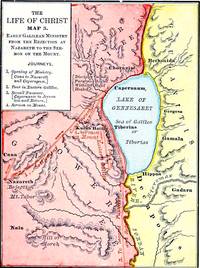 The Life of Jesus, Map 3: Early Work in Galilee