and And, even, also, namely. καί, conj., and. Copulative. Connecting single words; in general: Mt 2:18 16:1, Mk 2:15, Lk 8:15, He 1:1, al. mult.; repeated before each of the terms in a series, Mt 23:23, Lk 14:21, Ro 7:12 9:4, al.; connecting numerals (WM, § 37, 4): Jo 2:20, Ac 13:20; joining terms which are not mutually exclusive, as the part with the whole: Mt 8:33 26:59, Mk 16:17, Ac 5:29, al. Connecting clauses and sentences: Mt 3:12, Ac 5:21, al. mult.; esp. where, after the simplicity of the popular language, sentences are paratactically joined (WM, § 60, 3; M, Pr., 12; Deiss., LAE, 128 ff.): Mt 1:21 7:25, Mk 9:5, Jo 10:3, al.; joining affirmative to negative sentences: Lk 3:14, Jo 4:11, III Jo 10; consecutive, and so: Mt 5:15 23:32, He 3:19, al.; after imperatives, Mt 4:19, Lk 7:7, al.; = καίτοι, and yet: Mt 3:14 6:26, Mk 12:12, Lk 18:7 (Field, Notes, 72), I Co 5:2, al.; beginning an apodosis (= Heb. וְ; so sometimes δέ in cl.), then: Lk 2:21 7:12, Ac 1:10; beginning a question (WM, § 53, 3a): Mk 10:26, Lk 10:29, Jo 9:36. Epexegetic, and, and indeed, namely (WM, § 53, 3c): Lk 3:18, Jo 1:16, Ac 23:6, Ro 1:5, I Co 3:5, al. In transition: Mt 4:23, Mk 5:1, 21, Jo 1:19, al.; so, Hebraistically, καὶ ἐγένετο ( וַיְהִי; also ἐγένετο δέ ), Mk 1:9 (cf. Lk 5:1; V. Burton, §§ 357-60; M, Pr., 14, 16). καὶ... καί, both... and (for τε... καί, v.s. τε ); connecting single words: Mt 10:28, Mk 4:41, Ro 11:33, al.; clauses and sentences: Mk 9:13, Jo 7:28, I Co 1:22, al. Adjunctive, also, even, still: Mt 5:39, 40, Mk 2:28, al. mult.; esp. c. pron., adv., etc., Mt 20:4, Jo 7:47, al; ὡς κ., Ac 11:17; καθὼς κ., Ro 15:7; οὕτω κ., Ro 6:11; διὸ κ., Lk 1:35; ὁ κ. (Deiss., BS, 313ff.), Ac 13:9; pleonastically, μετὰ κ.. (Bl., §77, 7; Deiss., BS, 265 f,), Phl 4:3; τί κ., 1 Co 15:29; ἀλλὰ κ., Lk 14:22, Jo 5:18, al.; καίγε (M, Pr., 230; Burton, § 437), Ac 17:27; καίπερ, He 5:8; κ. ἐάν, v.s. ἐάν. Scroll for more
to say (denoting speech in progress), (a) I say, speak; I mean, mention, tell, (b) I call, name, especially in the pass., (c) I tell, command. λέγω, [in LXX very freq., chiefly for אמר; λέγει for נְאֻם, Ge 22:16, al.;] in Hom., to pick out, gather, reckon, recount. In Hdt. and Att., to say, speak, affirm, declare: absol., Ac 13:15 24:10; seq. orat. dir., Mt 9:34, Mk 3:11, Jo 1:29, al.; seq. ὅτι recit., Mk 3:21, Lk 1:24, Jo 6:14, al.; acc. et. inf., Lk 11:18, Jo 12:29, al.; after another verb of speaking, προσφωνεῖν κ. λέγειν, Mt 11:17, al.; ἀπεκρίθη ( ἐλάλησεν ) λέγων ( καὶ λέγει; Dalman, Words, 24 ff.), Mt 25:9, Mk 3:33, 7:28, Lk 24:6, 7, al.; of unspoken thought, λ. ἐν ἑαυτῷ, Mt 3:9, Lk 3:8, al.; of writing, II Co 8:8, Phl 4:11, al.; λέγει ἡ γραφή, Ro 4:3, Ja 2:23, al.; c. acc. rei, Lk 8:8 9:33, Jo 5:34, al.; σὺ λέγεις (a non-committal phrase; Swete, Mk., 359, 369 f.), Mt 27:11, Mk 15:2, Lk 23:3, Jo 18:37; c. dat. pers., seq. orat. dir., Mt 8:20, Mk 2:17, al. mult.; id. seq. ὅτι, Mt 3:9, al.; c. prep., πρός, μετά, περί, etc., Mk 4:41, Jo 11:56, He 9:5, al.; to mean (cl.), Mk 14:71, Jo 6:71, I Co 10:29, al.; to call, name, Mk 10:18; pass., Mt 9:9, Mk 15:7, al (cf. ἀντι-, δια- ( -μαι ), προ-, συλ-λέγω ). SYN.: λαλέω, which refers to the utterance, as λέγω to the meaning of what is said, its correspondence with thought (Tr., Syn., Ixxvi; Thayer, s.v. λαλέω ). Scroll for more
it/s/he He, she, it, they, them, same. αὐτός, -ή, -ό, determinative pron., in late Gk. much more freq. than in cl. (WM, 178 f.; Jannaris, HGG, §1399). Emphatic (so always in nom. exc. when preceded by the art., v. infr., iii); self ( ipse ), expressing opposition, distinction, exclusion, etc., αὐ. ἐκχυθήσεται, Lk 5:37; αὐ. ἐγινώσκεν, Jo 2:25; αὐ. ὑμεῖς, Jo 3:28; καὶ αὐ. ἐγώ, Ro 15:14; αὐ. Ἰησοῦς, Jo 2:24; αὐ. καὶ οἱ μετ’ αὐτοῦ, Mk 2:25; ὑμεῖς αὐ., Mk 6:31; esp. (as freq in cl.) αὐ. ὁ, Mt 3:4, Mk 6:17, Jo 16:27, I Th 3:11, al.; in late Gk., sometimes weakened, ἐν αὐτῇ τ. ὥρᾳ, in that hour, Lk 10:21 (M, Pr., 91; MM, s.v.); emphatic, he, she, it (M, Pr., 86; Bl., § 48, 1, 2, 7), Mt 1:21 12:50, Lk 6:35, al.; pointing to some one as master (cl.), Mt 8:24, Mk 4:38, al.; αὐ., καὶ αὐ. = οὗτος, ὁ δε (Bl., § 48, 1), Mt 14:2, Mk 14:15, 44, Lk 1:22 2:28, al. In oblique cases (cl.), for the simple pron. of 3rd pers., he, she, it, Mt 7:9, 10:12, 26:44, al.; with ptcp. in gen. absol., Mt 9:18, Mk 13:1, al. (for irreg. constructions, V. Bl., § 74, 5); pleonastically after the relative (cf. Heb. אֲשֶׁר לֹו; WM, 184 ff.; Bl., § 50, 4; MM, s.v.), Mk 7:25, Re 3:8, 7:2, al.; in constr. ad sensum, without proper subject expressly indicated, Mt 4:23, Ac 8:5, II Co 2:13, al.; gen. αὐτοῦ = ἐκείνου, Ro 11:11, I Th 2:19, Tit 3:5, He 2:4. ὁ, ἡ, τὸ αὐ., the same: He 1:12, 13:8; τὸ αὐ., ποιεῖν, Mt 5:46, 47, al.; φρονεῖν, Ro 12:16 15:5, Phl 2:2, al.; τὰ αὐ., Ac 15:27, Ro 2:1, al.; κατὰ τὸ ( τὰ ) αὐ. (MM, s.v.), Ac 14:1, Lk 6:23, al.; ἐπὶ τὸ αὐ., together (MM, s.v.), Mt 22:34, Ac 1:15, al.; ἓν κ. τὸ αὐ., I Co 11:5, 12:11; c. dat. (cl.), I Co 11:5; with a noun, λόγος, Mk 14:39; μέτρος, Phl 1:30; πνεῦμα, I Co 12:4. Scroll for more
if If. εἰ, conjunctive particle, used in conditions and in indirect questions. Conditional, if; c. indic., expressing a general assumption; pres.: seq. indic, pres., Mt 11:14, Ro 8:25, al.; seq. imperat., Mk 4:23 9:22, Jo 15:18, I Co 7:9, al.; seq. fut. indic., Lk 16:31, Ro 8:11, al.; seq. pf. or aor., with negation in apodosis, Mt 12:26, Ro 4:14, al.; similarly, seq. impf., Lk 17:6, Jo 8:39; seq. quæst., Mt 6:23, Jo 5:47 7:23 8:46, I Pe 2:20; fut.: Mt 26:33, I Pe 2:20; pf.: Jo 11:12, Ro 6:5, al.; aor.: Lk 16:11 19:8, Jo 13:32, 18:23, Re 20:15, al. Where the assumption is certain = ἐπεί: Mt 12:28, Jo 7:4, Ro 5:17, al. Of an unfulfilled condition, c. indic, impf., aor. or plpf., seq. ἄν, c. imp. or aor. (v.s. ἄν, I, i). C. indic., after verbs denoting wonder, etc., sometimes, but not always, coupled with an element of doubt: Mk 15:44, I Jo 3:13, al. C. indic., as in LXX ( Nu 14:3o, I Ki 14:45, al. = Heb. אִם ), in oaths, with the formula of imprecation understood in a suppressed apodosis (WM, 627; Burton, §272): Mk 8:12, He 3:11 (LXX) 4:3 (LXX). Rarely (cl.) c. optat., to express a merely possible condition: Ac 24:19 27:39, I Co 14:10 15:37, I Pe3:14, 17. Interrogative, if, whether. As in cl., in indir. questions after verbs of seeing, asking, knowing, saying, etc.: c. indic. pres., Mt 26:63, Mk 15:36, Ac 19:2, II Co 13:5, al.; fut., Mk 3:2, Ac 8:22, al.; aor., Mk 15:44, I Co 1:16, al.; c. subjc. aor. (M, Pr., 194), Phl 3:12. As in LXX (= Heb. אִם and interrog. הֲ, Ge 17:17, al.; v. WM, 639 f.; Viteau, i, 22), in direct questions: Mk 8:23 (Tr., WH, txt.), Lk 13:23, 22:49, Ac 19:2, al. With other particles. εἰ ἄρα, εἴγε, εἰ δὲ μήγε, v.s. ἄρα, γε. εἰ δὲ καί, but if also: Lk 11:18; but even if, I Co 4:7, II Co 4:3 11:16. εἰ δὲ μή, but if not, but if otherwise: Mk 2:21, 22, Jo 14:2, Re 2:5, al. εἰ καί, if even, if also, although: Mk 14:29, Lk 11:8, I Co 7:21, II Co 4:16, Phl 2:17, al. καὶ εἰ, even if, v.s. καί εἰ μή, if not, unless, except, but only: Mt 24:22, Mk 2:26 6:5, Jo 9:33, I Co 7:17 ( only ), Ga 1:19 (cf. ἐὰν μή, 2:16; v. Hort., Ja., xvi); ἐκτὸς εἰ μή, pleonastic (Bl., §65, 6), I Co 14:5 15:2, I Ti 5:19. εἰ μήν = cl. ἦ μήν (M, Pr., 46), in oaths, surely ( Ez 33:27, al.): He 6:14. εἴ πως, if haply: Ac 27:12, Ro 1:10. εἴτε... εἴτε, whether... or: Ro 12:6-8, I Co 3:22 13:8, al. Scroll for more
son A son, descendent. υἱός, -οῦ, ὁ, [in LXX very freq. and nearly always for בֵּן, Ge 4:17, al.; for בַּר, Da LXX TH 7:13, al.; etc.;], a son; in the ordinary sense: Mt 10:37, Mk 9:17, Lk 1:13, al. mult.; omitted with the art. of origin (WM, § 30, 3; Bl., §35, 2), τὸν τοῦ Ἰεσσαί, Ac 13:22 (LXX); also c. gen. anarth. (cl.), Σώπατρος Πύρρου Βεροιαῖος, Ac 20:4; c. adj., προτότοκος, Lk 2:7; μονογένης, Lk 7:12; opp. to νόθος, He 12:8; in a wider sense, of posterity: ὁ υἱ. Δαυΐδ, of the Messiah (cf. Dalman, Words, 316 ff.; DCG, ii, 653f.), Mt 22:42, 45 Mk 12:35, 37 Lk 20:41, 44 al.; υἱοὶ Ἰσραήλ, (cf. υἷες Ἀχαιῶν, Hom., Il., i, 162, al.), Mt 27:9, Ac 9:15, al. Metaph.; as belonging to, being connected with or having the quality of that which follows (a usage mainly due to translation from a Semitic original; cf. Deiss., BS, 161ff.; Dalman, Words, 115 f.; DCG, ii, 652f.): τ. πονμροῦ (διαβόλου), Mt 13:38, Ac 13:10; τ. νυμφῶνος (v.s. νυμφών ), Mt 9:15, Mk 2:19, al.; τ. φωτός (Lft., Notes, 74), Lk 16:8, Jo 12:36, I Th 5:5; τ. εἰρήνης, Lk 10:6; γεέννης, Mt 23:15; τ. ἀπωλείας, Jo 17:12, II Th 2:3; τ. αἰῶνος τούτου, Lk 16:8 20:34; τ. ἀπειθειάς, Eph 2:2 5:6; βροντῆς, Mk 3:17; τ. ἀναστάσεως, Lk 20:36; παρακλήσεως, Ac 4:36; τ. προφητῶν κ. τ. διαθήκης, Ac 3:25; υἱὸς τ. θεοῦ (cf. Dalman, Words, 268 ff.; Deiss., BS, 166 f.; DB, iv, 570 ff.; DCG, ii, 654 ff.), of men, as partakers of the Divine nature and of the life to come: Mt 5:9, Lk 20:36, Ro 8:14 9:26, al.; υἱοὶ (κ. θυγατέρες) τ. ὑψίστου, Lk 6:35, II Co 6:18; in an unique sense of Jesus, Mt 4:3 8:29 28:19, Mk 3:4, Lk 4:41, Jo 9:35 11:27, al.; ὁ Χριστὸς ὁ υἱ. τ. θεοῦ ζῶντος (τ. εὐλογητοῦ), Mt 16:16, Mk 14:61; (ὁ) υἱὸς τοῦ ἀνθρώπου (in LXX for Heb. בּן אדם, Aram, בּר אנשׁ; cf. Dalman, Words, 234 ff.; DB, iv, 579 ff.; DCG, ii, 659 ff.; Westc., St. John, i, 74 ff.; other reff. in Swete, Mk, 2:10 ), based on the Aram. of Da 7:13, where the phrase, like the corresponding Heb. (as in Ps 8:5 ), means a man, one of the species, and indicates the human appearance of the person in question. It is used of the Messiah in Enoch, c. 46, §1-4, also in II Es 13:3, 12, al. Our Lord first makes the phrase a title, using the def. art. It seems to combine the ideas of his true humanity and representative character. Exc. in Ac 7:56 and (anarth.) Re 1:13 14:14, it is used of Jesus only by himself: Mt 8:20, Mk 2:10, Lk 5:24, Jo 1:52, al. Scroll for more
you are εἰμί, with various uses and significations, like the English verb to be. As substantive verb. Of persons and things, to be, exist: Ac 17:28, Jo 1:1 8:58 17:5, al; ὁ ὢν καὶ ὁ ἦν (for past ptcp.), Re 1:4, 8 4:8 11:17 16:5 (v. Swete, Ap., 5; M, Pr., 228); τὰ (μὴ) ὄντα, Ro 4:17, I Co 1:28. Of times, events, etc., to be, happen, take place: Mt 24:3, Mk 14:2 15:42, Lk 21:23, Jo 4:6, 23 5:10, al. to be present, be in a place, have come: Mt 2:13, 15, Mk 1:45 5:21 15:40, Lk 1:80 5:29, Jo 7:30, al.; seq. εἰς, Mk 2:1; seq. ἐκ, (ἐξ), Mt 1:20 21:25, Mk 11:30, Jo 3:31, al. Impers., ἔστι, ἦν, etc.; there is (Fr. il y a ), was, etc.: Mt 16:28, Lk 16:19, Jo 3:1 5:2, Ro 3:10, al.; c. dat. (of the possessor; Bl., §37, 3), Mt 16:22, Lk 1:7, Jo 18.10, Ro 9:2, al.; ἔστιν ὅς, ὅστις (chiefly in pl), Mt 16:28 19:2, Mk 9:1, al.; c. inf., = ἔξεστιν (q.v.), it is possible: He 9:5, I Co 11:20, RV (but v. ICC, in l.). As copula uniting subject and predicate. Expressing simply identity or equivalence: Mt 5:13 14:15, Lk 1:18, 19, Jo 1:1 4:19, Re 3:9, al. mult. Explicative, as in parable, figure, type, etc.: Mt 13:19, I Co 9:2, 10:4, 11:25, Ga 4:24, Re 17:15, al.; τοῦτ’ ἔστιν, Mt 27:46, Mk 7:2, Ro 7:18 al.; ὅ ἐστιν, Mk 3:17, Col 1:24, He 7:2, al.; akin to this is the sacramental usage: Mt 26:26-28, Mk 14:22, 24, Lk 22:19, I Co 11:24 (v. ICC on Mk, I Co, ll. c.; DB, iii, 148 f.). C. gen.: qual., etc., Mk 5:42, Lk 3:23, I Co 14:33, He 12:11, al.; part., I Ti 1:20, II Ti 1:15; poss., Mt 5:3, 10, Mk 12:7, Lk 4:7; of service or partisanship, Ro 8:9, I Co 1:12, II Co 10:7, II Ti 2:19. C. dat. (BL, §37, 3): Ac 1:8 9:15, Ro 4:12, I Co 1:18 2:14, Re 21:7, al. C. ptcp., as a periphrasis for the simple verb (Bl., §62, 1, 2; M, Pr., 225 ff.); c. ptcp. pf. (cl.): Mt 10:30, Lk 9:32, Jo 3:24, Ac 21:35, I Co 15:19, al; c. ptcp. pr. (esp. in impf., as in Heb. and Aram.; Dalman, Words, 35 f.), Mt 7:29, Mk 1:22, Lk 4:31 14:1, Ac 1:10, al. mult., id. for imper. (M, Pr., 180f., 182f.), with ellipsis of εἰμί, Ro 12:9, 10, He 13:5, al.; c. ptcp. aor. (cl), Lk 23:9. Seq. εἰς (cf. Heb. הָיָה לְ ), a vernac. usage (M, Pr., 71): Mt 19:5, Mk 10:8, He 8:10, al. C. adv.: Mt 19:20, Mk 4:26, Lk 18:11, al. Ellipses; of the copula (Bl., §30, 3): Mt 8:29 24:32, Jo 21:22, 23, He 6:4, al.; of the predicate: ἐγώ εἰμί, Mt 14:27, Mk 6:50, al.; absol. (cf. De 32:39; אֲנִי הוּא ), Mk 13:6, Jo 4:26, al. (cf. ἄπ-, ἔν-, πάρ-, συμ-πάρ-, σύν-ειμι ). Scroll for more
the/this/who The, the definite article. ὁ, ἡ, τό, the prepositive article ( ἄρθρον προτακτικόν ), originally a demonstr. pron. (so usually in Hom.), in general corresponding to the Eng. definite article. As demonstr. pron. As freq. in Hom., absol., he ( she, it ), his (etc.): Ac 17:28 (quoted from the poet Aratus). Distributive, ὁ μὲν... ὁ δέ, the one... the other: I Co 7:7, Ga 4:22; pl., Ac 14:4, 17:32, Phl 1:16, al.; οἱ μὲν... ἄλλοι δέ, Mt 16:14, Jo 7:12; οἱ μεν̀... ὁ δέ, He 7:21, 23. In narration (without ὁ μὲν preceding), ὁ δέ, but he: Mt 2:14, Mk 1:45, Lk 8:21, Jo 9:38, al. mult. As prepositive article, the, prefixed, to nouns unmodified: ὁ θεός, τὸ φῶς, etc.; to abstract nouns, ἡ σοφία, etc., to pl. nouns which indicate a class, οἱ ἀλώπεκες, foxes, Mt 8:20, al.; to an individual as representing a class, ὁ ἐργάτης, Lk 10:7; c. nom. = voc. in addresses, Mt 11:26, Jo 19:3, Ja 5:1, al.; to things which pertain to one, ἡ χεῖρ, his hand, Mk 3:1; to names of persons well known or already mentioned; usually to names of countries (originally adjectives), ἡ Ἰουδαία, etc. To modified nouns: c. pers. pron. gen., μοῦ, σοῦ, etc.; c. poss. pron., ἐμός, σός, etc.; c. adj. between the art. and the noun, ὁ ἀγαθὸς ἄνθρωπος, Mt 12:35; the noun foll. by adj., both c. art., ὁ ποιμὴν ὁ καλός, Jo 10:11 (on ὁ ὄχλος πολύς, Jo 12:9, v. M, Pr., 84); before adjectival phrases, ἡ κατ’ ἐκλογὴν πρόθεσις, Ro 9:11. To Other parts of speech used as substantives; neuter adjectives: τ. ἀγαθόν, etc.; cardinal numerals: ὁ εἶς, οἷ δύο, etc.; participles: ὁ βαπτίζων (= ὁ Βαπτιστής, Mt 14:2 ), Mk 6:14; πᾶς ὁ, c. ptcp., every one who, etc.; adverbs: τὸ πέραν, τὰ νῦν, ὁ ἔσω ἄνθρωπος; infinitives: nom., τὸ θέλειν, Ro 7:18, al.; gen., τοῦ, after adjectives, ἄξιον τοῦ πορεύεσθαι, I Co 16:4; verbs, ἔλαχεν τοῦ θυμιᾶσαι, Lk 1:9; and freq. in a final sense, ἐξῆλθεν ὁ σπείρειν, Mt 13:3 (on the artic. inf., v. Bl., § 71). In the neut. to sentences, phrases or single words treated as a quotation: τὸ Ἐι δύνῃ, Mk 9:23; τὸ ἔτι ἅπαξ, He 12:27; τὸ ἀνέβη, Eph 4:9, al. To prepositional phrases: οἱ ἀπὸ Ἰταλίας, He 13:24; οἱ ἐκ νόμου, Ro 4:14; neut. acc. absol., in adverbial phrases, τὸ καθ’ ἡμέραν, daily, Lk 11:3; τὸ κατὰ σάρκα, as regards the flesh, Ro 9:5. To nouns in the genitive, denoting kinship, association, etc.: ὁ τοῦ, the son of (unless context indicates a different relationship), Mt 10:2, al.; τὰ τοῦ θεοῦ, the things that pertain to God, Mt 16:23; τὰ τῆς εἰρήνης, Ro 14:19 (cf. M, Pr., 81 ff.; Bl, §§ 46, 47). Scroll for more
God (a) God, (b) a god, generally. θεός, -οῦ, ὁ, ἡ ( Ac 19:37 only; v. M, Pr., 60, 244), late voc., θεέ ( Mt 27:46; cf. De 3:24, al.), [in LXX chiefly for אֱלֹהִים, also for אֵל and other cognate forms, יהוה, etc.;] a god or deity, God. In polytheistic sense, a god or deity: Ac 28:6, I Co 8:4, II Th 2:4, al.; pl., Ac. 14:11 19:26, Ga 4:8, al. Of the one true God; anarthrous: Mt 6:24, Lk 20:38, al.; esp. c. prep. (Kühner 3, iii, 605), ἀπὸ θ., Jo 3:2; ἐκ, Ac 5:39, II Co 5:1, Phl 3:9; ὑπό, Ro 13:1; παρὰ θεοῦ, Jo 1:6; παρὰ θεῷ, II Th 1:6, I Pe 2:4; κατὰ θεόν, Ro 8:27, II Co 7:9, 10; also when in gen. dependent on an anarth. noun (Bl., §46, 6), Mt 27:43, Lk 3:2, Ro 1:17, I Th 2:13; as pred., Lk 20:38, Jo 1:1, and when the nature and character rather than the person of God is meant, Ac 5:29, Ga 2:6, al. (M, Th., 14); more freq., c. art.: Mt 1:23, Mk 2:7, al. mult.; c. prep., ἀπὸ τ. θ., Lk 1:26; ἐκ, Jo 8:42, al.; παρὰ τοῦ θ., Jo 8:40; π. τῷ θ., Ro 9:14; ἐν, Col 3:3; ἐπὶ τῷ θ., Lk 1:47; ἐπὶ τὸν θ., Ac 15:19; εἰς τ. θ., Ac 24:15; πρὸς τ. θ., Jo 1:2; c. gen. pers., Mt 22:32, Mk 12:26, 27, Lk 20:37, Jo 20:17, al.; ὁ θ. μου, Ro 1:8, Phi 1:3, al.; ὁ θ. καὶ πατήρ κ. τ. λ., Ro 15:6, Eph 1:3, Phi 4:20, al.; c. gen. rei, Ro 15:5, 13, 33, II Co 1:3, I Th 5:23; τὰ τ. θεοῦ, Mt 16:23, Mk 12:17, I Co 2:11; τὰ πρὸς τὸν θ., Ro 15:17, He 2:17 5:1; τ. θεῷ, as a superl. (LXX, Jos 3:3 ), Ac 7:20, II Co 10:4; Hebraistically, of judges ( Ps 81(82):6 ), Jo 10:34 (LXX), 35. Scroll for more
to throw: throw (a) I cast, throw, rush, (b) often, in the weaker sense: I place, put, drop. βάλλω, [in LXX for נפל, שׂום, ידד, etc.;] prop., of a weapon or missile; then generally, of things and persons, lit. and metaph., to throw, cast, put, place: c. acc., seq. εἰς, Mt 4:18, and freq. ἐπί, Mt 10:34; κάτω, Mt 4:6; ἔξω, Mt 5:13; ἀπό, Mt 5:29; ἐκ, Mk 12:44; δρέπανον, Re 14:19; μάχαιραν, Mt 10:34; κλῆρον, Mt 27:35; of fluids, to pour: Mt 9:17, Jo 13:5; pass., to be laid, to lie ill: Mt 9:2; ἐβλήθη (timeless aor., M, Pr., 134), Jo 15:6; intrans., to rush (Bl., §53, 1): Ac 27:14. Metaph., β. εἰς τ. καρδίαν, Jo 13:2 (cf. usage in π., without idea of violence; also of liquids; MM, Exp., x; v. also Cremer, 120, 657; cf. ἀμφι-, ἀνα-, ἀντι-, ἀπο-, δια-, ἐκ-, ἐμ-, παρ-εμ-, ἐπι-, κατα-, μετα-, παρα-, περι-, προ-, συμ-, ὑπερ-, ὑπο-βάλλω ). Scroll for more
yourself Of yourself. σεαυτοῦ, -ῆς, -οῦ (in NT not contracted, σαυτοῦ, as in Att..), reflex. prop. of 2nd pers. sing., used only in gen., dat. and acc. ( of, to ) thyself: Mt 4:6, Jo 8:13, I Ti 4:16, al. (In Hellenistic, the pl. is ἑαυτῶν (q.v.), not ὑμῶν αὐτῶν as in Attic, v. Bl., § 13, 1.) † Scroll for more
under (a) down, below, also: downwards, (b) lower, under, less, of a length of time. κάτω, adv. (< κατά ), [in LXX for מַטָּה, מִתַּחַת and cogn. forms;] down, downwards (with verbs of motion), Mt 4:6, Lk 4:9, Jo 8:[6, 8], Ac 20:9. below, beneath: Mk 14:66, Ac 2:19 (LXX); ἕως κ. ( Ez 1:27, al.), Mt 27:51, Mk 15:38; τὰ κ. (opp. to τ. ἄνω ), Jo 8:23. Compar. κατωτέρω: ἀπὸ διετοῦς καὶ κ. (cf. I Ch 27:23 ), Mt 2:16.† Scroll for more
to write I write; pass: it is written, it stands written (in the scriptures). γράφω, [in LXX chiefly for כּתב ]; to scrape, graze (Hom.), and later (Hdt.) to sketch, draw. to write; of forming or tracing letters on writing material: Jo 8:[6], Ga 6:11, II Th 3:17; to express in writing, commit to writing, record: Lk 1:63, Jo 19:21, 22 Re 1:11, 19 al.; of scripture as a standing authority (Deiss., BS, 112ff.), γέγραπται, it stands written (Luther), Mt 4:4, Mk 7:6, Lk 4:8, Ro 1:17, I Co 1:31, al.; id. seq. ἐν, Mk 1:2, Ac 1:20, al.; c. acc., to write of: Jo 1:46, Ro 10:5; seq. περί, Mt 26:24, Mk 14:21, Jo 5:46; al.; c. dat. (WM, §31, 4), Lk 18:31; id. seq. ἵνα (M, Pr., 207f.), Mk 12:19, Lk 20:28; κατὰ τ. γεγραμμένον, II Co 4:13; γεγραμμένον ἐστί, Jo 2:17; ἐγράφη, Ro 4:24; ἐπ’ αὐτῷ γεγραμμένα, Jo 12:16; of writing directions or information, c. dat. pers.: Ro 15:15, II Co 7:12, al.; of that which contains the record or message: βιβλίον, Mk 10:4, Jo 21:25, Re 5:1; τίτλον, Jo 19:19; ἐπιστολήν, Ac 23:25; ἐντολήν, Mk 10:5 (cf. ἀπο-, ἐγ-, ἐπι-, κατα-, προ- ). Scroll for more
for For. γάρ, co-ordinating particle, contr. of γε ἄρα, verily then, hence, in truth, indeed, yea, then, why, and when giving a reason or explanation, for, the usage in NT being in general accord with that of cl.; explicative and epexegetic: Mt 4:18 19:12, Mk 1:16 5:42 16:4, Lk 11:30, Ro 7:1, I Co 16:5, al. Conclusive, in questions, answers and exclamations: Mt 9:5 27:23, Lk 9:25 22:27, Jo 9:30, Ac 8:31 16:37 19:35, Ro 15:26, I Co 9:10, Phl 1:18 (Ellic., in l.), I Th 2:20, al. Causal: Mt 1:21 2:2, 5, 6, 3:23, Mk 1:22, 9:6, Lk 1:15, 18, Jo 2:25, Ac 2:25, Ro 1:9, 11, I Co 11:5, Re 1:3, al.; giving the reason for a command or prohibition, Mt 2:20 3:9, Ro 13:11, Col 3:3, I Th 4:3, al.; where the cause is contained in an interrog. statement, Lk 22:27, Ro 3:3 4:3, I Co 10:29; καὶ γάρ, for also, Mk 10:45, Lk 6:32, I Co 5:7, al. id. as in cl. = etenim, where the καί loses its connective force (Bl., §78, 6; Kühner 3, ii, 854f.), Mk 14:70, Lk 1:66 22:37, II Co 13:4. The proper place of γάρ is after the first word in a clause, but in poets it often comes third or fourth, and so in late prose: II Co 1:19. Yet "not the number but the nature of the word after which it stands is the point to be noticed" (v. Thayer, s.v.). Scroll for more
that/since: that That, since, because; may introduce direct discourse. ὅτι, conjc. (prop. neut. of ὅστις ). As conjc, introducing an objective clause, that; after verbs of seeing, knowing, thinking, saying, feeling: Mt 3:9 6:32 11:25, Mk 3:28, Lk 2:49, Jo 2:22, Ac 4:13, Ro 1:13 8:38 10:9, Phl 4:15, Ja 2:24, al.; elliptically, Jo 6:46, Phl 3:12, al. After εἶναι ( γίνεσθαι ): defining a demonstr. or pers. pron., Jo 3:19 16:19, Ro 9:6, I Jo 3:16 al.; c. pron. interrog., Mt 8:27, Mk 4:41, Lk 4:36, Jo 4:22 al.; id. elliptically, Lk 2:49, Ac 5:4, 9, al.; Untranslatable, before direct discourse ( ὅτι recitantis ): Mt 7:23, Mk 2:16, Lk 1:61, Jo 1:20, Ac 15:1, He 11:18, al. (on the pleonastic ὡς ὅτι, v.s. ὡς ). As causal particle, for that, because: Mt 5:4-12, Lk 6:20, 21, Jo 1:30 5:27, Ac 1:5, I Jo 4:18, Re 3:10, al. mult.; διὰ τοῦτο ὅτι, Jo 8:47 10:17, al.; answering a question ( διὰ τί ), Ro 9:32, al.; οὐκ ὅτι... ἀλλ’ ὅτι, Jo 6:26 12:6. Scroll for more
the/this/who The, the definite article. ὁ, ἡ, τό, the prepositive article ( ἄρθρον προτακτικόν ), originally a demonstr. pron. (so usually in Hom.), in general corresponding to the Eng. definite article. As demonstr. pron. As freq. in Hom., absol., he ( she, it ), his (etc.): Ac 17:28 (quoted from the poet Aratus). Distributive, ὁ μὲν... ὁ δέ, the one... the other: I Co 7:7, Ga 4:22; pl., Ac 14:4, 17:32, Phl 1:16, al.; οἱ μὲν... ἄλλοι δέ, Mt 16:14, Jo 7:12; οἱ μεν̀... ὁ δέ, He 7:21, 23. In narration (without ὁ μὲν preceding), ὁ δέ, but he: Mt 2:14, Mk 1:45, Lk 8:21, Jo 9:38, al. mult. As prepositive article, the, prefixed, to nouns unmodified: ὁ θεός, τὸ φῶς, etc.; to abstract nouns, ἡ σοφία, etc., to pl. nouns which indicate a class, οἱ ἀλώπεκες, foxes, Mt 8:20, al.; to an individual as representing a class, ὁ ἐργάτης, Lk 10:7; c. nom. = voc. in addresses, Mt 11:26, Jo 19:3, Ja 5:1, al.; to things which pertain to one, ἡ χεῖρ, his hand, Mk 3:1; to names of persons well known or already mentioned; usually to names of countries (originally adjectives), ἡ Ἰουδαία, etc. To modified nouns: c. pers. pron. gen., μοῦ, σοῦ, etc.; c. poss. pron., ἐμός, σός, etc.; c. adj. between the art. and the noun, ὁ ἀγαθὸς ἄνθρωπος, Mt 12:35; the noun foll. by adj., both c. art., ὁ ποιμὴν ὁ καλός, Jo 10:11 (on ὁ ὄχλος πολύς, Jo 12:9, v. M, Pr., 84); before adjectival phrases, ἡ κατ’ ἐκλογὴν πρόθεσις, Ro 9:11. To Other parts of speech used as substantives; neuter adjectives: τ. ἀγαθόν, etc.; cardinal numerals: ὁ εἶς, οἷ δύο, etc.; participles: ὁ βαπτίζων (= ὁ Βαπτιστής, Mt 14:2 ), Mk 6:14; πᾶς ὁ, c. ptcp., every one who, etc.; adverbs: τὸ πέραν, τὰ νῦν, ὁ ἔσω ἄνθρωπος; infinitives: nom., τὸ θέλειν, Ro 7:18, al.; gen., τοῦ, after adjectives, ἄξιον τοῦ πορεύεσθαι, I Co 16:4; verbs, ἔλαχεν τοῦ θυμιᾶσαι, Lk 1:9; and freq. in a final sense, ἐξῆλθεν ὁ σπείρειν, Mt 13:3 (on the artic. inf., v. Bl., § 71). In the neut. to sentences, phrases or single words treated as a quotation: τὸ Ἐι δύνῃ, Mk 9:23; τὸ ἔτι ἅπαξ, He 12:27; τὸ ἀνέβη, Eph 4:9, al. To prepositional phrases: οἱ ἀπὸ Ἰταλίας, He 13:24; οἱ ἐκ νόμου, Ro 4:14; neut. acc. absol., in adverbial phrases, τὸ καθ’ ἡμέραν, daily, Lk 11:3; τὸ κατὰ σάρκα, as regards the flesh, Ro 9:5. To nouns in the genitive, denoting kinship, association, etc.: ὁ τοῦ, the son of (unless context indicates a different relationship), Mt 10:2, al.; τὰ τοῦ θεοῦ, the things that pertain to God, Mt 16:23; τὰ τῆς εἰρήνης, Ro 14:19 (cf. M, Pr., 81 ff.; Bl, §§ 46, 47). Scroll for more
angel A messenger, generally a (supernatural) messenger from God, an angel, conveying news or behests from God to men. ἄγγελος, -ου, ὁ, [in LXX chiefly for מַלְאָךְ;] a messenger, one sent: Mt 11:10, Ja 22:25. As in LXX, in the special sense of angel, a spiritual, heavenly being, attendant upon God and employed as his messenger to men, to make known his purposes, as Lk 1:11, or to execute them, as Mt 4:6. The ἄ. in Re 1:20 2:1, al., is variously understood as a messenger or delegate, a bishop or ruler, a guardian angel, the prevailing spirit of each church, i.e. the Church itself. (Cf. Swete, Ap )., in l.; DB, iv, 991; Thayer, s.v.; Cremer, 18; MM, VGT, s.v.) Scroll for more
it/s/he He, she, it, they, them, same. αὐτός, -ή, -ό, determinative pron., in late Gk. much more freq. than in cl. (WM, 178 f.; Jannaris, HGG, §1399). Emphatic (so always in nom. exc. when preceded by the art., v. infr., iii); self ( ipse ), expressing opposition, distinction, exclusion, etc., αὐ. ἐκχυθήσεται, Lk 5:37; αὐ. ἐγινώσκεν, Jo 2:25; αὐ. ὑμεῖς, Jo 3:28; καὶ αὐ. ἐγώ, Ro 15:14; αὐ. Ἰησοῦς, Jo 2:24; αὐ. καὶ οἱ μετ’ αὐτοῦ, Mk 2:25; ὑμεῖς αὐ., Mk 6:31; esp. (as freq in cl.) αὐ. ὁ, Mt 3:4, Mk 6:17, Jo 16:27, I Th 3:11, al.; in late Gk., sometimes weakened, ἐν αὐτῇ τ. ὥρᾳ, in that hour, Lk 10:21 (M, Pr., 91; MM, s.v.); emphatic, he, she, it (M, Pr., 86; Bl., § 48, 1, 2, 7), Mt 1:21 12:50, Lk 6:35, al.; pointing to some one as master (cl.), Mt 8:24, Mk 4:38, al.; αὐ., καὶ αὐ. = οὗτος, ὁ δε (Bl., § 48, 1), Mt 14:2, Mk 14:15, 44, Lk 1:22 2:28, al. In oblique cases (cl.), for the simple pron. of 3rd pers., he, she, it, Mt 7:9, 10:12, 26:44, al.; with ptcp. in gen. absol., Mt 9:18, Mk 13:1, al. (for irreg. constructions, V. Bl., § 74, 5); pleonastically after the relative (cf. Heb. אֲשֶׁר לֹו; WM, 184 ff.; Bl., § 50, 4; MM, s.v.), Mk 7:25, Re 3:8, 7:2, al.; in constr. ad sensum, without proper subject expressly indicated, Mt 4:23, Ac 8:5, II Co 2:13, al.; gen. αὐτοῦ = ἐκείνου, Ro 11:11, I Th 2:19, Tit 3:5, He 2:4. ὁ, ἡ, τὸ αὐ., the same: He 1:12, 13:8; τὸ αὐ., ποιεῖν, Mt 5:46, 47, al.; φρονεῖν, Ro 12:16 15:5, Phl 2:2, al.; τὰ αὐ., Ac 15:27, Ro 2:1, al.; κατὰ τὸ ( τὰ ) αὐ. (MM, s.v.), Ac 14:1, Lk 6:23, al.; ἐπὶ τὸ αὐ., together (MM, s.v.), Mt 22:34, Ac 1:15, al.; ἓν κ. τὸ αὐ., I Co 11:5, 12:11; c. dat. (cl.), I Co 11:5; with a noun, λόγος, Mk 14:39; μέτρος, Phl 1:30; πνεῦμα, I Co 12:4. Scroll for more
to order I give orders (injunctions, instructions, commands). ἐν-τέλλω [in LXX, as in NT (and mostly in Hdt.), always mid., chiefly for צָוָה pi.;] -ομαι, to command, enjoin, instruct: seq. περί He 11:22; c. inf., Mt 19:7; c. dat. pers., Ac 1:2; οὕτως, Ac 13:47; καθώς, Jo 14:31 ( ἐντολὴν ἔδωκεν, WH); seq. λέγων, Mt 17:9; c. inf., Jo 8:5; ἵνα, Mk 13:34; c. acc rei, Mt 28:20, Mk 10:3, Jo 15:14, 17; seq. περί, c. gen. pers., Mt 4:6 and Lk 4:10 (LXX); διαθήκην ἐ. πρός, c. acc pers., He 9:20 (LXX) (cf. Si 45:3 ).† SYN.: κελεύω, to command, of verbal orders in general; παραγγέλλω, to charge, esp. of the transmitted orders of a military commander; ἐντέλλω points rather to the contents of the command (v. Thayer, s.v. κελεύω ) Scroll for more
about (a) gen: about, concerning, (b) acc: around. περί, prep. c. gen., acc. (in cl. also c. dat.; cf. M, Pr., 105f.), with radical sense round about (as distinct from ἀμφί, on both sides ). C. gen., of place, about (poët.). Causal, about, on account of, concerning, in reference to: Mt 2:8, Mk 1:44, Lk 4:38, Jo 16:26, Ac 28:21, al. mult.; τὰ περί, c. gen., the things concerning one, one's state or case: Mk 5:27, Ac 1:3 28:15, Eph 6:22, al.; at the beginning of a sentence, περί, regarding, as to, I Co 7:1, al.; in the sense on account of ( Mt 26:28, I Co 1:13, al.), often with ὑπέρ as variant (cf. M, Pr., 105). C. acc., of place, about, around: Mt 3:4, Mk 1:6, Lk 13:8, Ac 22:6, al.; οἱ περί, c. acc. pers., of one's associates, friends, etc., Mk 4:10, Lk 22:49, Jo 11:19, Ac 13:13; οἱ περὶ τ. τοιαῦτα ἐργάται, Ac 19:25; metaph., about, as to, concerning: I Ti 1:19 6:4, II Ti 2:18 3:8, Tit 2:7; τὰ περὶ ἐμέ, Phl 2:23; αἱ περὶ τ. λοιπὰ ἐπιθυμίαι, Mk 4:19. Of time, in a loose reckoning, about, near: Mt 20:3, 5, 6, 9 27:46, Mk 6:48, Ac 10:3, 9 22:6. In composition: round about ( περιβάλλω, περίκειμαι ), beyond, over and above ( περιποιέω, περιλείπω ), to excess ( περιεργάζομαι, περισσεύω ). Scroll for more
you αὐτός, -ή, -ό, determinative pron., in late Gk. much more freq. than in cl. (WM, 178 f.; Jannaris, HGG, §1399). Emphatic (so always in nom. exc. when preceded by the art., v. infr., iii); self ( ipse ), expressing opposition, distinction, exclusion, etc., αὐ. ἐκχυθήσεται, Lk 5:37; αὐ. ἐγινώσκεν, Jo 2:25; αὐ. ὑμεῖς, Jo 3:28; καὶ αὐ. ἐγώ, Ro 15:14; αὐ. Ἰησοῦς, Jo 2:24; αὐ. καὶ οἱ μετ’ αὐτοῦ, Mk 2:25; ὑμεῖς αὐ., Mk 6:31; esp. (as freq in cl.) αὐ. ὁ, Mt 3:4, Mk 6:17, Jo 16:27, I Th 3:11, al.; in late Gk., sometimes weakened, ἐν αὐτῇ τ. ὥρᾳ, in that hour, Lk 10:21 (M, Pr., 91; MM, s.v.); emphatic, he, she, it (M, Pr., 86; Bl., § 48, 1, 2, 7), Mt 1:21 12:50, Lk 6:35, al.; pointing to some one as master (cl.), Mt 8:24, Mk 4:38, al.; αὐ., καὶ αὐ. = οὗτος, ὁ δε (Bl., § 48, 1), Mt 14:2, Mk 14:15, 44, Lk 1:22 2:28, al. In oblique cases (cl.), for the simple pron. of 3rd pers., he, she, it, Mt 7:9, 10:12, 26:44, al.; with ptcp. in gen. absol., Mt 9:18, Mk 13:1, al. (for irreg. constructions, V. Bl., § 74, 5); pleonastically after the relative (cf. Heb. אֲשֶׁר לֹו; WM, 184 ff.; Bl., § 50, 4; MM, s.v.), Mk 7:25, Re 3:8, 7:2, al.; in constr. ad sensum, without proper subject expressly indicated, Mt 4:23, Ac 8:5, II Co 2:13, al.; gen. αὐτοῦ = ἐκείνου, Ro 11:11, I Th 2:19, Tit 3:5, He 2:4. ὁ, ἡ, τὸ αὐ., the same: He 1:12, 13:8; τὸ αὐ., ποιεῖν, Mt 5:46, 47, al.; φρονεῖν, Ro 12:16 15:5, Phl 2:2, al.; τὰ αὐ., Ac 15:27, Ro 2:1, al.; κατὰ τὸ ( τὰ ) αὐ. (MM, s.v.), Ac 14:1, Lk 6:23, al.; ἐπὶ τὸ αὐ., together (MM, s.v.), Mt 22:34, Ac 1:15, al.; ἓν κ. τὸ αὐ., I Co 11:5, 12:11; c. dat. (cl.), I Co 11:5; with a noun, λόγος, Mk 14:39; μέτρος, Phl 1:30; πνεῦμα, I Co 12:4. Scroll for more
and And, even, also, namely. καί, conj., and. Copulative. Connecting single words; in general: Mt 2:18 16:1, Mk 2:15, Lk 8:15, He 1:1, al. mult.; repeated before each of the terms in a series, Mt 23:23, Lk 14:21, Ro 7:12 9:4, al.; connecting numerals (WM, § 37, 4): Jo 2:20, Ac 13:20; joining terms which are not mutually exclusive, as the part with the whole: Mt 8:33 26:59, Mk 16:17, Ac 5:29, al. Connecting clauses and sentences: Mt 3:12, Ac 5:21, al. mult.; esp. where, after the simplicity of the popular language, sentences are paratactically joined (WM, § 60, 3; M, Pr., 12; Deiss., LAE, 128 ff.): Mt 1:21 7:25, Mk 9:5, Jo 10:3, al.; joining affirmative to negative sentences: Lk 3:14, Jo 4:11, III Jo 10; consecutive, and so: Mt 5:15 23:32, He 3:19, al.; after imperatives, Mt 4:19, Lk 7:7, al.; = καίτοι, and yet: Mt 3:14 6:26, Mk 12:12, Lk 18:7 (Field, Notes, 72), I Co 5:2, al.; beginning an apodosis (= Heb. וְ; so sometimes δέ in cl.), then: Lk 2:21 7:12, Ac 1:10; beginning a question (WM, § 53, 3a): Mk 10:26, Lk 10:29, Jo 9:36. Epexegetic, and, and indeed, namely (WM, § 53, 3c): Lk 3:18, Jo 1:16, Ac 23:6, Ro 1:5, I Co 3:5, al. In transition: Mt 4:23, Mk 5:1, 21, Jo 1:19, al.; so, Hebraistically, καὶ ἐγένετο ( וַיְהִי; also ἐγένετο δέ ), Mk 1:9 (cf. Lk 5:1; V. Burton, §§ 357-60; M, Pr., 14, 16). καὶ... καί, both... and (for τε... καί, v.s. τε ); connecting single words: Mt 10:28, Mk 4:41, Ro 11:33, al.; clauses and sentences: Mk 9:13, Jo 7:28, I Co 1:22, al. Adjunctive, also, even, still: Mt 5:39, 40, Mk 2:28, al. mult.; esp. c. pron., adv., etc., Mt 20:4, Jo 7:47, al; ὡς κ., Ac 11:17; καθὼς κ., Ro 15:7; οὕτω κ., Ro 6:11; διὸ κ., Lk 1:35; ὁ κ. (Deiss., BS, 313ff.), Ac 13:9; pleonastically, μετὰ κ.. (Bl., §77, 7; Deiss., BS, 265 f,), Phl 4:3; τί κ., 1 Co 15:29; ἀλλὰ κ., Lk 14:22, Jo 5:18, al.; καίγε (M, Pr., 230; Burton, § 437), Ac 17:27; καίπερ, He 5:8; κ. ἐάν, v.s. ἐάν. Scroll for more
upon/to/against On, to, against, on the basis of, at. ἐπί (before a smooth breathing ἐπ’, before a rough breathing ἐφ’ ), prep. c. gen., dat., acc. (acc. most freq. in NT), with primary sense of superposition, on, upon. C. gen., of place, answering the question, where? of the place on which, on, upon: ἐπὶ (τ.) γῆς, Mt 6:10, 19, al.; τ. κεφαλῆς, I Co 11:10; τ. νεφελῶν, Mt 24:30, al.; like ἐν, in constr. praegn. after verbs of motion: βάλλειν, Mk 4:26; σπείρειν, ib. 31; ἔρχεσθαι, He 6:7, al.; fig., ἐπ’ ἀληθείας (MM, s.v. ἀ. ); of the subject of thought or speech, Ga 3:16; of power or authority, over, πάντων, Ro 9:5: τ. γάζης, Ac 8:27; ἐξουσία, Re 2:26 20:6; of vicinity, at, by: τ. θαλάσσης, Jo 6:9; τ. ὁδοῦ, Mt 21:19; τοῦ βάτου, Mk 12:26 (v. Swete, in l.); c. gen. pers., in the presence of, before, Mt 28:14, Ac 23:30, I Co 6:1, al. Of time, c. gen. pers., in the time of: ἐπὶ Ἐλισαίου, Lk 4:27; ἐπὶ Κλαυδίου, Ac 11:28; ἐπὶ Ἀβιάθαρ ἀρχιερέως, when A. was high priest, Mk 2:26; c. gen. rei, at, at the time of: Mt 1:11, He 1:2, II Pe 3:3; ἐπὶ τ. προσευχῶν, Ro 1:10, Eph 1:16, I Th 1:2, Phm 4. C. dat., of place, answering the question, where? lit., on, upon: Mt 9:16, 14:8, al.; after verbs of motion (v. supr., I, 1, ( a )), Mt 9:16 Ac 8:16; above, Lk 23:38; at, by, Mk 13:29, Jo 5:2, Ac 5:9, al.; metaph., upon, on the ground of, Lk 4:4 (LXX); in the matter of, Mk 6:52 (v. Swete, in l.); upon, of, concerning, Ac 5:35, 40; of the ground, reason or motive (Bl., §38, 2; 43, 3), Mt 18:3 19:9, Ro 12:12, al.; ἐφ’ ᾧ, for the reason that, because, Ro 5:12 II Co 5:4; after verbs of motion, over, Mt 18:13, Ro 16:19, al.; of a condition (cl.), Ro 8:20, I Co 9:10; ἐπὶ δυσὶ μάρτυσιν (v. Westc. on He 9:10 ), He 10:28; of purpose or aim, Eph 2:10, Phl 4:10; of authority, over, Mt 24:47 Lk 12:44; of hostility, c. dat. pers. (cl.), against, Lk 12:52; in addition to (cl.), II Co 7:13; of an adjunct, in, at, on, Phl 1:3 2:17. C. acc., of place of motion upon or over, answering the question, whither? lit., upon, over: Mt 14:28, 29, Lk 5:19, al. mult.; in NT also, answering the question, where? (as c. gen., dat.), Mk 4:38 11:2, Lk 2:25, Jo 1:32; ἐπὶ τ. αὐτό, Ac 1:15 2:1, al.; of motion to a vicinity, to, Mk 16:2, Ac 8:36, al.; metaph. (in wh. "the acc. is more widely prevalent than it strictly should be," Bl., §43, 1); of blessings, evils, etc., coming upon one, c. acc. pers., Mt 10:13 12:28, Ac 2:17, Jo 18:4, Eph 5:6, al.; of addition (dat. in cl.), λύπη ἐπὶ λύπην, Phl 2:27; ἐπικαλεῖν ὄνομα ἐπί (v.s. ἐπικαλέω ), Ac 15:17, Ja 2:7; καλεῖν ἐπί, to call after, Lk 1:59; of number or degree: ἐπὶ τρίς (cl. εἰς τ. ), thrice, Ac 10:16 11:10; ἐπὶ πλεῖον, the more, further, Ac 4:17 II Ti 2:16 3:9 (v. also infr., 2, ( a )); ἐφ’ ὅσον (v. infr., ib.), forasmuch as, Mt 25:40, 45, Ro 11:13; of power, authority, control, Lk 1:33, Ac 7:10 Ro 5:14, He 3:6, al.; of the direction of thoughts and feelings, unto, towards, Lk 1:17 23:28, Ac 9:35, 42, Ro 11:22, Ga 4:9, Eph 2:7, I Ti 5:5, al.; of purpose, for, Mt 3:7, Lk 23:48; ἐφ’ ὅ πάρει (Rec. ἐφ’ ᾧ, Mt 26:50; of hostility, against, Mt 24:7, Mk 3:24-26 10:11 13:8, Lk 9:5, Jo 13:18, Ac 7:54, I Co 7:36, II Co 1:23; Of reference, concerning, for (cl. usually dat.), Mk 9:12 15:24, Jo 19:24, Ro 4:9. Of time, during, for: Lk 4:25 (WH, txt., omits ἐπί ), Ac 13:31 16:18, He 11:30, al.; ἐφ’ ὅσον (χρόνον), as long as, for so long time as, Mk 9:15 Ro 7:1, al. (for ἐφ’ ὅ in another sense, v. supr., 1, ( b )); ἐφ’ ἱκανόν (v.s. ἱ ), Ac 20:11; ἐπὶ πλεῖον (v. supr., 1, (b)), yet longer, further, Ac 20:9 24:4; on, about, towards (cl. εἰς ): Lk 10:35 Ac 3:1 4:5. In composition, ἐπί signifies: up, ἐπαίρω; upon, ἐπίγειος, ἐπιδημέω, ἐπικαθίζω; towards, επιβλέπω, ἐπεκτείνω; over (of superintendence), ἐπιστάτης; again, in addition, ἐπαιτέω; against, ἐπιορκέω, ἐπιβουλή. Scroll for more
hand A hand. χείρ, gen., χειρος (acc., χεῖραν, I Pe 5:6 T), ἡ, [in LXX chiefly for יָד;] the hand: Mt 3:12, Mk 3:1, Lk 6:6, al. mult.; ἡ χ., acting subject, Lk 22:21; pl., Ac 17:25 20:34, I Jo 1:1; τ. ἔργα τῶν χ., Ac 7:41, Re 9:20; ὁ ἀσπασμὸς τ. ἐμῇ χ., I Co 16:21, Col 4:18, II Th 3:17; prepositional phrases, esp. those without art., similar to Heb. constructions (Bl., §32, 4; 40, 9; 46, 9), ἐν χ.; c gen. (Lft., in l.), Ga 3:19; σὺν χ. ἀγγέλου, Ac 7:35; διὰ (τῶν) χειρῶν (διὰ χειρός), Mk 6:2, Ac 5:12 7:25, al.; ἐπὶ χειρῶν, Mt 4:6, Lk 4:11; ellipse of χ. ( ἡ δεξία, ἀριστερα; Bl., § 44, 1), Mt 6:3, al. By meton., for the power or activity of an individual, Mt 17:22, Mk 9:31, Lk 9:44, Jo 10:39, Ac 12:11, al.; metaph., of the activity or power of God: Lk 1:66 23:46, Jo 10:29, Ac 11:21 13:11, al. Scroll for more
to take up I raise, lift up, take away, remove. αἴρω, [in LXX chiefly for נשׂא, also for לקח, etc.;] to raise, take up, lift or draw up: Jo 8:59 11:41, Ac 27:17, al. to bear, carry: Mt 4:6 16:24, al. to bear or take away, carry off, remove: Mt 21:21, Jo 19:31, I Co 5:12 6:15 (v. Lft., Notes, 216), al.; of the taking away sin by Christ, Jo 1:29, I Jo 3:5. (Cf. ἀπ’, ἐξ-, ἐπ-, μετ-, συν-, ὑπερ-αίρω ). For exx. from π., v. MM, VGT, s.v.) Scroll for more
you αὐτός, -ή, -ό, determinative pron., in late Gk. much more freq. than in cl. (WM, 178 f.; Jannaris, HGG, §1399). Emphatic (so always in nom. exc. when preceded by the art., v. infr., iii); self ( ipse ), expressing opposition, distinction, exclusion, etc., αὐ. ἐκχυθήσεται, Lk 5:37; αὐ. ἐγινώσκεν, Jo 2:25; αὐ. ὑμεῖς, Jo 3:28; καὶ αὐ. ἐγώ, Ro 15:14; αὐ. Ἰησοῦς, Jo 2:24; αὐ. καὶ οἱ μετ’ αὐτοῦ, Mk 2:25; ὑμεῖς αὐ., Mk 6:31; esp. (as freq in cl.) αὐ. ὁ, Mt 3:4, Mk 6:17, Jo 16:27, I Th 3:11, al.; in late Gk., sometimes weakened, ἐν αὐτῇ τ. ὥρᾳ, in that hour, Lk 10:21 (M, Pr., 91; MM, s.v.); emphatic, he, she, it (M, Pr., 86; Bl., § 48, 1, 2, 7), Mt 1:21 12:50, Lk 6:35, al.; pointing to some one as master (cl.), Mt 8:24, Mk 4:38, al.; αὐ., καὶ αὐ. = οὗτος, ὁ δε (Bl., § 48, 1), Mt 14:2, Mk 14:15, 44, Lk 1:22 2:28, al. In oblique cases (cl.), for the simple pron. of 3rd pers., he, she, it, Mt 7:9, 10:12, 26:44, al.; with ptcp. in gen. absol., Mt 9:18, Mk 13:1, al. (for irreg. constructions, V. Bl., § 74, 5); pleonastically after the relative (cf. Heb. אֲשֶׁר לֹו; WM, 184 ff.; Bl., § 50, 4; MM, s.v.), Mk 7:25, Re 3:8, 7:2, al.; in constr. ad sensum, without proper subject expressly indicated, Mt 4:23, Ac 8:5, II Co 2:13, al.; gen. αὐτοῦ = ἐκείνου, Ro 11:11, I Th 2:19, Tit 3:5, He 2:4. ὁ, ἡ, τὸ αὐ., the same: He 1:12, 13:8; τὸ αὐ., ποιεῖν, Mt 5:46, 47, al.; φρονεῖν, Ro 12:16 15:5, Phl 2:2, al.; τὰ αὐ., Ac 15:27, Ro 2:1, al.; κατὰ τὸ ( τὰ ) αὐ. (MM, s.v.), Ac 14:1, Lk 6:23, al.; ἐπὶ τὸ αὐ., together (MM, s.v.), Mt 22:34, Ac 1:15, al.; ἓν κ. τὸ αὐ., I Co 11:5, 12:11; c. dat. (cl.), I Co 11:5; with a noun, λόγος, Mk 14:39; μέτρος, Phl 1:30; πνεῦμα, I Co 12:4. Scroll for more
lest Lest at any time, lest; then weakened: whether perhaps, whether at all; in a principal clause: perhaps. μήποτε (= μή ποτε, and so written in WH, exc. Mt 25:9 ), negative particle, related to οὔποτε as μή to οὐ. As neg. particle, never: He 9:17 (R, mg., but v. infr.; WH, txt., μή τότε ). As conjc., lest ever, lest haply (the idea of chance rather than of time seems to prevail in NT): Mt 4:6 (LXX) 5:25 7:6 13:15 (LXX), 29 15:32 27:64, Mk 4:12 (LXX) 14:2, Lk 4:11 12:58 14:12, 29, Ac 28:27; after verbs of fearing or taking heed, Lk 21:34, He 2:1 3:12 4:1; with ellipse of the verb or ptcp., Lk 14:8, Ac 5:39; in later writers (v. M, Pr., 192 f.), perhaps, Mt 25:9. As interrogative; in direct questions, like μή, expecting a negative answer: Jo 7:26, He 9:17, (R, txt., cf. Westc., in l.; but v. supr.); in indirect questions, whether haply, if haply: Lk 3:15, II Ti 2:25.† Scroll for more
to strike I stumble, strike the foot against, beat upon, take offense at. προσ-κόπτω, [in LXX for נגף, כּשׁל ni., etc.;] trans., to strike (e.g. hand or foot) against: c. acc. seq. πρός, fig., Mt 4:6, Lk 4:11 (LXX). Intrans., to stumble: absol. ( To 11:9, Pr 3:23 ), Jo 11:9, 10; of wind, to rush against, beat upon: c. dat, Mt 7:27. Metaph., in late writers, to offend (Polyb.); to take offence at, stumble at: seq. ἐν, Ro 14:21; c. dat., τ. λόγῳ, I Pe 2:8; τ. λίθῳ τ. προσκόμματος, Ro 9:32.† Scroll for more
to/with To, towards, with. πρός, prep. c. gen., dat., acc. C. gen., of motion from a place, from the side of, hence metaph., in the interests of, Ac 27:34 (cf. Page, in l.). C. dat., of local proximity, hard by, near, at: Mk 5:11, Lk 19:37, Jo 18:16 20:11, 12, Re 1:13. C. acc., of motion or direction towards a place or object, to, towards. Of place, after verbs of motion or of speaking and other words with the idea of direction: ἔρχομαι, ἀναβαίνω, πορεύομαι, λέγω, ἐπιστολή, etc., Mt 3:14, Mk 6:51, Lk 11:5, Jo 2:3, Ac 9:2, al. mult.; metaph., of mental direction, hostile or otherwise, Lk 23:12, Jo 6:52, II Co 7:4, Eph 6:12, Col 3:13, al.; of the issue or end, Lk 14:32, Jo 11:4, al.; of purpose, Mt 26:12, Ro 3:26, I Co 6:5, al.; πρὸς τό, c. inf., denoting purpose (cf. M, Pr., 218, 220; Lft., Notes, 131), Mt 5:28, Mk 13:22, Eph 6:11, I Th 2:9, al.; of close proximity, at, by, with: Mt 3:10, Mk 11:4, Lk 4:11, Ac 3:2, al.; after εἶναι, Mt 13:56, Mk 6:3, Jo 1:1, al. Of time, towards (Plat., Xen., LXX: Ge 8:11, al.): Lk 24:29; for: πρὸς καιρόν, Lk 8:13, I Co 7:5; πρὸς ὥραν, Jo 5:35, al.; πρὸς ὀλίγον, Ja 4:14. Of relation toward, with: Ro 5:1, II Co 1:12, Col 4:5, I Th 4:12, al.; with regard to: Mt 19:8, Mk 12:12, Ro 8:31, al.; pertaining to, to: Mt 27:4, Jo 21:22, Ro 15:17, He 2:17 5:1; according to: Lk 12:47, II Co 5:10, Ga 2:14, Eph 3:4 4:14; in comparison with: Ro 8:18. In composition: towards ( προσέρχομαι ), to ( προσάγω ), against ( προσκόπτω ), besides ( προσδαπανάω ). Scroll for more
stone A stone; met: of Jesus as the chief stone in a building. λίθος, -ου, ὁ (and, in Att., of precious stones, ἡ. ), [in LXX for אֶבֶן, Ge 11:3, al.; λ. τίμιος, for פָּז, Ps 18 (19):10 20 (21):3, Pr 8:19, al.;] a stone: Mt 4:6, al.; pl., Mt 3:9, al.; at the entrance of a tomb, Mt 27:60, 66 28:2, Mk 15:46 16:3, 4, Lk 24:2, Jo 11:38, 39, 41 20:1; λ. μυλικός, Lk 17:2, cf. Re 18:21; of building stones, Mt 21:42, [ 44 ] 24:2, Mk 12:10 13:1, 2, Lk 19:44 20:17, 18 21:5, 6 Ac 4:11, I Pe 2:7; metaph., of Christ, λ. ἀκρογωναῖος, ἐκλεκτός, ἔντιμος, I Pe 2:6 (LXX); λ. ζῶν, I Pe 2:4; προσκόμματος, I Pe 2:8, Ro 9:33; of Christians, λ. ζῶντες, I Pe 2:5; of precious stones, λ. τίμιος, Re 17:4 18:12, 16 21:11, 19; ἴασπις, Re 4:3; ἐνδεδυμένοι λ. καθαρόν, Re 15:6 ( λίνον, Rec., R, mg., v. Swete, in l.); metaph., λ. τίμιοι, I Co 3:12; of the tables of the law, II Co 3:7; of idols, Ac 17:29. Scroll for more
the/this/who The, the definite article. ὁ, ἡ, τό, the prepositive article ( ἄρθρον προτακτικόν ), originally a demonstr. pron. (so usually in Hom.), in general corresponding to the Eng. definite article. As demonstr. pron. As freq. in Hom., absol., he ( she, it ), his (etc.): Ac 17:28 (quoted from the poet Aratus). Distributive, ὁ μὲν... ὁ δέ, the one... the other: I Co 7:7, Ga 4:22; pl., Ac 14:4, 17:32, Phl 1:16, al.; οἱ μὲν... ἄλλοι δέ, Mt 16:14, Jo 7:12; οἱ μεν̀... ὁ δέ, He 7:21, 23. In narration (without ὁ μὲν preceding), ὁ δέ, but he: Mt 2:14, Mk 1:45, Lk 8:21, Jo 9:38, al. mult. As prepositive article, the, prefixed, to nouns unmodified: ὁ θεός, τὸ φῶς, etc.; to abstract nouns, ἡ σοφία, etc., to pl. nouns which indicate a class, οἱ ἀλώπεκες, foxes, Mt 8:20, al.; to an individual as representing a class, ὁ ἐργάτης, Lk 10:7; c. nom. = voc. in addresses, Mt 11:26, Jo 19:3, Ja 5:1, al.; to things which pertain to one, ἡ χεῖρ, his hand, Mk 3:1; to names of persons well known or already mentioned; usually to names of countries (originally adjectives), ἡ Ἰουδαία, etc. To modified nouns: c. pers. pron. gen., μοῦ, σοῦ, etc.; c. poss. pron., ἐμός, σός, etc.; c. adj. between the art. and the noun, ὁ ἀγαθὸς ἄνθρωπος, Mt 12:35; the noun foll. by adj., both c. art., ὁ ποιμὴν ὁ καλός, Jo 10:11 (on ὁ ὄχλος πολύς, Jo 12:9, v. M, Pr., 84); before adjectival phrases, ἡ κατ’ ἐκλογὴν πρόθεσις, Ro 9:11. To Other parts of speech used as substantives; neuter adjectives: τ. ἀγαθόν, etc.; cardinal numerals: ὁ εἶς, οἷ δύο, etc.; participles: ὁ βαπτίζων (= ὁ Βαπτιστής, Mt 14:2 ), Mk 6:14; πᾶς ὁ, c. ptcp., every one who, etc.; adverbs: τὸ πέραν, τὰ νῦν, ὁ ἔσω ἄνθρωπος; infinitives: nom., τὸ θέλειν, Ro 7:18, al.; gen., τοῦ, after adjectives, ἄξιον τοῦ πορεύεσθαι, I Co 16:4; verbs, ἔλαχεν τοῦ θυμιᾶσαι, Lk 1:9; and freq. in a final sense, ἐξῆλθεν ὁ σπείρειν, Mt 13:3 (on the artic. inf., v. Bl., § 71). In the neut. to sentences, phrases or single words treated as a quotation: τὸ Ἐι δύνῃ, Mk 9:23; τὸ ἔτι ἅπαξ, He 12:27; τὸ ἀνέβη, Eph 4:9, al. To prepositional phrases: οἱ ἀπὸ Ἰταλίας, He 13:24; οἱ ἐκ νόμου, Ro 4:14; neut. acc. absol., in adverbial phrases, τὸ καθ’ ἡμέραν, daily, Lk 11:3; τὸ κατὰ σάρκα, as regards the flesh, Ro 9:5. To nouns in the genitive, denoting kinship, association, etc.: ὁ τοῦ, the son of (unless context indicates a different relationship), Mt 10:2, al.; τὰ τοῦ θεοῦ, the things that pertain to God, Mt 16:23; τὰ τῆς εἰρήνης, Ro 14:19 (cf. M, Pr., 81 ff.; Bl, §§ 46, 47). Scroll for more
foot The foot. πούς, ποδός, ὁ, [in LXX chiefly for רֶגֶל;] a foot, both of men and beasts: Mt 4:6 (LXX), Mk 9:45, Lk 1:79, Jo 11:44, Ac 7:5, al.; ὑπο τοὺς π., Ro 16:20, I Co 15:25, 27, Eph 1:22, He 2:8; ὑποκάτω τῶν π., Mt 22:44 (LXX); πρὸς ( παρὰ ) τοὺς π., Mk 5:22, Lk 8:41, al.; fig., Mt 15:30, Lk 10:39, Ac 5:2, al.; ἔμπροσθεν τῶν π., Re 3:9 19:10, al.; ἐπὶ τοὺς π., Ac 10:25. By meton., of a person in motion ( Ps 118 (119):101 ): Lk 1:79, Ac 5:9, Ro 3:15 10:15, He 12:13. Scroll for more
you αὐτός, -ή, -ό, determinative pron., in late Gk. much more freq. than in cl. (WM, 178 f.; Jannaris, HGG, §1399). Emphatic (so always in nom. exc. when preceded by the art., v. infr., iii); self ( ipse ), expressing opposition, distinction, exclusion, etc., αὐ. ἐκχυθήσεται, Lk 5:37; αὐ. ἐγινώσκεν, Jo 2:25; αὐ. ὑμεῖς, Jo 3:28; καὶ αὐ. ἐγώ, Ro 15:14; αὐ. Ἰησοῦς, Jo 2:24; αὐ. καὶ οἱ μετ’ αὐτοῦ, Mk 2:25; ὑμεῖς αὐ., Mk 6:31; esp. (as freq in cl.) αὐ. ὁ, Mt 3:4, Mk 6:17, Jo 16:27, I Th 3:11, al.; in late Gk., sometimes weakened, ἐν αὐτῇ τ. ὥρᾳ, in that hour, Lk 10:21 (M, Pr., 91; MM, s.v.); emphatic, he, she, it (M, Pr., 86; Bl., § 48, 1, 2, 7), Mt 1:21 12:50, Lk 6:35, al.; pointing to some one as master (cl.), Mt 8:24, Mk 4:38, al.; αὐ., καὶ αὐ. = οὗτος, ὁ δε (Bl., § 48, 1), Mt 14:2, Mk 14:15, 44, Lk 1:22 2:28, al. In oblique cases (cl.), for the simple pron. of 3rd pers., he, she, it, Mt 7:9, 10:12, 26:44, al.; with ptcp. in gen. absol., Mt 9:18, Mk 13:1, al. (for irreg. constructions, V. Bl., § 74, 5); pleonastically after the relative (cf. Heb. אֲשֶׁר לֹו; WM, 184 ff.; Bl., § 50, 4; MM, s.v.), Mk 7:25, Re 3:8, 7:2, al.; in constr. ad sensum, without proper subject expressly indicated, Mt 4:23, Ac 8:5, II Co 2:13, al.; gen. αὐτοῦ = ἐκείνου, Ro 11:11, I Th 2:19, Tit 3:5, He 2:4. ὁ, ἡ, τὸ αὐ., the same: He 1:12, 13:8; τὸ αὐ., ποιεῖν, Mt 5:46, 47, al.; φρονεῖν, Ro 12:16 15:5, Phl 2:2, al.; τὰ αὐ., Ac 15:27, Ro 2:1, al.; κατὰ τὸ ( τὰ ) αὐ. (MM, s.v.), Ac 14:1, Lk 6:23, al.; ἐπὶ τὸ αὐ., together (MM, s.v.), Mt 22:34, Ac 1:15, al.; ἓν κ. τὸ αὐ., I Co 11:5, 12:11; c. dat. (cl.), I Co 11:5; with a noun, λόγος, Mk 14:39; μέτρος, Phl 1:30; πνεῦμα, I Co 12:4. Scroll for more
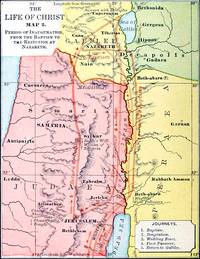 The Life of Jesus, Map 2: The Start of His Work
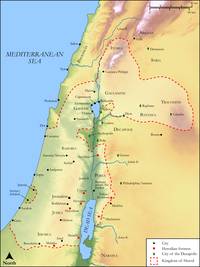 The Kingdom of Herod the Great
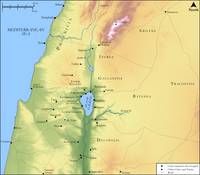 Galilee in Jesus' Time