you You. σύ, pron. of 2nd pers., thou, you, gen., σοῦ, dat., σοί, acc., σέ, pl., ὑμεῖς, -ῶν, -ῖν, -ᾶς (enclitic in oblique cases sing., except after prep. (BL, §48, 3), though πρὸς σέ occurs in Mt 25:39 ). Nom. for emphasis or contrast: Jo 1:30, 42 4:10 5:33, 39, 44, Ac 4:7, Eph 5:32; so also perhaps σὺ εἶπας, Mt 26:64, al. (M, Pr., 86); before voc., Mt 2:6, Lk 1:76, Jo 17:5, al.; sometimes without emphasis (M, Pr., 85f.), as also in cl., but esp. as rendering of Heb. phrase, e.g. υἱός μου εἶ σύ ( בְּנִי־אַתָּה, Ps 2:7 ), Ac 13:33. The gen. ( σοῦ, ὑμῶν ) is sometimes placed bef. the noun: Lk 7:48, 12:30, al.; so also the enclitic σοῦ, Mt 9:6; on τί ἐμοὶ κ. σοί, v.s. ἐγώ. Scroll for more
then A weak adversative particle, generally placed second in its clause; but, on the other hand, and. δέ (before vowels δ’; on the general neglect of the elision in NT, v. WH, App., 146; Tdf., Pr., 96), post-positive conjunctive particle; copulative, but, in the next place, and, now (Abbott, JG, 104): Mt 1:2 ff., II Co 6:15, 16, II Pe 1:5-7; in repetition for emphasis, Ro 3:21, 22, 9:30, I Co 2:6, Ga 2:2, Phl 2:8; in transition to something new, Mt 1:18 2:19, Lk 13:1, Jo 7:14, Ac 6:1, Ro 8:28, I Co 7:1 8:1, al.; in explanatory parenthesis or addition, Jo 3:19, Ro 5:8, I Co 1:12, Eph 2:4 5:32, al.; ὡς δέ, Jo 2:9; καὶ... δέ, but also, Mt 10:18, Lk 1:76, Jo 6:51, Ro 11:23, al.; καὶ ἐὰν δέ, yea even if, Jo 8:16. Adversative, but, on the other hand, prop., answering to a foregoing μέν (q.v.), and distinguishing a word or clause from one preceding (in NT most freq. without μέν; Bl., §77, 12): ἐὰν δέ, Mt 6:14, 23, al.; ἐγὼ ( σὺ, etc.) δέ, Mt 5:22 6:6, Mk 8:29, al.; ὁ δέ, αὐτὸς δέ, Mk 1:45, Lk 4:40, al.; after a negation, Mt 6:19, 20, Ro 3:4, I Th 5:21, al. Scroll for more
whenever When, whenever. ὅταν (for ὅτ’ ἄν = ὅτε ἄν ), temporal particle, with a conditional sense, usually of things expected to occur in an indefinite future; prop., whenever; c. subjc. praes.: Mt 6:2, 5, Mk 14:7, Lk 11:36, Jo 7:27, Ac 23:35, I Co 3:4, al.; ἕως τ. ἡμέρας ἐκείνης, ὅ., Mt 26:29, Mk 14:25; seq. τότε, I Th 5:3; c. subjc. aor. (M, Pr., 185): Mt 5:11, Mk 4:15, Lk 6:22, Jo 2:10 8:28 (Field, Notes, 94), 10:4, al. As in Hom. (LS, s.v.), but not in cl. prose, c. indic., when (M, Pr., 167 f.; Bl., § 65, 9): c. impf., Mk 3:11 (cf. Ge 38:9, al.); c. praes., Mk 11:25; c. fut., Re 4:9 (Swete, in l.); c. aor., Mk 11:19, Re 8:1 (Swete, in ll.; M, Pr., 168, 248; Field, Notes, 35). Scroll for more
to pray I pray, pray for, offer prayer. προσ-εύχομαι, [in LXX chiefly for פלל hith.;] to pray (always of prayer to God, or in cl., to gods): absol., Mt 6:5-7, 9 14:23 19:13 26:36, 39, 41, 44, Mk 1:35 6:46 11:24, 25 13:33 (WH, R, txt., om.) Mk 14:32, 38, 39, Lk 1:10 3:21 5:16 6:12 9:18, 28, 29 11:1, 2 18:1, 10 22:44 (WH, R, mg., om.), Ac 1:24 6:6 9:11, 40 10:9, 30 11:5 12:12 13:3 14:23 16:25 20:36 21:5 22:17 28:8, I Co 11:4, 5 14:14, I Th 5:17, I Ti 2:8, Ja 5:13, 18; seq. λέγων, Mt 26:39, 42, Lk 22:41; c. dat. instr., I Co 11:5 14:14, 15; μακρά, Mt 23:14 (WH, R, txt., om.), Mk 12:40, Lk 20:47; ἐν πνεύματι ( ἁγίῳ ), Eph 6:18, Ju 20; προσευχῇ π. (a Hebraism, v.s. προσευχή ), Ja 5:17; c. acc. rei, Lk 18:11, Ro 8:26; seq. ἐπί, c. acc. pers., Ja 5:14; c. dat. pers., Mt 6:6, I Co 11:13; seq. περί, c. gen., Ac 8:15, Col 1:3 4:3, I Th 5:25, II Th 1:11 3:1, He 13:18; ὑπέρ, Mt 5:44, Lk 6:28, Col 1:9, Ja 5:16; seq. ἵνα, Mt 24:20, Mk 13:18 14:35, Lk 22:46, I Co 14:13; τοῦτο ἵνα, Phl 1:9; c. inf., Lk 22:46; seq. τοῦ, c. inf. (Bl., § 71, 3), Ja 5:17.† Scroll for more
to enter I go in, come in, enter. εἰσ-έρχομαι, [in LXX chiefly for בּוֹא;] to go in or into, enter: Mt 9:25, Lk 7:45, al.; seq. εἰς, Mt 10:12, Mk 2:1, al.; seq. διά ( πύλης, θύρας, etc.), Mt 7:13, Jo 10:1, al.; ὑπὸ τ. στέγην, Mt 8:8; c. adv.: ὅπου, Mk 14:14, He 6:20; ὧδε, Mt 22:12; ἔσω, Mt 26:58; seq. πρός, c acc. pers., Mk 15:43, Lk 1:28, Ac 10:3 11:3 16:40 17:2 28:8, Re 3:20; of demons taking possession, Mk 9:25, Lk 8:30 22:3, Jo 13:27; of food, Mt 15:11, Ac 11:8. Metaph., of thoughts, Lk 9:46; εἰς κόπον, Jo 4:38; εἰς πειρασμόν, Mt 26:41, Lk 22:40, 46; of hope as an anchor, He 6:19; βοαί, Ja 5:4; πνεῦμα ζωῆς, Re 11:11; εἰς τ. κόσμον (cf. Wi 2:24 14:14, Jo 18:37 ), Ro 5:12, He 10:5; in counterparts of Jewish Aram. phrases relating to the theocracy (cf. Dalman, Words, 116ff.): εἰς τ. γάμους, Mt 25:10; εἰς τ. χάραν τ. κυρίου, Mt 25:21, 23; εἰς τ. ζωήν, Mt 18:8, 9 19:17, Mk 9:43, 45; εἰς τ. βασιλ. τ. οὐρανῶν, Mt 5:20 7:21, al. (v.s. βασιλεία ); εἰς τ. κατάπαυσιν, He 3:11, 18 4:1 ff.; εἰς τ. δόξαν, Lk 24:26; εἰσ. καὶ ἐξερχ., to go in and out (like Heb. בֹוא וְצֵאת, De 28:6, etc.), of familiar intercourse, Ac 1:21; fig., of moral freedom, Jo 10:9 (cf. ἐπ-, παρ-, συν-εισέρχομαι ). Scroll for more
toward Into, in, unto, to, upon, towards, for, among. εἰς, prep. c. acc., expressing entrance, direction, limit, into, unto, to, upon, towards, for, among (Lat. in, c. acc.). Of place. After verbs of motion; of entrance into: Mt 8:23 9:7, Mk 1:45, Lk 2:15 8:31, al.; of approach, to or towards: Mk 11:1, Lk 6:8 19:28, Jo 11:31 21:6, al.; before pl. and collective nouns, among: Mk 4:7 8:19, 20, Lk 11:49, Jo 21:23, al.; Of a limit reached, unto, on, upon: Mt 8:18, 21:1, Mk 11:1 13:16, Lk 14:10, Jo 6:3 11:32, al.; c. acc. pers. (as in Ep. and Ion.), Ac 23:15, Ro 5:12 16:19, II Co 10:14; elliptical: ἐπιστολαὶ εἰς Δαμασκόν, Ac 9:2; ἡ διακονία μου ἡ εἰς Ἱ., Ro 15:31; metaph., of entrance into a certain state or condition, or of approach or direction towards some end (Thayer, B, i, 1; ii, 1), εἰς τ. ὄνομα, M, Pr., 200. Of direction; after verbs of seeing: Mt 6:26, Mk 6:41, Lk 9:16, 62, Jo 13:22, al.; metaph., of the mind, He 11:26 12:2, al.; after verbs of speaking: Mt 13:10 14:9, I Th 2:9, al. After verbs of rest; in "pregnant" construction, implying previous motion (cl.; v. WM, 516; Bl., §39, 3; M, Pr., 234f.): Mt 2:23 4:13, II Th 2:4, II Ti 1:11, He 11:9, al.; by an assimilation general in late Gk (v. Bl., M, Pr., ll. c.) = ἐν: Lk 1:44 4:23, Ac 20:16 21:17, Jo 1:18 (but v. Westc, in l.), al. Of time, for, unto; accentuating the duration expressed by the acc.: εἰς τ. αἰῶνα, Mt 21:19; εἰς γενεὰς καὶ γ., Lk 1:50; εἰς τ. διηνεκές, He 7:3, al. Of a point or limit of time, unto, up to, until: Mt 6:34, Ac 4:3 25:21, Phl 1:10 2:16, I Th 4:15, II Ti 1:12; of entrance into a future period, εις τὸ μέλλον (v.s. μέλλω ), next (year), Lk 13:9 (but c. ICC, in l.); εἰς τ. μεταξὺ σάββατον, on the next Sabbath, Ac 13:42; εἰς τὸ πάλιν (v.s. πάλιν, II Co 13:2. Of result, after verbs of changing, joining, dividing, etc.: στρέφειν εἰς, Re 11:6; μετας-, Ac 2:20, Ja 4:9; μεταλλάσσειν, Ro 1:26; σχίζειν εἰς δύο, Mt 27:51, al.; predicatively with εἴναι, Ac 8:23. Of relation, to, towards, for, in regard to (so in cl., but more freq. in late Gk., εἰς encroaching on the simple dat., which it has wholly displaced in MGr.; Jannaris, Gr., §1541; Robertson, Gr., 594; Deiss., BS, 117f.): Lk 7:30, Ro 4:20 15:2, 26, I Co 16:1, Eph 3:16, al.; ἀγάπη εἰς, Ro 5:8, al.; χρηστός, Eph 4:32; φρονεῖν εἰς, Ro 12:16; θαρρεῖν, II Co 10:1. Of the end or object: εὔθετος εἰς, Lk 14:34; σόφος, Ro 16:19; ἰσχύειν, Mt 5:13; εἰς τοῦτο, Mk 1:38, al.; ἀφορίζειν εἰς, Ro 1:1; indicating purpose, εἰς φόβον, Ro 8:15; εἰς ἔνδειξιν, Ro 3:25; εἰς τό, c. inf. (= ἵνα or ὥστε; Bl., §71, 5; M, Pr., 218ff.): Mt 20:19, Ro 1:11, I Co 9:18, al. Adverbial phrases: εἰς τέλος, εἰς τὸ πάλιν, etc (v.s. τέλος, πάλιν, etc.). Scroll for more
the/this/who The, the definite article. ὁ, ἡ, τό, the prepositive article ( ἄρθρον προτακτικόν ), originally a demonstr. pron. (so usually in Hom.), in general corresponding to the Eng. definite article. As demonstr. pron. As freq. in Hom., absol., he ( she, it ), his (etc.): Ac 17:28 (quoted from the poet Aratus). Distributive, ὁ μὲν... ὁ δέ, the one... the other: I Co 7:7, Ga 4:22; pl., Ac 14:4, 17:32, Phl 1:16, al.; οἱ μὲν... ἄλλοι δέ, Mt 16:14, Jo 7:12; οἱ μεν̀... ὁ δέ, He 7:21, 23. In narration (without ὁ μὲν preceding), ὁ δέ, but he: Mt 2:14, Mk 1:45, Lk 8:21, Jo 9:38, al. mult. As prepositive article, the, prefixed, to nouns unmodified: ὁ θεός, τὸ φῶς, etc.; to abstract nouns, ἡ σοφία, etc., to pl. nouns which indicate a class, οἱ ἀλώπεκες, foxes, Mt 8:20, al.; to an individual as representing a class, ὁ ἐργάτης, Lk 10:7; c. nom. = voc. in addresses, Mt 11:26, Jo 19:3, Ja 5:1, al.; to things which pertain to one, ἡ χεῖρ, his hand, Mk 3:1; to names of persons well known or already mentioned; usually to names of countries (originally adjectives), ἡ Ἰουδαία, etc. To modified nouns: c. pers. pron. gen., μοῦ, σοῦ, etc.; c. poss. pron., ἐμός, σός, etc.; c. adj. between the art. and the noun, ὁ ἀγαθὸς ἄνθρωπος, Mt 12:35; the noun foll. by adj., both c. art., ὁ ποιμὴν ὁ καλός, Jo 10:11 (on ὁ ὄχλος πολύς, Jo 12:9, v. M, Pr., 84); before adjectival phrases, ἡ κατ’ ἐκλογὴν πρόθεσις, Ro 9:11. To Other parts of speech used as substantives; neuter adjectives: τ. ἀγαθόν, etc.; cardinal numerals: ὁ εἶς, οἷ δύο, etc.; participles: ὁ βαπτίζων (= ὁ Βαπτιστής, Mt 14:2 ), Mk 6:14; πᾶς ὁ, c. ptcp., every one who, etc.; adverbs: τὸ πέραν, τὰ νῦν, ὁ ἔσω ἄνθρωπος; infinitives: nom., τὸ θέλειν, Ro 7:18, al.; gen., τοῦ, after adjectives, ἄξιον τοῦ πορεύεσθαι, I Co 16:4; verbs, ἔλαχεν τοῦ θυμιᾶσαι, Lk 1:9; and freq. in a final sense, ἐξῆλθεν ὁ σπείρειν, Mt 13:3 (on the artic. inf., v. Bl., § 71). In the neut. to sentences, phrases or single words treated as a quotation: τὸ Ἐι δύνῃ, Mk 9:23; τὸ ἔτι ἅπαξ, He 12:27; τὸ ἀνέβη, Eph 4:9, al. To prepositional phrases: οἱ ἀπὸ Ἰταλίας, He 13:24; οἱ ἐκ νόμου, Ro 4:14; neut. acc. absol., in adverbial phrases, τὸ καθ’ ἡμέραν, daily, Lk 11:3; τὸ κατὰ σάρκα, as regards the flesh, Ro 9:5. To nouns in the genitive, denoting kinship, association, etc.: ὁ τοῦ, the son of (unless context indicates a different relationship), Mt 10:2, al.; τὰ τοῦ θεοῦ, the things that pertain to God, Mt 16:23; τὰ τῆς εἰρήνης, Ro 14:19 (cf. M, Pr., 81 ff.; Bl, §§ 46, 47). Scroll for more
inner room A store-chamber, secret chamber, closet; a granary, barn. ταμεῖον (late syncopated form of cl. ταμιεῖον; v. M, Pr., 44 f.; Bl., § 6, 5; Thackeray, Gr., 63 ff.; Deiss., BS, 182 f.), -ου, τό, [in LXX chiefly for חֶדֶר;] a treasury (Thuc., al). a store-chamber (Arist., Xen.; De 28:8 ): Lk 12:24. an inner chamber (Xen., Hell., v, 4, 5; Is 26:20, al.): Mt 6:6 24:26, Lk 12:3.† Scroll for more
you αὐτός, -ή, -ό, determinative pron., in late Gk. much more freq. than in cl. (WM, 178 f.; Jannaris, HGG, §1399). Emphatic (so always in nom. exc. when preceded by the art., v. infr., iii); self ( ipse ), expressing opposition, distinction, exclusion, etc., αὐ. ἐκχυθήσεται, Lk 5:37; αὐ. ἐγινώσκεν, Jo 2:25; αὐ. ὑμεῖς, Jo 3:28; καὶ αὐ. ἐγώ, Ro 15:14; αὐ. Ἰησοῦς, Jo 2:24; αὐ. καὶ οἱ μετ’ αὐτοῦ, Mk 2:25; ὑμεῖς αὐ., Mk 6:31; esp. (as freq in cl.) αὐ. ὁ, Mt 3:4, Mk 6:17, Jo 16:27, I Th 3:11, al.; in late Gk., sometimes weakened, ἐν αὐτῇ τ. ὥρᾳ, in that hour, Lk 10:21 (M, Pr., 91; MM, s.v.); emphatic, he, she, it (M, Pr., 86; Bl., § 48, 1, 2, 7), Mt 1:21 12:50, Lk 6:35, al.; pointing to some one as master (cl.), Mt 8:24, Mk 4:38, al.; αὐ., καὶ αὐ. = οὗτος, ὁ δε (Bl., § 48, 1), Mt 14:2, Mk 14:15, 44, Lk 1:22 2:28, al. In oblique cases (cl.), for the simple pron. of 3rd pers., he, she, it, Mt 7:9, 10:12, 26:44, al.; with ptcp. in gen. absol., Mt 9:18, Mk 13:1, al. (for irreg. constructions, V. Bl., § 74, 5); pleonastically after the relative (cf. Heb. אֲשֶׁר לֹו; WM, 184 ff.; Bl., § 50, 4; MM, s.v.), Mk 7:25, Re 3:8, 7:2, al.; in constr. ad sensum, without proper subject expressly indicated, Mt 4:23, Ac 8:5, II Co 2:13, al.; gen. αὐτοῦ = ἐκείνου, Ro 11:11, I Th 2:19, Tit 3:5, He 2:4. ὁ, ἡ, τὸ αὐ., the same: He 1:12, 13:8; τὸ αὐ., ποιεῖν, Mt 5:46, 47, al.; φρονεῖν, Ro 12:16 15:5, Phl 2:2, al.; τὰ αὐ., Ac 15:27, Ro 2:1, al.; κατὰ τὸ ( τὰ ) αὐ. (MM, s.v.), Ac 14:1, Lk 6:23, al.; ἐπὶ τὸ αὐ., together (MM, s.v.), Mt 22:34, Ac 1:15, al.; ἓν κ. τὸ αὐ., I Co 11:5, 12:11; c. dat. (cl.), I Co 11:5; with a noun, λόγος, Mk 14:39; μέτρος, Phl 1:30; πνεῦμα, I Co 12:4. Scroll for more
and And, even, also, namely. καί, conj., and. Copulative. Connecting single words; in general: Mt 2:18 16:1, Mk 2:15, Lk 8:15, He 1:1, al. mult.; repeated before each of the terms in a series, Mt 23:23, Lk 14:21, Ro 7:12 9:4, al.; connecting numerals (WM, § 37, 4): Jo 2:20, Ac 13:20; joining terms which are not mutually exclusive, as the part with the whole: Mt 8:33 26:59, Mk 16:17, Ac 5:29, al. Connecting clauses and sentences: Mt 3:12, Ac 5:21, al. mult.; esp. where, after the simplicity of the popular language, sentences are paratactically joined (WM, § 60, 3; M, Pr., 12; Deiss., LAE, 128 ff.): Mt 1:21 7:25, Mk 9:5, Jo 10:3, al.; joining affirmative to negative sentences: Lk 3:14, Jo 4:11, III Jo 10; consecutive, and so: Mt 5:15 23:32, He 3:19, al.; after imperatives, Mt 4:19, Lk 7:7, al.; = καίτοι, and yet: Mt 3:14 6:26, Mk 12:12, Lk 18:7 (Field, Notes, 72), I Co 5:2, al.; beginning an apodosis (= Heb. וְ; so sometimes δέ in cl.), then: Lk 2:21 7:12, Ac 1:10; beginning a question (WM, § 53, 3a): Mk 10:26, Lk 10:29, Jo 9:36. Epexegetic, and, and indeed, namely (WM, § 53, 3c): Lk 3:18, Jo 1:16, Ac 23:6, Ro 1:5, I Co 3:5, al. In transition: Mt 4:23, Mk 5:1, 21, Jo 1:19, al.; so, Hebraistically, καὶ ἐγένετο ( וַיְהִי; also ἐγένετο δέ ), Mk 1:9 (cf. Lk 5:1; V. Burton, §§ 357-60; M, Pr., 14, 16). καὶ... καί, both... and (for τε... καί, v.s. τε ); connecting single words: Mt 10:28, Mk 4:41, Ro 11:33, al.; clauses and sentences: Mk 9:13, Jo 7:28, I Co 1:22, al. Adjunctive, also, even, still: Mt 5:39, 40, Mk 2:28, al. mult.; esp. c. pron., adv., etc., Mt 20:4, Jo 7:47, al; ὡς κ., Ac 11:17; καθὼς κ., Ro 15:7; οὕτω κ., Ro 6:11; διὸ κ., Lk 1:35; ὁ κ. (Deiss., BS, 313ff.), Ac 13:9; pleonastically, μετὰ κ.. (Bl., §77, 7; Deiss., BS, 265 f,), Phl 4:3; τί κ., 1 Co 15:29; ἀλλὰ κ., Lk 14:22, Jo 5:18, al.; καίγε (M, Pr., 230; Burton, § 437), Ac 17:27; καίπερ, He 5:8; κ. ἐάν, v.s. ἐάν. Scroll for more
to shut I shut, shut up. κλείω, [in LXX chiefly for סגר;] to shut: θύραν, Mt 6:6; τ. ἄβυσσον, Re 20:3; pass., θύρα, Mt 25:10, Lk 11:7 (pl.), Jo 20:19, 26, Ac 21:30; δεσμωτήριον, Ac 5:23; πυλῶνες, Re 21:25. Metaph., τ. οὐρανόν, Lk 4:25, Ro 11:6; τ. σπλάγχνα, I Jn 3:17; τ. βασιλείαν, Mt 23:14; id. absol., Re 3:7; τ. θύραν, Re 3:8. (Cf. ἀπο-, ἐκ-, κατα-, συν-κλείω.)† Scroll for more
the/this/who The, the definite article. ὁ, ἡ, τό, the prepositive article ( ἄρθρον προτακτικόν ), originally a demonstr. pron. (so usually in Hom.), in general corresponding to the Eng. definite article. As demonstr. pron. As freq. in Hom., absol., he ( she, it ), his (etc.): Ac 17:28 (quoted from the poet Aratus). Distributive, ὁ μὲν... ὁ δέ, the one... the other: I Co 7:7, Ga 4:22; pl., Ac 14:4, 17:32, Phl 1:16, al.; οἱ μὲν... ἄλλοι δέ, Mt 16:14, Jo 7:12; οἱ μεν̀... ὁ δέ, He 7:21, 23. In narration (without ὁ μὲν preceding), ὁ δέ, but he: Mt 2:14, Mk 1:45, Lk 8:21, Jo 9:38, al. mult. As prepositive article, the, prefixed, to nouns unmodified: ὁ θεός, τὸ φῶς, etc.; to abstract nouns, ἡ σοφία, etc., to pl. nouns which indicate a class, οἱ ἀλώπεκες, foxes, Mt 8:20, al.; to an individual as representing a class, ὁ ἐργάτης, Lk 10:7; c. nom. = voc. in addresses, Mt 11:26, Jo 19:3, Ja 5:1, al.; to things which pertain to one, ἡ χεῖρ, his hand, Mk 3:1; to names of persons well known or already mentioned; usually to names of countries (originally adjectives), ἡ Ἰουδαία, etc. To modified nouns: c. pers. pron. gen., μοῦ, σοῦ, etc.; c. poss. pron., ἐμός, σός, etc.; c. adj. between the art. and the noun, ὁ ἀγαθὸς ἄνθρωπος, Mt 12:35; the noun foll. by adj., both c. art., ὁ ποιμὴν ὁ καλός, Jo 10:11 (on ὁ ὄχλος πολύς, Jo 12:9, v. M, Pr., 84); before adjectival phrases, ἡ κατ’ ἐκλογὴν πρόθεσις, Ro 9:11. To Other parts of speech used as substantives; neuter adjectives: τ. ἀγαθόν, etc.; cardinal numerals: ὁ εἶς, οἷ δύο, etc.; participles: ὁ βαπτίζων (= ὁ Βαπτιστής, Mt 14:2 ), Mk 6:14; πᾶς ὁ, c. ptcp., every one who, etc.; adverbs: τὸ πέραν, τὰ νῦν, ὁ ἔσω ἄνθρωπος; infinitives: nom., τὸ θέλειν, Ro 7:18, al.; gen., τοῦ, after adjectives, ἄξιον τοῦ πορεύεσθαι, I Co 16:4; verbs, ἔλαχεν τοῦ θυμιᾶσαι, Lk 1:9; and freq. in a final sense, ἐξῆλθεν ὁ σπείρειν, Mt 13:3 (on the artic. inf., v. Bl., § 71). In the neut. to sentences, phrases or single words treated as a quotation: τὸ Ἐι δύνῃ, Mk 9:23; τὸ ἔτι ἅπαξ, He 12:27; τὸ ἀνέβη, Eph 4:9, al. To prepositional phrases: οἱ ἀπὸ Ἰταλίας, He 13:24; οἱ ἐκ νόμου, Ro 4:14; neut. acc. absol., in adverbial phrases, τὸ καθ’ ἡμέραν, daily, Lk 11:3; τὸ κατὰ σάρκα, as regards the flesh, Ro 9:5. To nouns in the genitive, denoting kinship, association, etc.: ὁ τοῦ, the son of (unless context indicates a different relationship), Mt 10:2, al.; τὰ τοῦ θεοῦ, the things that pertain to God, Mt 16:23; τὰ τῆς εἰρήνης, Ro 14:19 (cf. M, Pr., 81 ff.; Bl, §§ 46, 47). Scroll for more
door (a) a door, (b) met: an opportunity. θύρα, -ας, ἡ, [in LXX chiefly for פֶּתַח, also for דַּל, דֶּלֶת, etc.;] a door: κλείειν ( ἀποκ- ) τὴν θ., Mt 6:6, Lk 13:25; pass., Mt 25:10, Lk 11:7, Jo 20:19, 26, Ac 21:30; ἀνοίγειν, Ac 5:19; pass., Ac 16:26, 27; κρούειν, Ac 12:13; διὰ τῆς θ., Jo 10:1, 2; πρὸς τὴν θ., Mk 1:33 11:4 (WH om. τήν ), Ac 3:2; τὰ πρὸς τὴν θ., the space by the door, Mk 2:2; πρὸς τῇ θ., Jo 18:16; ἐπὶ τῇ θ, Ac 5:9; πρὸ τῆς θ., Ac 12:6; ἐπὶ τῶν θ., Ac 5:23; ἡ θ. τ. μνημείου, Mt 27:60, Mk 15:46 16:3. Metaph., of Christ, ἡ θ. τ. προβάτων, Jo 10:7, 9; of the Kingdom of Heaven, Lk 13:24; of opportunities, θ. πίστεως, Ac 14:27; θ. μεγάλη, I Co 16:9; θ. τ. λόγου, Col 4:3; θ. ἀνεῳγμένη ( ἠνεῳγ- ), II Co 2:12, Re 3:8 4:1; of Christ, ἑστηκὼς ἐπὶ τὴν θ. καὶ κρούων, Re 3:20; of his second coming, ἐπὶ θύραις εἶναι, Mt 24:33, Mk 13:29; πρὸ θυρῶν ἑστηκέναι, Ja 5:9.† Scroll for more
you αὐτός, -ή, -ό, determinative pron., in late Gk. much more freq. than in cl. (WM, 178 f.; Jannaris, HGG, §1399). Emphatic (so always in nom. exc. when preceded by the art., v. infr., iii); self ( ipse ), expressing opposition, distinction, exclusion, etc., αὐ. ἐκχυθήσεται, Lk 5:37; αὐ. ἐγινώσκεν, Jo 2:25; αὐ. ὑμεῖς, Jo 3:28; καὶ αὐ. ἐγώ, Ro 15:14; αὐ. Ἰησοῦς, Jo 2:24; αὐ. καὶ οἱ μετ’ αὐτοῦ, Mk 2:25; ὑμεῖς αὐ., Mk 6:31; esp. (as freq in cl.) αὐ. ὁ, Mt 3:4, Mk 6:17, Jo 16:27, I Th 3:11, al.; in late Gk., sometimes weakened, ἐν αὐτῇ τ. ὥρᾳ, in that hour, Lk 10:21 (M, Pr., 91; MM, s.v.); emphatic, he, she, it (M, Pr., 86; Bl., § 48, 1, 2, 7), Mt 1:21 12:50, Lk 6:35, al.; pointing to some one as master (cl.), Mt 8:24, Mk 4:38, al.; αὐ., καὶ αὐ. = οὗτος, ὁ δε (Bl., § 48, 1), Mt 14:2, Mk 14:15, 44, Lk 1:22 2:28, al. In oblique cases (cl.), for the simple pron. of 3rd pers., he, she, it, Mt 7:9, 10:12, 26:44, al.; with ptcp. in gen. absol., Mt 9:18, Mk 13:1, al. (for irreg. constructions, V. Bl., § 74, 5); pleonastically after the relative (cf. Heb. אֲשֶׁר לֹו; WM, 184 ff.; Bl., § 50, 4; MM, s.v.), Mk 7:25, Re 3:8, 7:2, al.; in constr. ad sensum, without proper subject expressly indicated, Mt 4:23, Ac 8:5, II Co 2:13, al.; gen. αὐτοῦ = ἐκείνου, Ro 11:11, I Th 2:19, Tit 3:5, He 2:4. ὁ, ἡ, τὸ αὐ., the same: He 1:12, 13:8; τὸ αὐ., ποιεῖν, Mt 5:46, 47, al.; φρονεῖν, Ro 12:16 15:5, Phl 2:2, al.; τὰ αὐ., Ac 15:27, Ro 2:1, al.; κατὰ τὸ ( τὰ ) αὐ. (MM, s.v.), Ac 14:1, Lk 6:23, al.; ἐπὶ τὸ αὐ., together (MM, s.v.), Mt 22:34, Ac 1:15, al.; ἓν κ. τὸ αὐ., I Co 11:5, 12:11; c. dat. (cl.), I Co 11:5; with a noun, λόγος, Mk 14:39; μέτρος, Phl 1:30; πνεῦμα, I Co 12:4. Scroll for more
to pray I pray, pray for, offer prayer. προσ-εύχομαι, [in LXX chiefly for פלל hith.;] to pray (always of prayer to God, or in cl., to gods): absol., Mt 6:5-7, 9 14:23 19:13 26:36, 39, 41, 44, Mk 1:35 6:46 11:24, 25 13:33 (WH, R, txt., om.) Mk 14:32, 38, 39, Lk 1:10 3:21 5:16 6:12 9:18, 28, 29 11:1, 2 18:1, 10 22:44 (WH, R, mg., om.), Ac 1:24 6:6 9:11, 40 10:9, 30 11:5 12:12 13:3 14:23 16:25 20:36 21:5 22:17 28:8, I Co 11:4, 5 14:14, I Th 5:17, I Ti 2:8, Ja 5:13, 18; seq. λέγων, Mt 26:39, 42, Lk 22:41; c. dat. instr., I Co 11:5 14:14, 15; μακρά, Mt 23:14 (WH, R, txt., om.), Mk 12:40, Lk 20:47; ἐν πνεύματι ( ἁγίῳ ), Eph 6:18, Ju 20; προσευχῇ π. (a Hebraism, v.s. προσευχή ), Ja 5:17; c. acc. rei, Lk 18:11, Ro 8:26; seq. ἐπί, c. acc. pers., Ja 5:14; c. dat. pers., Mt 6:6, I Co 11:13; seq. περί, c. gen., Ac 8:15, Col 1:3 4:3, I Th 5:25, II Th 1:11 3:1, He 13:18; ὑπέρ, Mt 5:44, Lk 6:28, Col 1:9, Ja 5:16; seq. ἵνα, Mt 24:20, Mk 13:18 14:35, Lk 22:46, I Co 14:13; τοῦτο ἵνα, Phl 1:9; c. inf., Lk 22:46; seq. τοῦ, c. inf. (Bl., § 71, 3), Ja 5:17.† Scroll for more
the/this/who The, the definite article. ὁ, ἡ, τό, the prepositive article ( ἄρθρον προτακτικόν ), originally a demonstr. pron. (so usually in Hom.), in general corresponding to the Eng. definite article. As demonstr. pron. As freq. in Hom., absol., he ( she, it ), his (etc.): Ac 17:28 (quoted from the poet Aratus). Distributive, ὁ μὲν... ὁ δέ, the one... the other: I Co 7:7, Ga 4:22; pl., Ac 14:4, 17:32, Phl 1:16, al.; οἱ μὲν... ἄλλοι δέ, Mt 16:14, Jo 7:12; οἱ μεν̀... ὁ δέ, He 7:21, 23. In narration (without ὁ μὲν preceding), ὁ δέ, but he: Mt 2:14, Mk 1:45, Lk 8:21, Jo 9:38, al. mult. As prepositive article, the, prefixed, to nouns unmodified: ὁ θεός, τὸ φῶς, etc.; to abstract nouns, ἡ σοφία, etc., to pl. nouns which indicate a class, οἱ ἀλώπεκες, foxes, Mt 8:20, al.; to an individual as representing a class, ὁ ἐργάτης, Lk 10:7; c. nom. = voc. in addresses, Mt 11:26, Jo 19:3, Ja 5:1, al.; to things which pertain to one, ἡ χεῖρ, his hand, Mk 3:1; to names of persons well known or already mentioned; usually to names of countries (originally adjectives), ἡ Ἰουδαία, etc. To modified nouns: c. pers. pron. gen., μοῦ, σοῦ, etc.; c. poss. pron., ἐμός, σός, etc.; c. adj. between the art. and the noun, ὁ ἀγαθὸς ἄνθρωπος, Mt 12:35; the noun foll. by adj., both c. art., ὁ ποιμὴν ὁ καλός, Jo 10:11 (on ὁ ὄχλος πολύς, Jo 12:9, v. M, Pr., 84); before adjectival phrases, ἡ κατ’ ἐκλογὴν πρόθεσις, Ro 9:11. To Other parts of speech used as substantives; neuter adjectives: τ. ἀγαθόν, etc.; cardinal numerals: ὁ εἶς, οἷ δύο, etc.; participles: ὁ βαπτίζων (= ὁ Βαπτιστής, Mt 14:2 ), Mk 6:14; πᾶς ὁ, c. ptcp., every one who, etc.; adverbs: τὸ πέραν, τὰ νῦν, ὁ ἔσω ἄνθρωπος; infinitives: nom., τὸ θέλειν, Ro 7:18, al.; gen., τοῦ, after adjectives, ἄξιον τοῦ πορεύεσθαι, I Co 16:4; verbs, ἔλαχεν τοῦ θυμιᾶσαι, Lk 1:9; and freq. in a final sense, ἐξῆλθεν ὁ σπείρειν, Mt 13:3 (on the artic. inf., v. Bl., § 71). In the neut. to sentences, phrases or single words treated as a quotation: τὸ Ἐι δύνῃ, Mk 9:23; τὸ ἔτι ἅπαξ, He 12:27; τὸ ἀνέβη, Eph 4:9, al. To prepositional phrases: οἱ ἀπὸ Ἰταλίας, He 13:24; οἱ ἐκ νόμου, Ro 4:14; neut. acc. absol., in adverbial phrases, τὸ καθ’ ἡμέραν, daily, Lk 11:3; τὸ κατὰ σάρκα, as regards the flesh, Ro 9:5. To nouns in the genitive, denoting kinship, association, etc.: ὁ τοῦ, the son of (unless context indicates a different relationship), Mt 10:2, al.; τὰ τοῦ θεοῦ, the things that pertain to God, Mt 16:23; τὰ τῆς εἰρήνης, Ro 14:19 (cf. M, Pr., 81 ff.; Bl, §§ 46, 47). Scroll for more
father Father, (Heavenly) Father, ancestor, elder, senior. πατήρ, πατρός, -τρί, τέρα, [in LXX chiefly and very freq. for אָב;] a father; prop., of the male parent: Mt 2:22, Lk 1:17, Jo 4:53; anarth., He 12:7 (M, Pr., 82 f.); pl., of both parents (cl.), He 11:23; οἱ π. τ. σαρκός, He 12:9; of a forefather or ancestor (in cl. usually in pl.; Hom., al.): Mt 3:9, Lk 1:73, Jo 8:39, al.; pl., Mt 23:30, 32, Lk 6:23, 26, Jo 4:20, I Co 10:1, al. Metaph., of an author, originator, or archetype (= αἴτιος, ἀρχηγός, etc.; Pind., Plat., al.): Jo 8:41-44, Ro 4:11, 12, 16. as a title of respect or honour, used of seniors, teachers and others in a position of responsible authority ( Jg 17:10, II Ki 2:12, Pr 1:8, al.): Mt 23:9, Ac 7:2 22:1, I Jo 2:13. Of God (as in cl. of Zeus) as Father; of created things: τ. φώτων, Ja 1:17; of all sentient beings: Eph 3:14, 15, He 12:9; of men, esp. those in covenant relation with Him (freq in OT and later Jewish lit.; v. Dalman, Words, 184 ff.): Mt 6:4, Lk 6:36, Jo 4:21, Ja 3:9, al.; ὁ π. ὁ ἐν ( τ. ) οὐρανοῖς, Mt 5:16, Mk 11:25; ὁ π. ὁ οὐράνιος, Mt 6:14 15:13; esp. in the Epp., of Christians: Ro 8:15, II Co 6:18, Ga 4:6, Eph 2:18 4:6, I Jo 2:1; c. gen. qual., τ. οἰκτιρμῶν, II Co 1:3; τ. δοξῆς, Eph 1:17; of Christ (Dalman, Words, 190 ff.); by our Lord himself: ὁ π., Mt 11:25-27, Lk 10:21, 22, Jo 5:20-23, al.; ὁ π. μου, Mt 11:27, al.; ὁ ἐν τ. οὐρανοῖς, Mt 7:11, al.; ὁ οὐράνιος, Mt 15:13; vocat., Jo 11:41 12:27, 28 17:1, 5, 11, 20, 25 (cf. Abbott, JG., 96 f.); by Apostles: Jo 1:14 (anarth.; v. M, Pr., 82 f.), Ro 15:6, II Co 1:3 11:31, Eph 1:3, Col 1:3, He 1:5, I Pe 1:3, Re 1:6 (cf. Westc., Epp. Jo., 27-34). Scroll for more
you αὐτός, -ή, -ό, determinative pron., in late Gk. much more freq. than in cl. (WM, 178 f.; Jannaris, HGG, §1399). Emphatic (so always in nom. exc. when preceded by the art., v. infr., iii); self ( ipse ), expressing opposition, distinction, exclusion, etc., αὐ. ἐκχυθήσεται, Lk 5:37; αὐ. ἐγινώσκεν, Jo 2:25; αὐ. ὑμεῖς, Jo 3:28; καὶ αὐ. ἐγώ, Ro 15:14; αὐ. Ἰησοῦς, Jo 2:24; αὐ. καὶ οἱ μετ’ αὐτοῦ, Mk 2:25; ὑμεῖς αὐ., Mk 6:31; esp. (as freq in cl.) αὐ. ὁ, Mt 3:4, Mk 6:17, Jo 16:27, I Th 3:11, al.; in late Gk., sometimes weakened, ἐν αὐτῇ τ. ὥρᾳ, in that hour, Lk 10:21 (M, Pr., 91; MM, s.v.); emphatic, he, she, it (M, Pr., 86; Bl., § 48, 1, 2, 7), Mt 1:21 12:50, Lk 6:35, al.; pointing to some one as master (cl.), Mt 8:24, Mk 4:38, al.; αὐ., καὶ αὐ. = οὗτος, ὁ δε (Bl., § 48, 1), Mt 14:2, Mk 14:15, 44, Lk 1:22 2:28, al. In oblique cases (cl.), for the simple pron. of 3rd pers., he, she, it, Mt 7:9, 10:12, 26:44, al.; with ptcp. in gen. absol., Mt 9:18, Mk 13:1, al. (for irreg. constructions, V. Bl., § 74, 5); pleonastically after the relative (cf. Heb. אֲשֶׁר לֹו; WM, 184 ff.; Bl., § 50, 4; MM, s.v.), Mk 7:25, Re 3:8, 7:2, al.; in constr. ad sensum, without proper subject expressly indicated, Mt 4:23, Ac 8:5, II Co 2:13, al.; gen. αὐτοῦ = ἐκείνου, Ro 11:11, I Th 2:19, Tit 3:5, He 2:4. ὁ, ἡ, τὸ αὐ., the same: He 1:12, 13:8; τὸ αὐ., ποιεῖν, Mt 5:46, 47, al.; φρονεῖν, Ro 12:16 15:5, Phl 2:2, al.; τὰ αὐ., Ac 15:27, Ro 2:1, al.; κατὰ τὸ ( τὰ ) αὐ. (MM, s.v.), Ac 14:1, Lk 6:23, al.; ἐπὶ τὸ αὐ., together (MM, s.v.), Mt 22:34, Ac 1:15, al.; ἓν κ. τὸ αὐ., I Co 11:5, 12:11; c. dat. (cl.), I Co 11:5; with a noun, λόγος, Mk 14:39; μέτρος, Phl 1:30; πνεῦμα, I Co 12:4. Scroll for more
the/this/who The, the definite article. ὁ, ἡ, τό, the prepositive article ( ἄρθρον προτακτικόν ), originally a demonstr. pron. (so usually in Hom.), in general corresponding to the Eng. definite article. As demonstr. pron. As freq. in Hom., absol., he ( she, it ), his (etc.): Ac 17:28 (quoted from the poet Aratus). Distributive, ὁ μὲν... ὁ δέ, the one... the other: I Co 7:7, Ga 4:22; pl., Ac 14:4, 17:32, Phl 1:16, al.; οἱ μὲν... ἄλλοι δέ, Mt 16:14, Jo 7:12; οἱ μεν̀... ὁ δέ, He 7:21, 23. In narration (without ὁ μὲν preceding), ὁ δέ, but he: Mt 2:14, Mk 1:45, Lk 8:21, Jo 9:38, al. mult. As prepositive article, the, prefixed, to nouns unmodified: ὁ θεός, τὸ φῶς, etc.; to abstract nouns, ἡ σοφία, etc., to pl. nouns which indicate a class, οἱ ἀλώπεκες, foxes, Mt 8:20, al.; to an individual as representing a class, ὁ ἐργάτης, Lk 10:7; c. nom. = voc. in addresses, Mt 11:26, Jo 19:3, Ja 5:1, al.; to things which pertain to one, ἡ χεῖρ, his hand, Mk 3:1; to names of persons well known or already mentioned; usually to names of countries (originally adjectives), ἡ Ἰουδαία, etc. To modified nouns: c. pers. pron. gen., μοῦ, σοῦ, etc.; c. poss. pron., ἐμός, σός, etc.; c. adj. between the art. and the noun, ὁ ἀγαθὸς ἄνθρωπος, Mt 12:35; the noun foll. by adj., both c. art., ὁ ποιμὴν ὁ καλός, Jo 10:11 (on ὁ ὄχλος πολύς, Jo 12:9, v. M, Pr., 84); before adjectival phrases, ἡ κατ’ ἐκλογὴν πρόθεσις, Ro 9:11. To Other parts of speech used as substantives; neuter adjectives: τ. ἀγαθόν, etc.; cardinal numerals: ὁ εἶς, οἷ δύο, etc.; participles: ὁ βαπτίζων (= ὁ Βαπτιστής, Mt 14:2 ), Mk 6:14; πᾶς ὁ, c. ptcp., every one who, etc.; adverbs: τὸ πέραν, τὰ νῦν, ὁ ἔσω ἄνθρωπος; infinitives: nom., τὸ θέλειν, Ro 7:18, al.; gen., τοῦ, after adjectives, ἄξιον τοῦ πορεύεσθαι, I Co 16:4; verbs, ἔλαχεν τοῦ θυμιᾶσαι, Lk 1:9; and freq. in a final sense, ἐξῆλθεν ὁ σπείρειν, Mt 13:3 (on the artic. inf., v. Bl., § 71). In the neut. to sentences, phrases or single words treated as a quotation: τὸ Ἐι δύνῃ, Mk 9:23; τὸ ἔτι ἅπαξ, He 12:27; τὸ ἀνέβη, Eph 4:9, al. To prepositional phrases: οἱ ἀπὸ Ἰταλίας, He 13:24; οἱ ἐκ νόμου, Ro 4:14; neut. acc. absol., in adverbial phrases, τὸ καθ’ ἡμέραν, daily, Lk 11:3; τὸ κατὰ σάρκα, as regards the flesh, Ro 9:5. To nouns in the genitive, denoting kinship, association, etc.: ὁ τοῦ, the son of (unless context indicates a different relationship), Mt 10:2, al.; τὰ τοῦ θεοῦ, the things that pertain to God, Mt 16:23; τὰ τῆς εἰρήνης, Ro 14:19 (cf. M, Pr., 81 ff.; Bl, §§ 46, 47). Scroll for more
in/on/among In, on, among. ἐν, prep, (the most freq. of all in NT), c. dat. (= Heb. בְּ, Lat. in, c. abl.). Of place, c. dat. rei, pers., in, within, on, at, by, among: ἐν τ. πόλει, Lk 7:37; τ. οφθαλμῷ, Mt 7:3; τ. κοιλίᾳ, Mt 12:40; τ. ὄρει, II Pe 1:18; τ. θρόνῳ, Re 3:21; τ. δεξιᾷ τ. θεοῦ, Ro 8:34; ἐν ἡμῖν Abbott-Smith has ὑμῖν., Lk 1:1; of books, ἐν τ. βιβλίῳ, Ga 3:10; τ. νόμῳ, Mt 12:5, al.; ἐν τοῖς τ. Πατρός, in my Father's house (RV; cf. M, Pr., 103), Lk 2:49; trop., of the region of thought or feeling, ἐν τ. καρδίᾳ (-αις), Mt 5:28, II Co 4:6, al.; τ. συνειδήσεσιν, II Co 5:11; after verbs of motion, instead of εἰς ( constructio praegnans, a usage extended in late Gk. beyond the limits observed in cl.; cf. Bl., §41, 1; M, Th., 12), ἀποστέλλω... ἐν, Mt 10:16. δέδωκεν ἐν τ. χειρί (cf. τιθέναι ἐν χερσί, Hom., Il., i, 441, al.), Jo 3:35; id. after verbs of coming and going (not in cl.), εἰσῆλθε, Lk 9:46; ἐξῆλθεν, Lk 7:17. Of state, condition, form, occupation, etc.: ἐν ζωῇ, Ro 5:10; ἐν τ. θανάτῳ, I Jo 3:14; ἐν πειρασμοῖς, I Pe 1:6; ἐν εἰρήνῃ, Mk 5:25; ἐν δόξῃ, Phl 4:19; ἐν πραΰτητι, Ja 3:13; ἐν μυστηρίῳ, I Co 2:7; ἐν τ. διδαχῇ, Mk 4:2; of a part as contained in a whole, ἐν τ. ἀμπέλῳ, Jo 15:4; ἐν ἑνὶ σώματι, Ro 12:4; of accompanying objects or persons (simple dat. in cl.), with, ἐν αἵματι, He 9:25; ἐν δέκα χιλιάσιν, Lk 14:31 (cf. Ju 14, Ac 7:14 ); similarly (cl.), of clothing, armour, arms, ἐν στολαῖς, Mk 12:38; ἐν ἐσθῆτι λαμπρᾷ, Ja 2:2; ἐν μαξαίρῃ, Lk 22:49; ἐν ῥάβδῳ, I Co 4:21 (cf. ἐν τόξοις, Xen., Mem., 3, 9, 2); of manner (cl.), ἐν τάχει (= ταχέως ), Lk 18:8 (cf. Bl., §41, 1); of spiritual influence, ἐν πνεύματι, Ro 8:9; ἐν π. ἀκαθάρτῳ, Mk 1:23; of the mystical relation of the Christian life and the believer himself, to God and Christ (cf. ICC, Ro., 160f.; Mayor on Ju 1; M, Pr., 103): ἐν Χριστῷ, Ro 3:24, 6:11, I Co 3:1, 4:10, II Co 12:2, Ga 2:17, Eph 6:21, Col 4:7, I Th 4:16, al. Of the agent, instrument or means (an extension of cl. ἐν of instr.—v. LS, s.v. Ill—corresponding to similar use of Heb. בְּ ), by, with: ἐν ὑμῖν κρίνεται ὁ κόσμος (= cl. παρά, C. dat.), I Co 6:2; ἐν τ. ἄρχοντι τ. δαιμονίων, Mt 9:34; ἐν αἵματι, He 9:22; ἐν ὕδατι, Mt 3:11, al.; ἐν μαχαίρᾳ ἀποκτενεῖ (cf. the absol. ἐν μ., ἐν ῥάβδῳ, supr., II, which some would classify here), Re 13:10 (cf. 6:8 ). Allied to this usage and distinctly Semitic are the following: ἠγόρασας... ἐν τ. αἵματι σου (cf. BDB, s.v. בְּ, III, 3), Re 5:9; ὁμολογεῖν ἐν (= Aram. אודי בּ; cf. McNeile on Mt, I.c.; M, Pr., 104), Mt 10:32, Lk 12:8; ὀμνύναι ἐν (= cl. acc., so Ja 5:12 ), Mt 5:34, al.; also at the rate of, amounting to, Mk 4:8 (WH; vv. ll., εἰς, ἒν ), Ac 7:14 (LXX). Of time, in or during a period: ἐν τ. ἡμέρᾳ (νυκτί), Jo 11:9, al.; ἐν σαββάτῳ, Mt 12:2, al.; ἐν τῷ μεταξύ, meanwhile, Jo 4:31; at the time of an event: ἐν τ. παρουσίᾳ, I Co 15:23; ἐν τ. ἀναστάσει, Mt 22:28; c. art. inf., pres. (so sometimes in cl., but not as in NT = ἕως; V. M, Pr., 215), while: Mt 13:4, Mk 6:48, Ga 4:18, al.; aor., when, after: Lk 9:36, al.; within (cl.): Mt 27:40, In composition: (1) meaning: (a) with adjectives, it signifies usually the possession of a quality, as ἐνάλιος, ἐν́δοξος; (b) with verbs, continuance in (seq. ἐν ) or motion into (seq. εἰς ), as ἐμμένω, ἐμβαίνω. (ii) Assimilation: ἐν becomes ἐμ- before β, μ, π, φ, ψ; ἐγ- before γ, κ, ξ, χ; ἐλ- before λ. But in the older MSS of NT, followed by modern editions, assimilation is sometimes neglected, as in ἐνγράφω, ἐγκαινίζω, etc. Scroll for more
the/this/who The, the definite article. ὁ, ἡ, τό, the prepositive article ( ἄρθρον προτακτικόν ), originally a demonstr. pron. (so usually in Hom.), in general corresponding to the Eng. definite article. As demonstr. pron. As freq. in Hom., absol., he ( she, it ), his (etc.): Ac 17:28 (quoted from the poet Aratus). Distributive, ὁ μὲν... ὁ δέ, the one... the other: I Co 7:7, Ga 4:22; pl., Ac 14:4, 17:32, Phl 1:16, al.; οἱ μὲν... ἄλλοι δέ, Mt 16:14, Jo 7:12; οἱ μεν̀... ὁ δέ, He 7:21, 23. In narration (without ὁ μὲν preceding), ὁ δέ, but he: Mt 2:14, Mk 1:45, Lk 8:21, Jo 9:38, al. mult. As prepositive article, the, prefixed, to nouns unmodified: ὁ θεός, τὸ φῶς, etc.; to abstract nouns, ἡ σοφία, etc., to pl. nouns which indicate a class, οἱ ἀλώπεκες, foxes, Mt 8:20, al.; to an individual as representing a class, ὁ ἐργάτης, Lk 10:7; c. nom. = voc. in addresses, Mt 11:26, Jo 19:3, Ja 5:1, al.; to things which pertain to one, ἡ χεῖρ, his hand, Mk 3:1; to names of persons well known or already mentioned; usually to names of countries (originally adjectives), ἡ Ἰουδαία, etc. To modified nouns: c. pers. pron. gen., μοῦ, σοῦ, etc.; c. poss. pron., ἐμός, σός, etc.; c. adj. between the art. and the noun, ὁ ἀγαθὸς ἄνθρωπος, Mt 12:35; the noun foll. by adj., both c. art., ὁ ποιμὴν ὁ καλός, Jo 10:11 (on ὁ ὄχλος πολύς, Jo 12:9, v. M, Pr., 84); before adjectival phrases, ἡ κατ’ ἐκλογὴν πρόθεσις, Ro 9:11. To Other parts of speech used as substantives; neuter adjectives: τ. ἀγαθόν, etc.; cardinal numerals: ὁ εἶς, οἷ δύο, etc.; participles: ὁ βαπτίζων (= ὁ Βαπτιστής, Mt 14:2 ), Mk 6:14; πᾶς ὁ, c. ptcp., every one who, etc.; adverbs: τὸ πέραν, τὰ νῦν, ὁ ἔσω ἄνθρωπος; infinitives: nom., τὸ θέλειν, Ro 7:18, al.; gen., τοῦ, after adjectives, ἄξιον τοῦ πορεύεσθαι, I Co 16:4; verbs, ἔλαχεν τοῦ θυμιᾶσαι, Lk 1:9; and freq. in a final sense, ἐξῆλθεν ὁ σπείρειν, Mt 13:3 (on the artic. inf., v. Bl., § 71). In the neut. to sentences, phrases or single words treated as a quotation: τὸ Ἐι δύνῃ, Mk 9:23; τὸ ἔτι ἅπαξ, He 12:27; τὸ ἀνέβη, Eph 4:9, al. To prepositional phrases: οἱ ἀπὸ Ἰταλίας, He 13:24; οἱ ἐκ νόμου, Ro 4:14; neut. acc. absol., in adverbial phrases, τὸ καθ’ ἡμέραν, daily, Lk 11:3; τὸ κατὰ σάρκα, as regards the flesh, Ro 9:5. To nouns in the genitive, denoting kinship, association, etc.: ὁ τοῦ, the son of (unless context indicates a different relationship), Mt 10:2, al.; τὰ τοῦ θεοῦ, the things that pertain to God, Mt 16:23; τὰ τῆς εἰρήνης, Ro 14:19 (cf. M, Pr., 81 ff.; Bl, §§ 46, 47). Scroll for more
hidden Hidden, secret; as subst: the hidden (secret) things (parts), the inward nature (character). κρυπτός, -ή, -όν ( κρύπτω ), [in LXX for אטם, מִסְתָּר, etc.;] hidden, secret: Mt 10:26, Mk 4:22, Lk 8:17 12:2; ὁ κ. τῆς καρδίας ἄνθρωπος, I Pe 3:4; neut., ἐν τῷ κ., Mt 6:4, 6; ἐν κ., Jo 7:4, 10 18:20; ὁ ἐν κ. Ἰουδαῖος, Ro 2:29; pl., τὰ κ. τ. σκότους, I Co 4:5; τ. ἀνθρώπων, Ro 2:16; τ. καρδίας, I Co 14:25; τ. αἰσχύνης, II Co 4:2.† Scroll for more
and And, even, also, namely. καί, conj., and. Copulative. Connecting single words; in general: Mt 2:18 16:1, Mk 2:15, Lk 8:15, He 1:1, al. mult.; repeated before each of the terms in a series, Mt 23:23, Lk 14:21, Ro 7:12 9:4, al.; connecting numerals (WM, § 37, 4): Jo 2:20, Ac 13:20; joining terms which are not mutually exclusive, as the part with the whole: Mt 8:33 26:59, Mk 16:17, Ac 5:29, al. Connecting clauses and sentences: Mt 3:12, Ac 5:21, al. mult.; esp. where, after the simplicity of the popular language, sentences are paratactically joined (WM, § 60, 3; M, Pr., 12; Deiss., LAE, 128 ff.): Mt 1:21 7:25, Mk 9:5, Jo 10:3, al.; joining affirmative to negative sentences: Lk 3:14, Jo 4:11, III Jo 10; consecutive, and so: Mt 5:15 23:32, He 3:19, al.; after imperatives, Mt 4:19, Lk 7:7, al.; = καίτοι, and yet: Mt 3:14 6:26, Mk 12:12, Lk 18:7 (Field, Notes, 72), I Co 5:2, al.; beginning an apodosis (= Heb. וְ; so sometimes δέ in cl.), then: Lk 2:21 7:12, Ac 1:10; beginning a question (WM, § 53, 3a): Mk 10:26, Lk 10:29, Jo 9:36. Epexegetic, and, and indeed, namely (WM, § 53, 3c): Lk 3:18, Jo 1:16, Ac 23:6, Ro 1:5, I Co 3:5, al. In transition: Mt 4:23, Mk 5:1, 21, Jo 1:19, al.; so, Hebraistically, καὶ ἐγένετο ( וַיְהִי; also ἐγένετο δέ ), Mk 1:9 (cf. Lk 5:1; V. Burton, §§ 357-60; M, Pr., 14, 16). καὶ... καί, both... and (for τε... καί, v.s. τε ); connecting single words: Mt 10:28, Mk 4:41, Ro 11:33, al.; clauses and sentences: Mk 9:13, Jo 7:28, I Co 1:22, al. Adjunctive, also, even, still: Mt 5:39, 40, Mk 2:28, al. mult.; esp. c. pron., adv., etc., Mt 20:4, Jo 7:47, al; ὡς κ., Ac 11:17; καθὼς κ., Ro 15:7; οὕτω κ., Ro 6:11; διὸ κ., Lk 1:35; ὁ κ. (Deiss., BS, 313ff.), Ac 13:9; pleonastically, μετὰ κ.. (Bl., §77, 7; Deiss., BS, 265 f,), Phl 4:3; τί κ., 1 Co 15:29; ἀλλὰ κ., Lk 14:22, Jo 5:18, al.; καίγε (M, Pr., 230; Burton, § 437), Ac 17:27; καίπερ, He 5:8; κ. ἐάν, v.s. ἐάν. Scroll for more
the/this/who The, the definite article. ὁ, ἡ, τό, the prepositive article ( ἄρθρον προτακτικόν ), originally a demonstr. pron. (so usually in Hom.), in general corresponding to the Eng. definite article. As demonstr. pron. As freq. in Hom., absol., he ( she, it ), his (etc.): Ac 17:28 (quoted from the poet Aratus). Distributive, ὁ μὲν... ὁ δέ, the one... the other: I Co 7:7, Ga 4:22; pl., Ac 14:4, 17:32, Phl 1:16, al.; οἱ μὲν... ἄλλοι δέ, Mt 16:14, Jo 7:12; οἱ μεν̀... ὁ δέ, He 7:21, 23. In narration (without ὁ μὲν preceding), ὁ δέ, but he: Mt 2:14, Mk 1:45, Lk 8:21, Jo 9:38, al. mult. As prepositive article, the, prefixed, to nouns unmodified: ὁ θεός, τὸ φῶς, etc.; to abstract nouns, ἡ σοφία, etc., to pl. nouns which indicate a class, οἱ ἀλώπεκες, foxes, Mt 8:20, al.; to an individual as representing a class, ὁ ἐργάτης, Lk 10:7; c. nom. = voc. in addresses, Mt 11:26, Jo 19:3, Ja 5:1, al.; to things which pertain to one, ἡ χεῖρ, his hand, Mk 3:1; to names of persons well known or already mentioned; usually to names of countries (originally adjectives), ἡ Ἰουδαία, etc. To modified nouns: c. pers. pron. gen., μοῦ, σοῦ, etc.; c. poss. pron., ἐμός, σός, etc.; c. adj. between the art. and the noun, ὁ ἀγαθὸς ἄνθρωπος, Mt 12:35; the noun foll. by adj., both c. art., ὁ ποιμὴν ὁ καλός, Jo 10:11 (on ὁ ὄχλος πολύς, Jo 12:9, v. M, Pr., 84); before adjectival phrases, ἡ κατ’ ἐκλογὴν πρόθεσις, Ro 9:11. To Other parts of speech used as substantives; neuter adjectives: τ. ἀγαθόν, etc.; cardinal numerals: ὁ εἶς, οἷ δύο, etc.; participles: ὁ βαπτίζων (= ὁ Βαπτιστής, Mt 14:2 ), Mk 6:14; πᾶς ὁ, c. ptcp., every one who, etc.; adverbs: τὸ πέραν, τὰ νῦν, ὁ ἔσω ἄνθρωπος; infinitives: nom., τὸ θέλειν, Ro 7:18, al.; gen., τοῦ, after adjectives, ἄξιον τοῦ πορεύεσθαι, I Co 16:4; verbs, ἔλαχεν τοῦ θυμιᾶσαι, Lk 1:9; and freq. in a final sense, ἐξῆλθεν ὁ σπείρειν, Mt 13:3 (on the artic. inf., v. Bl., § 71). In the neut. to sentences, phrases or single words treated as a quotation: τὸ Ἐι δύνῃ, Mk 9:23; τὸ ἔτι ἅπαξ, He 12:27; τὸ ἀνέβη, Eph 4:9, al. To prepositional phrases: οἱ ἀπὸ Ἰταλίας, He 13:24; οἱ ἐκ νόμου, Ro 4:14; neut. acc. absol., in adverbial phrases, τὸ καθ’ ἡμέραν, daily, Lk 11:3; τὸ κατὰ σάρκα, as regards the flesh, Ro 9:5. To nouns in the genitive, denoting kinship, association, etc.: ὁ τοῦ, the son of (unless context indicates a different relationship), Mt 10:2, al.; τὰ τοῦ θεοῦ, the things that pertain to God, Mt 16:23; τὰ τῆς εἰρήνης, Ro 14:19 (cf. M, Pr., 81 ff.; Bl, §§ 46, 47). Scroll for more
father Father, (Heavenly) Father, ancestor, elder, senior. πατήρ, πατρός, -τρί, τέρα, [in LXX chiefly and very freq. for אָב;] a father; prop., of the male parent: Mt 2:22, Lk 1:17, Jo 4:53; anarth., He 12:7 (M, Pr., 82 f.); pl., of both parents (cl.), He 11:23; οἱ π. τ. σαρκός, He 12:9; of a forefather or ancestor (in cl. usually in pl.; Hom., al.): Mt 3:9, Lk 1:73, Jo 8:39, al.; pl., Mt 23:30, 32, Lk 6:23, 26, Jo 4:20, I Co 10:1, al. Metaph., of an author, originator, or archetype (= αἴτιος, ἀρχηγός, etc.; Pind., Plat., al.): Jo 8:41-44, Ro 4:11, 12, 16. as a title of respect or honour, used of seniors, teachers and others in a position of responsible authority ( Jg 17:10, II Ki 2:12, Pr 1:8, al.): Mt 23:9, Ac 7:2 22:1, I Jo 2:13. Of God (as in cl. of Zeus) as Father; of created things: τ. φώτων, Ja 1:17; of all sentient beings: Eph 3:14, 15, He 12:9; of men, esp. those in covenant relation with Him (freq in OT and later Jewish lit.; v. Dalman, Words, 184 ff.): Mt 6:4, Lk 6:36, Jo 4:21, Ja 3:9, al.; ὁ π. ὁ ἐν ( τ. ) οὐρανοῖς, Mt 5:16, Mk 11:25; ὁ π. ὁ οὐράνιος, Mt 6:14 15:13; esp. in the Epp., of Christians: Ro 8:15, II Co 6:18, Ga 4:6, Eph 2:18 4:6, I Jo 2:1; c. gen. qual., τ. οἰκτιρμῶν, II Co 1:3; τ. δοξῆς, Eph 1:17; of Christ (Dalman, Words, 190 ff.); by our Lord himself: ὁ π., Mt 11:25-27, Lk 10:21, 22, Jo 5:20-23, al.; ὁ π. μου, Mt 11:27, al.; ὁ ἐν τ. οὐρανοῖς, Mt 7:11, al.; ὁ οὐράνιος, Mt 15:13; vocat., Jo 11:41 12:27, 28 17:1, 5, 11, 20, 25 (cf. Abbott, JG., 96 f.); by Apostles: Jo 1:14 (anarth.; v. M, Pr., 82 f.), Ro 15:6, II Co 1:3 11:31, Eph 1:3, Col 1:3, He 1:5, I Pe 1:3, Re 1:6 (cf. Westc., Epp. Jo., 27-34). Scroll for more
you αὐτός, -ή, -ό, determinative pron., in late Gk. much more freq. than in cl. (WM, 178 f.; Jannaris, HGG, §1399). Emphatic (so always in nom. exc. when preceded by the art., v. infr., iii); self ( ipse ), expressing opposition, distinction, exclusion, etc., αὐ. ἐκχυθήσεται, Lk 5:37; αὐ. ἐγινώσκεν, Jo 2:25; αὐ. ὑμεῖς, Jo 3:28; καὶ αὐ. ἐγώ, Ro 15:14; αὐ. Ἰησοῦς, Jo 2:24; αὐ. καὶ οἱ μετ’ αὐτοῦ, Mk 2:25; ὑμεῖς αὐ., Mk 6:31; esp. (as freq in cl.) αὐ. ὁ, Mt 3:4, Mk 6:17, Jo 16:27, I Th 3:11, al.; in late Gk., sometimes weakened, ἐν αὐτῇ τ. ὥρᾳ, in that hour, Lk 10:21 (M, Pr., 91; MM, s.v.); emphatic, he, she, it (M, Pr., 86; Bl., § 48, 1, 2, 7), Mt 1:21 12:50, Lk 6:35, al.; pointing to some one as master (cl.), Mt 8:24, Mk 4:38, al.; αὐ., καὶ αὐ. = οὗτος, ὁ δε (Bl., § 48, 1), Mt 14:2, Mk 14:15, 44, Lk 1:22 2:28, al. In oblique cases (cl.), for the simple pron. of 3rd pers., he, she, it, Mt 7:9, 10:12, 26:44, al.; with ptcp. in gen. absol., Mt 9:18, Mk 13:1, al. (for irreg. constructions, V. Bl., § 74, 5); pleonastically after the relative (cf. Heb. אֲשֶׁר לֹו; WM, 184 ff.; Bl., § 50, 4; MM, s.v.), Mk 7:25, Re 3:8, 7:2, al.; in constr. ad sensum, without proper subject expressly indicated, Mt 4:23, Ac 8:5, II Co 2:13, al.; gen. αὐτοῦ = ἐκείνου, Ro 11:11, I Th 2:19, Tit 3:5, He 2:4. ὁ, ἡ, τὸ αὐ., the same: He 1:12, 13:8; τὸ αὐ., ποιεῖν, Mt 5:46, 47, al.; φρονεῖν, Ro 12:16 15:5, Phl 2:2, al.; τὰ αὐ., Ac 15:27, Ro 2:1, al.; κατὰ τὸ ( τὰ ) αὐ. (MM, s.v.), Ac 14:1, Lk 6:23, al.; ἐπὶ τὸ αὐ., together (MM, s.v.), Mt 22:34, Ac 1:15, al.; ἓν κ. τὸ αὐ., I Co 11:5, 12:11; c. dat. (cl.), I Co 11:5; with a noun, λόγος, Mk 14:39; μέτρος, Phl 1:30; πνεῦμα, I Co 12:4. Scroll for more
the/this/who The, the definite article. ὁ, ἡ, τό, the prepositive article ( ἄρθρον προτακτικόν ), originally a demonstr. pron. (so usually in Hom.), in general corresponding to the Eng. definite article. As demonstr. pron. As freq. in Hom., absol., he ( she, it ), his (etc.): Ac 17:28 (quoted from the poet Aratus). Distributive, ὁ μὲν... ὁ δέ, the one... the other: I Co 7:7, Ga 4:22; pl., Ac 14:4, 17:32, Phl 1:16, al.; οἱ μὲν... ἄλλοι δέ, Mt 16:14, Jo 7:12; οἱ μεν̀... ὁ δέ, He 7:21, 23. In narration (without ὁ μὲν preceding), ὁ δέ, but he: Mt 2:14, Mk 1:45, Lk 8:21, Jo 9:38, al. mult. As prepositive article, the, prefixed, to nouns unmodified: ὁ θεός, τὸ φῶς, etc.; to abstract nouns, ἡ σοφία, etc., to pl. nouns which indicate a class, οἱ ἀλώπεκες, foxes, Mt 8:20, al.; to an individual as representing a class, ὁ ἐργάτης, Lk 10:7; c. nom. = voc. in addresses, Mt 11:26, Jo 19:3, Ja 5:1, al.; to things which pertain to one, ἡ χεῖρ, his hand, Mk 3:1; to names of persons well known or already mentioned; usually to names of countries (originally adjectives), ἡ Ἰουδαία, etc. To modified nouns: c. pers. pron. gen., μοῦ, σοῦ, etc.; c. poss. pron., ἐμός, σός, etc.; c. adj. between the art. and the noun, ὁ ἀγαθὸς ἄνθρωπος, Mt 12:35; the noun foll. by adj., both c. art., ὁ ποιμὴν ὁ καλός, Jo 10:11 (on ὁ ὄχλος πολύς, Jo 12:9, v. M, Pr., 84); before adjectival phrases, ἡ κατ’ ἐκλογὴν πρόθεσις, Ro 9:11. To Other parts of speech used as substantives; neuter adjectives: τ. ἀγαθόν, etc.; cardinal numerals: ὁ εἶς, οἷ δύο, etc.; participles: ὁ βαπτίζων (= ὁ Βαπτιστής, Mt 14:2 ), Mk 6:14; πᾶς ὁ, c. ptcp., every one who, etc.; adverbs: τὸ πέραν, τὰ νῦν, ὁ ἔσω ἄνθρωπος; infinitives: nom., τὸ θέλειν, Ro 7:18, al.; gen., τοῦ, after adjectives, ἄξιον τοῦ πορεύεσθαι, I Co 16:4; verbs, ἔλαχεν τοῦ θυμιᾶσαι, Lk 1:9; and freq. in a final sense, ἐξῆλθεν ὁ σπείρειν, Mt 13:3 (on the artic. inf., v. Bl., § 71). In the neut. to sentences, phrases or single words treated as a quotation: τὸ Ἐι δύνῃ, Mk 9:23; τὸ ἔτι ἅπαξ, He 12:27; τὸ ἀνέβη, Eph 4:9, al. To prepositional phrases: οἱ ἀπὸ Ἰταλίας, He 13:24; οἱ ἐκ νόμου, Ro 4:14; neut. acc. absol., in adverbial phrases, τὸ καθ’ ἡμέραν, daily, Lk 11:3; τὸ κατὰ σάρκα, as regards the flesh, Ro 9:5. To nouns in the genitive, denoting kinship, association, etc.: ὁ τοῦ, the son of (unless context indicates a different relationship), Mt 10:2, al.; τὰ τοῦ θεοῦ, the things that pertain to God, Mt 16:23; τὰ τῆς εἰρήνης, Ro 14:19 (cf. M, Pr., 81 ff.; Bl, §§ 46, 47). Scroll for more
to see (primarily physical), I look, see, perceive, discern. βλέπω, [in LXX chiefly for ראה, also for פּנה, etc.;] of bodily sight; to see, have sight (opp. to τυφλὸς εἶναι ): Mt 12:22, Jo 9:7, Ac 9:9, Ro 11:8, Re 3:18, al.; to perceive, look (at), see: absol., Ac 1:9; c. acc., Mt 7:3, Mk 5:31, Lk 6:41, Jo 1:29, al.; ὅραμα, Ac 12:9; γυναῖκα, Mt 5:28; βιβλίον, Re 5:3, 4; τ. βλεπόμενα, II Co 4:18. Metaph., of mental vision; to see, perceive, discern: absol., Mt 13:13, Lk 8:10; δι’ ἐσόπτρου, I Co 13:12; c. acc., He 2:9 10:25; seq. ὅτι, He 3:19, Ja 2:22; to consider, look to, take heed: absol., Mk 13:23, 33; c. acc., I Co 1:26, al.; seq. πῶς, c. indic., Lk 8:18, I Co 3:10, Eph 5:15; seq. τί, c. indic., Mk 4:24; seq. εἰς πρόσωπον, of partiality, Mt 22:16, Mk 12:14. Colloq. (for ex. from π., V. Deiss., LAE, 122; M, Pr., 107; MM, Exp., x; Milligan, NTD, 50), β. ἑαυτόν: Mk 13:9; seq. ἵνα μή, II Jo 8; β. ἀπό, Mk 8:15 12:38; seq. μή (cl. ὁρᾶν ), c. fut. indic., Col 2:8, He 3:12; id. c. aor. subj., Mt 24:4, Mk 13:5. Of situation and direction (Lat. specto ), to look, face (towards), places, etc. (seq. πρός, Xen, Hell., vii, 1, 17; Ez 40:23, 24): seq. κατά, c. acc., Ac 27:12 (cf. ἀνα-, ἀπο-, δια-, ἐμ-, ἐπι-, περ-, προ-βλέπω ), v. DCG, i, 446; ii, 596. Scroll for more
in/on/among In, on, among. ἐν, prep, (the most freq. of all in NT), c. dat. (= Heb. בְּ, Lat. in, c. abl.). Of place, c. dat. rei, pers., in, within, on, at, by, among: ἐν τ. πόλει, Lk 7:37; τ. οφθαλμῷ, Mt 7:3; τ. κοιλίᾳ, Mt 12:40; τ. ὄρει, II Pe 1:18; τ. θρόνῳ, Re 3:21; τ. δεξιᾷ τ. θεοῦ, Ro 8:34; ἐν ἡμῖν Abbott-Smith has ὑμῖν., Lk 1:1; of books, ἐν τ. βιβλίῳ, Ga 3:10; τ. νόμῳ, Mt 12:5, al.; ἐν τοῖς τ. Πατρός, in my Father's house (RV; cf. M, Pr., 103), Lk 2:49; trop., of the region of thought or feeling, ἐν τ. καρδίᾳ (-αις), Mt 5:28, II Co 4:6, al.; τ. συνειδήσεσιν, II Co 5:11; after verbs of motion, instead of εἰς ( constructio praegnans, a usage extended in late Gk. beyond the limits observed in cl.; cf. Bl., §41, 1; M, Th., 12), ἀποστέλλω... ἐν, Mt 10:16. δέδωκεν ἐν τ. χειρί (cf. τιθέναι ἐν χερσί, Hom., Il., i, 441, al.), Jo 3:35; id. after verbs of coming and going (not in cl.), εἰσῆλθε, Lk 9:46; ἐξῆλθεν, Lk 7:17. Of state, condition, form, occupation, etc.: ἐν ζωῇ, Ro 5:10; ἐν τ. θανάτῳ, I Jo 3:14; ἐν πειρασμοῖς, I Pe 1:6; ἐν εἰρήνῃ, Mk 5:25; ἐν δόξῃ, Phl 4:19; ἐν πραΰτητι, Ja 3:13; ἐν μυστηρίῳ, I Co 2:7; ἐν τ. διδαχῇ, Mk 4:2; of a part as contained in a whole, ἐν τ. ἀμπέλῳ, Jo 15:4; ἐν ἑνὶ σώματι, Ro 12:4; of accompanying objects or persons (simple dat. in cl.), with, ἐν αἵματι, He 9:25; ἐν δέκα χιλιάσιν, Lk 14:31 (cf. Ju 14, Ac 7:14 ); similarly (cl.), of clothing, armour, arms, ἐν στολαῖς, Mk 12:38; ἐν ἐσθῆτι λαμπρᾷ, Ja 2:2; ἐν μαξαίρῃ, Lk 22:49; ἐν ῥάβδῳ, I Co 4:21 (cf. ἐν τόξοις, Xen., Mem., 3, 9, 2); of manner (cl.), ἐν τάχει (= ταχέως ), Lk 18:8 (cf. Bl., §41, 1); of spiritual influence, ἐν πνεύματι, Ro 8:9; ἐν π. ἀκαθάρτῳ, Mk 1:23; of the mystical relation of the Christian life and the believer himself, to God and Christ (cf. ICC, Ro., 160f.; Mayor on Ju 1; M, Pr., 103): ἐν Χριστῷ, Ro 3:24, 6:11, I Co 3:1, 4:10, II Co 12:2, Ga 2:17, Eph 6:21, Col 4:7, I Th 4:16, al. Of the agent, instrument or means (an extension of cl. ἐν of instr.—v. LS, s.v. Ill—corresponding to similar use of Heb. בְּ ), by, with: ἐν ὑμῖν κρίνεται ὁ κόσμος (= cl. παρά, C. dat.), I Co 6:2; ἐν τ. ἄρχοντι τ. δαιμονίων, Mt 9:34; ἐν αἵματι, He 9:22; ἐν ὕδατι, Mt 3:11, al.; ἐν μαχαίρᾳ ἀποκτενεῖ (cf. the absol. ἐν μ., ἐν ῥάβδῳ, supr., II, which some would classify here), Re 13:10 (cf. 6:8 ). Allied to this usage and distinctly Semitic are the following: ἠγόρασας... ἐν τ. αἵματι σου (cf. BDB, s.v. בְּ, III, 3), Re 5:9; ὁμολογεῖν ἐν (= Aram. אודי בּ; cf. McNeile on Mt, I.c.; M, Pr., 104), Mt 10:32, Lk 12:8; ὀμνύναι ἐν (= cl. acc., so Ja 5:12 ), Mt 5:34, al.; also at the rate of, amounting to, Mk 4:8 (WH; vv. ll., εἰς, ἒν ), Ac 7:14 (LXX). Of time, in or during a period: ἐν τ. ἡμέρᾳ (νυκτί), Jo 11:9, al.; ἐν σαββάτῳ, Mt 12:2, al.; ἐν τῷ μεταξύ, meanwhile, Jo 4:31; at the time of an event: ἐν τ. παρουσίᾳ, I Co 15:23; ἐν τ. ἀναστάσει, Mt 22:28; c. art. inf., pres. (so sometimes in cl., but not as in NT = ἕως; V. M, Pr., 215), while: Mt 13:4, Mk 6:48, Ga 4:18, al.; aor., when, after: Lk 9:36, al.; within (cl.): Mt 27:40, In composition: (1) meaning: (a) with adjectives, it signifies usually the possession of a quality, as ἐνάλιος, ἐν́δοξος; (b) with verbs, continuance in (seq. ἐν ) or motion into (seq. εἰς ), as ἐμμένω, ἐμβαίνω. (ii) Assimilation: ἐν becomes ἐμ- before β, μ, π, φ, ψ; ἐγ- before γ, κ, ξ, χ; ἐλ- before λ. But in the older MSS of NT, followed by modern editions, assimilation is sometimes neglected, as in ἐνγράφω, ἐγκαινίζω, etc. Scroll for more
the/this/who The, the definite article. ὁ, ἡ, τό, the prepositive article ( ἄρθρον προτακτικόν ), originally a demonstr. pron. (so usually in Hom.), in general corresponding to the Eng. definite article. As demonstr. pron. As freq. in Hom., absol., he ( she, it ), his (etc.): Ac 17:28 (quoted from the poet Aratus). Distributive, ὁ μὲν... ὁ δέ, the one... the other: I Co 7:7, Ga 4:22; pl., Ac 14:4, 17:32, Phl 1:16, al.; οἱ μὲν... ἄλλοι δέ, Mt 16:14, Jo 7:12; οἱ μεν̀... ὁ δέ, He 7:21, 23. In narration (without ὁ μὲν preceding), ὁ δέ, but he: Mt 2:14, Mk 1:45, Lk 8:21, Jo 9:38, al. mult. As prepositive article, the, prefixed, to nouns unmodified: ὁ θεός, τὸ φῶς, etc.; to abstract nouns, ἡ σοφία, etc., to pl. nouns which indicate a class, οἱ ἀλώπεκες, foxes, Mt 8:20, al.; to an individual as representing a class, ὁ ἐργάτης, Lk 10:7; c. nom. = voc. in addresses, Mt 11:26, Jo 19:3, Ja 5:1, al.; to things which pertain to one, ἡ χεῖρ, his hand, Mk 3:1; to names of persons well known or already mentioned; usually to names of countries (originally adjectives), ἡ Ἰουδαία, etc. To modified nouns: c. pers. pron. gen., μοῦ, σοῦ, etc.; c. poss. pron., ἐμός, σός, etc.; c. adj. between the art. and the noun, ὁ ἀγαθὸς ἄνθρωπος, Mt 12:35; the noun foll. by adj., both c. art., ὁ ποιμὴν ὁ καλός, Jo 10:11 (on ὁ ὄχλος πολύς, Jo 12:9, v. M, Pr., 84); before adjectival phrases, ἡ κατ’ ἐκλογὴν πρόθεσις, Ro 9:11. To Other parts of speech used as substantives; neuter adjectives: τ. ἀγαθόν, etc.; cardinal numerals: ὁ εἶς, οἷ δύο, etc.; participles: ὁ βαπτίζων (= ὁ Βαπτιστής, Mt 14:2 ), Mk 6:14; πᾶς ὁ, c. ptcp., every one who, etc.; adverbs: τὸ πέραν, τὰ νῦν, ὁ ἔσω ἄνθρωπος; infinitives: nom., τὸ θέλειν, Ro 7:18, al.; gen., τοῦ, after adjectives, ἄξιον τοῦ πορεύεσθαι, I Co 16:4; verbs, ἔλαχεν τοῦ θυμιᾶσαι, Lk 1:9; and freq. in a final sense, ἐξῆλθεν ὁ σπείρειν, Mt 13:3 (on the artic. inf., v. Bl., § 71). In the neut. to sentences, phrases or single words treated as a quotation: τὸ Ἐι δύνῃ, Mk 9:23; τὸ ἔτι ἅπαξ, He 12:27; τὸ ἀνέβη, Eph 4:9, al. To prepositional phrases: οἱ ἀπὸ Ἰταλίας, He 13:24; οἱ ἐκ νόμου, Ro 4:14; neut. acc. absol., in adverbial phrases, τὸ καθ’ ἡμέραν, daily, Lk 11:3; τὸ κατὰ σάρκα, as regards the flesh, Ro 9:5. To nouns in the genitive, denoting kinship, association, etc.: ὁ τοῦ, the son of (unless context indicates a different relationship), Mt 10:2, al.; τὰ τοῦ θεοῦ, the things that pertain to God, Mt 16:23; τὰ τῆς εἰρήνης, Ro 14:19 (cf. M, Pr., 81 ff.; Bl, §§ 46, 47). Scroll for more
hidden Hidden, secret; as subst: the hidden (secret) things (parts), the inward nature (character). κρυπτός, -ή, -όν ( κρύπτω ), [in LXX for אטם, מִסְתָּר, etc.;] hidden, secret: Mt 10:26, Mk 4:22, Lk 8:17 12:2; ὁ κ. τῆς καρδίας ἄνθρωπος, I Pe 3:4; neut., ἐν τῷ κ., Mt 6:4, 6; ἐν κ., Jo 7:4, 10 18:20; ὁ ἐν κ. Ἰουδαῖος, Ro 2:29; pl., τὰ κ. τ. σκότους, I Co 4:5; τ. ἀνθρώπων, Ro 2:16; τ. καρδίας, I Co 14:25; τ. αἰσχύνης, II Co 4:2.† Scroll for more
to pay (a) I give back, return, restore, (b) I give, render, as due, (c) mid: I sell. ἀπο-δίδωμι, [in LXX for מכר, שׁוּב hi., נתן, שׁלם pi., etc.;] to give up or back, restore, return: Mt 27:58, Lk 4:20 9:42 19:8; esp. of wages, debts, oaths, etc. (MM, s.v.), to render what is due, to pay (Deiss., LAE, 334 f.): absol., Mt 18:25, 28, Lk 7:42. c. acc., Mt 5:26 18:29, 30, 34 20:8 21:41 22:21, Mk 12:17, Lk 10:35 12:59 20:25, Ro 13:7, He 12:11, Re 22:2; ὅρκους, Mt 5:33 (cf. Nu 30:3, De 23:21 al.); of conjugal duty, τ. ὀφειλήν, I Co 7:3; ἀμοιβάς, I Ti 5:4; μαρτύριον, to give (as in duty bound) testimony, Ac 4:33; λόγον, to render account, Mt 12:36, Lk 16:2, Ac 19:40, He 13:17, I Pe 4:5; hence of requital, recompense, both in good and bad sense, Mt 6:4, 6, 18 16:27, Ro 2:6, II Ti 4:8, 14, Re 18:6 22:12; κακὸν ἀντὶ κακοῦ, Ro 12:17, I Th 5:15, I Pe 3:9. Mid., to give up of one's own, hence to sell (fr. Hdt. on): c. acc. rei, Ac 5:8, He 12:16; c. acc. pers., Ac 7:9 (cf. ἀντ-αποδίδωμι ).† Scroll for more
you αὐτός, -ή, -ό, determinative pron., in late Gk. much more freq. than in cl. (WM, 178 f.; Jannaris, HGG, §1399). Emphatic (so always in nom. exc. when preceded by the art., v. infr., iii); self ( ipse ), expressing opposition, distinction, exclusion, etc., αὐ. ἐκχυθήσεται, Lk 5:37; αὐ. ἐγινώσκεν, Jo 2:25; αὐ. ὑμεῖς, Jo 3:28; καὶ αὐ. ἐγώ, Ro 15:14; αὐ. Ἰησοῦς, Jo 2:24; αὐ. καὶ οἱ μετ’ αὐτοῦ, Mk 2:25; ὑμεῖς αὐ., Mk 6:31; esp. (as freq in cl.) αὐ. ὁ, Mt 3:4, Mk 6:17, Jo 16:27, I Th 3:11, al.; in late Gk., sometimes weakened, ἐν αὐτῇ τ. ὥρᾳ, in that hour, Lk 10:21 (M, Pr., 91; MM, s.v.); emphatic, he, she, it (M, Pr., 86; Bl., § 48, 1, 2, 7), Mt 1:21 12:50, Lk 6:35, al.; pointing to some one as master (cl.), Mt 8:24, Mk 4:38, al.; αὐ., καὶ αὐ. = οὗτος, ὁ δε (Bl., § 48, 1), Mt 14:2, Mk 14:15, 44, Lk 1:22 2:28, al. In oblique cases (cl.), for the simple pron. of 3rd pers., he, she, it, Mt 7:9, 10:12, 26:44, al.; with ptcp. in gen. absol., Mt 9:18, Mk 13:1, al. (for irreg. constructions, V. Bl., § 74, 5); pleonastically after the relative (cf. Heb. אֲשֶׁר לֹו; WM, 184 ff.; Bl., § 50, 4; MM, s.v.), Mk 7:25, Re 3:8, 7:2, al.; in constr. ad sensum, without proper subject expressly indicated, Mt 4:23, Ac 8:5, II Co 2:13, al.; gen. αὐτοῦ = ἐκείνου, Ro 11:11, I Th 2:19, Tit 3:5, He 2:4. ὁ, ἡ, τὸ αὐ., the same: He 1:12, 13:8; τὸ αὐ., ποιεῖν, Mt 5:46, 47, al.; φρονεῖν, Ro 12:16 15:5, Phl 2:2, al.; τὰ αὐ., Ac 15:27, Ro 2:1, al.; κατὰ τὸ ( τὰ ) αὐ. (MM, s.v.), Ac 14:1, Lk 6:23, al.; ἐπὶ τὸ αὐ., together (MM, s.v.), Mt 22:34, Ac 1:15, al.; ἓν κ. τὸ αὐ., I Co 11:5, 12:11; c. dat. (cl.), I Co 11:5; with a noun, λόγος, Mk 14:39; μέτρος, Phl 1:30; πνεῦμα, I Co 12:4. Scroll for more
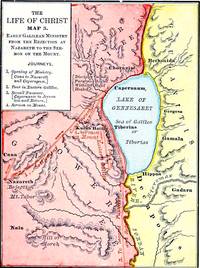 The Life of Jesus, Map 3: Early Work in Galilee