and I I also, I too, but I. κἀγώ v.s. ἐγώ. Scroll for more
no No, not. οὐ, before a vowel with smooth breathing οὐκ, before one with rough breathing οὐχ (but improperly οὐχ ἰδού, Ac 2:7, WH, mg.; cf. WH, Intr., § 409; M, Pr., 44, 244), [in LXX for לֹא, אַיִן, אֵין;] neg. particle, not, no, used generally c. indic. and for a denial of fact (cf. μή ); absol. (accented), οὔ, no: Mt 13:29, Jo 1:21 21:5; οὒ οὔ, Mt 5:37, Ja 5:12. Most freq. negativing a verb or other word, Mt 1:25 10:26, 38, Mk 3:25 9:37, Jo 8:29, Ac 7:5, Ro 1:16, Phl 3:3, al.; in litotes, οὐκ ὀλίγοι (i.e. very many ), Ac 17:4, al.; οὐκ ἄσημος, Ac 21:39; πᾶς... οὐ, c. verb, (like Heb. כֹּל... לֹא ), no, none, Mt 24:22, Mk 13:20, Lk 1:37, Eph 5:5, al.; in disjunctive statements, οὐκ... ἀλλά, Lk 8:52, Jo 1:33, Ro 8:20, al.; c. 2 pers. fut. (like Heb. לֹא, c. impf.), as emphatic prohibition, Mt 4:7, Lk 4:12, Ro 7:7, al. With another negative, strengthening the negation: Mk 5:37, Jo 8:15 12:19, Ac 8:39, al.; making an affirmative: Ac 4:20, I Co 12:15. With other particles: οὐ μή (v.s. μή ); οὐ μηκέτι, Mt 21:19; with μή interrog., Ro 10:18, I Co 9:4, 5 11:22. Interrogative, expecting an affirmative answer (Lat. nonne ): Mt 6:26, Mk 4:21, Lk 11:40, Jo 4:35, Ro 9:21, al. Scroll for more
to perceive I know, remember, appreciate. οἶδα, (from same root as εἶδον, q.v.), [in LXX chiefly for ידע;] pf. with pres. meaning (plpf. as impf.; on irregular tense-forms, v. App.), to have seen or perceived, hence, to know, have knowledge of: c. acc. rei, Mt 25:13, Mk 10:19, Jo 10:4, Ro 7:7, al.; c. acc. pers., Mt 26:72, Jo 1:31, Ac 3:16, al.; τ. θεόν, I Th 4:5, Tit 1:16, al.; c. acc. et inf., Lk 4:41, al.; seq. ὅτι, Mt 9:6, Lk 20:21, Jo 3:2, Ro 2:2 11:2, al.; seq. quaest. indir., Mt 26:70, Jo 9:21, Eph 1:18, al.; c. inf., to know how (cl.), Mt 7:11, Lk 11:13, Phl 4:12, I Th 4:4, al.; in unique sense of respect, appreciate: I Th 5:12 (but v. also ICC on I Th 4:4 ). SYN.: v.s. γινώσκω. Scroll for more
it/s/he He, she, it, they, them, same. αὐτός, -ή, -ό, determinative pron., in late Gk. much more freq. than in cl. (WM, 178 f.; Jannaris, HGG, §1399). Emphatic (so always in nom. exc. when preceded by the art., v. infr., iii); self ( ipse ), expressing opposition, distinction, exclusion, etc., αὐ. ἐκχυθήσεται, Lk 5:37; αὐ. ἐγινώσκεν, Jo 2:25; αὐ. ὑμεῖς, Jo 3:28; καὶ αὐ. ἐγώ, Ro 15:14; αὐ. Ἰησοῦς, Jo 2:24; αὐ. καὶ οἱ μετ’ αὐτοῦ, Mk 2:25; ὑμεῖς αὐ., Mk 6:31; esp. (as freq in cl.) αὐ. ὁ, Mt 3:4, Mk 6:17, Jo 16:27, I Th 3:11, al.; in late Gk., sometimes weakened, ἐν αὐτῇ τ. ὥρᾳ, in that hour, Lk 10:21 (M, Pr., 91; MM, s.v.); emphatic, he, she, it (M, Pr., 86; Bl., § 48, 1, 2, 7), Mt 1:21 12:50, Lk 6:35, al.; pointing to some one as master (cl.), Mt 8:24, Mk 4:38, al.; αὐ., καὶ αὐ. = οὗτος, ὁ δε (Bl., § 48, 1), Mt 14:2, Mk 14:15, 44, Lk 1:22 2:28, al. In oblique cases (cl.), for the simple pron. of 3rd pers., he, she, it, Mt 7:9, 10:12, 26:44, al.; with ptcp. in gen. absol., Mt 9:18, Mk 13:1, al. (for irreg. constructions, V. Bl., § 74, 5); pleonastically after the relative (cf. Heb. אֲשֶׁר לֹו; WM, 184 ff.; Bl., § 50, 4; MM, s.v.), Mk 7:25, Re 3:8, 7:2, al.; in constr. ad sensum, without proper subject expressly indicated, Mt 4:23, Ac 8:5, II Co 2:13, al.; gen. αὐτοῦ = ἐκείνου, Ro 11:11, I Th 2:19, Tit 3:5, He 2:4. ὁ, ἡ, τὸ αὐ., the same: He 1:12, 13:8; τὸ αὐ., ποιεῖν, Mt 5:46, 47, al.; φρονεῖν, Ro 12:16 15:5, Phl 2:2, al.; τὰ αὐ., Ac 15:27, Ro 2:1, al.; κατὰ τὸ ( τὰ ) αὐ. (MM, s.v.), Ac 14:1, Lk 6:23, al.; ἐπὶ τὸ αὐ., together (MM, s.v.), Mt 22:34, Ac 1:15, al.; ἓν κ. τὸ αὐ., I Co 11:5, 12:11; c. dat. (cl.), I Co 11:5; with a noun, λόγος, Mk 14:39; μέτρος, Phl 1:30; πνεῦμα, I Co 12:4. Scroll for more
but But, except, however. ἀλλά ( ἀλλ’ usually bef. α and υ, often bef. ε and η, rarely bef. ο and ω, never bef. ι; Tdf., Pr., 93 f.; WH, App., 146), adversative particle, stronger than δέ; prop. neuter pl. of ἄλλος, used adverbially, with changed accent; hence prop. otherwise, on the other hand (cf. Ro 3:31 ); opposing a previous negation, but: οὐ (μὴ)... ἀ., Mt 5:15, 17 Mk 5:39, Jo 7:16, al.; rhetorically subordinating but not entirely negativing what precedes, οὐ... ἀ., not so much... as, Mk 9:37, Mt 10:20, Jo 12:44, al.; with ellipse of the negation, Mt 11:7-9, Ac 19:2, I Co 3:6 6:11 7:7, II Co 7:1, Ga 2:3, al.; in opposition to a foregoing pos. sentence, ἀ. οὐ, Mt 24:6, I Co 10:23; οὐ μόνον... ἀ. καί, Jo 5:18, Ro 1:32, al.; elliptically, after a negation, ἀ. ἵνα, Mk 14:49, Jo 1:8 9:3, al.; = εἰ μή (Bl., §77, 13; M, Pr., 241; but cf. WM, §iii, 10), Mt 20:23, Mk 4:22. Without previous negation, to express opposition, interruption, transition, etc., but: Jo 16:20 12:27, Ga 2:14; before commands or requests, Ac 10:20 26:16, Mt 9:18, Mk 9:22, al.; to introduce an accessory idea, II Co 7:11; in the apodosis after a condition or concession with εἰ, ἐάν, εἴπερ, yet, still, at least, Mk 14:29, I Co 9:2, II Co 4:16, Col 2:5, al.; after μέν, Ac 4:17, Ro 14:20, I Co 14:17; giving emphasis to the following clause, ἀλλ’ ἔρχεται ὥρα, yea, etc., Jo 16:2; so with neg., ἀλλ’ οὐδέ, nay, nor yet, Lk 23:15. Joined with other particles (a practice which increases in late writers; Simcox, LNT, 166), ἀ. γε, yet at least, Lk 24:21, I Co 9:2; ἄ ἤ., save only, except, Lk 12:51, II Co 1:13; ἀ. μὲν οὖν, Phl 3:8 (on this usage, v. MM, VGT, s.v.). Scroll for more
the/this/who The, the definite article. ὁ, ἡ, τό, the prepositive article ( ἄρθρον προτακτικόν ), originally a demonstr. pron. (so usually in Hom.), in general corresponding to the Eng. definite article. As demonstr. pron. As freq. in Hom., absol., he ( she, it ), his (etc.): Ac 17:28 (quoted from the poet Aratus). Distributive, ὁ μὲν... ὁ δέ, the one... the other: I Co 7:7, Ga 4:22; pl., Ac 14:4, 17:32, Phl 1:16, al.; οἱ μὲν... ἄλλοι δέ, Mt 16:14, Jo 7:12; οἱ μεν̀... ὁ δέ, He 7:21, 23. In narration (without ὁ μὲν preceding), ὁ δέ, but he: Mt 2:14, Mk 1:45, Lk 8:21, Jo 9:38, al. mult. As prepositive article, the, prefixed, to nouns unmodified: ὁ θεός, τὸ φῶς, etc.; to abstract nouns, ἡ σοφία, etc., to pl. nouns which indicate a class, οἱ ἀλώπεκες, foxes, Mt 8:20, al.; to an individual as representing a class, ὁ ἐργάτης, Lk 10:7; c. nom. = voc. in addresses, Mt 11:26, Jo 19:3, Ja 5:1, al.; to things which pertain to one, ἡ χεῖρ, his hand, Mk 3:1; to names of persons well known or already mentioned; usually to names of countries (originally adjectives), ἡ Ἰουδαία, etc. To modified nouns: c. pers. pron. gen., μοῦ, σοῦ, etc.; c. poss. pron., ἐμός, σός, etc.; c. adj. between the art. and the noun, ὁ ἀγαθὸς ἄνθρωπος, Mt 12:35; the noun foll. by adj., both c. art., ὁ ποιμὴν ὁ καλός, Jo 10:11 (on ὁ ὄχλος πολύς, Jo 12:9, v. M, Pr., 84); before adjectival phrases, ἡ κατ’ ἐκλογὴν πρόθεσις, Ro 9:11. To Other parts of speech used as substantives; neuter adjectives: τ. ἀγαθόν, etc.; cardinal numerals: ὁ εἶς, οἷ δύο, etc.; participles: ὁ βαπτίζων (= ὁ Βαπτιστής, Mt 14:2 ), Mk 6:14; πᾶς ὁ, c. ptcp., every one who, etc.; adverbs: τὸ πέραν, τὰ νῦν, ὁ ἔσω ἄνθρωπος; infinitives: nom., τὸ θέλειν, Ro 7:18, al.; gen., τοῦ, after adjectives, ἄξιον τοῦ πορεύεσθαι, I Co 16:4; verbs, ἔλαχεν τοῦ θυμιᾶσαι, Lk 1:9; and freq. in a final sense, ἐξῆλθεν ὁ σπείρειν, Mt 13:3 (on the artic. inf., v. Bl., § 71). In the neut. to sentences, phrases or single words treated as a quotation: τὸ Ἐι δύνῃ, Mk 9:23; τὸ ἔτι ἅπαξ, He 12:27; τὸ ἀνέβη, Eph 4:9, al. To prepositional phrases: οἱ ἀπὸ Ἰταλίας, He 13:24; οἱ ἐκ νόμου, Ro 4:14; neut. acc. absol., in adverbial phrases, τὸ καθ’ ἡμέραν, daily, Lk 11:3; τὸ κατὰ σάρκα, as regards the flesh, Ro 9:5. To nouns in the genitive, denoting kinship, association, etc.: ὁ τοῦ, the son of (unless context indicates a different relationship), Mt 10:2, al.; τὰ τοῦ θεοῦ, the things that pertain to God, Mt 16:23; τὰ τῆς εἰρήνης, Ro 14:19 (cf. M, Pr., 81 ff.; Bl, §§ 46, 47). Scroll for more
to send I send, transmit, permit to go, put forth. πέμπω, [in LXX chiefly for שׁלח;] to send; of persons: c. acc., absol., Mt 22:7, Lk 7:19, Jo 1:22, II Co 9:3, al.; ptcp. seq. verb., Mt 14:10, Ac 19:31, al.; ptcp. seq. διά (= Heb. בְּיוֹד probably misspelled בְּיַד, I Ki 16:20, al.), Mt 11:2 (cf. Re 1:1 ); of teachers sent by God, Jo 1:33 4:34, Ro 8:3, al.; c. acc. et dat., I Co 4:17, Phl 2:19; seq. πρός, c. acc., Lk 4:26, Jo 16:7, al.; seq. λέγων (cf. Heb. שָׁלַח לֵאמֹר Ge 38:25, al.), Lk 7:6, 19; seq. εἰς, c. acc. loc., Mt 2:8, Lk 15:15, al.; seq. εἰς (of purpose), Eph 6:22, Col 4:8, I Pe 2:14; c. inf., Jo 1:33, I Co 16:3, Re 22:16; of things: Re 11:10; seq. εἰς, Re 1:11; id., of purpose, Ac 11:29, Phl 4:16; c. dat. pers., II Th 2:11; π. τ. δρέπανον σου (cf. εξαποστείλατε δρέπανα = שָׁלַח מַגָּל, Jl 3 (4):13 ), Re 14:15, 18 (cf. ἀνα-, ἐκ-, μετα-, προ-, συν-πέμπω ). SYN.: ἀποστέλλω, q.v. Scroll for more
me ἐγώ, gen, etc., ἐμοῦ, ἐμοί, ἐμέ (enclitic μου, μοι, με ), pl. ἡμεῖς, -ῶν, -ῖν, -ᾶς, pers. pron. I. The nom. is usually emphatic, when expressed as subjc, as in Mt 3:11, Mk 1:8, Lk 3:16, al. But often there is no apparent emphasis, as Mt 10:16, Jo 10:17; ἰδοὺ ἐ. (= Heb. הִנֵּנִי, cf. I Ki 3:8 ), Ac 9:10; ἐ. (like Heb. אֲנִי ), I am, Jo 1:23 (LXX), Ac 7:32 (LXX). The enclitic forms (v. supr.) are used with nouns, adjectives, verbs, adverbs, where there is no emphasis: ἐν τ. πατρί μου, Jo 14:20; μου τ. λόγους, Mt 7:24; ὀπίσω μου, Mt 3:11; ἰσχυρότερός μου, ib.; λέγει μοι, Re 5:5; also with the prep. πρός, as Mk 9:19, al. The full forms ( ἐμοῦ, etc.) are used with the other prepositions, as δι' ἐμοῦ, ἐν ἐμοί, εἰς ἐμέ, etc., also for emphasis, as Lk 10:16, Jo 7:23, Mk 14:7, al. The gen. μου and ἡμῶν are often used for the poss. pronouns ἐμός, ἡμέτερος: τ. λαόν μου, Mt 2:6; μου τῂ ἀπιστιᾳ, Mk 9:24. τί ἐμοὶ καὶ σοί ( = Heb. וָלָךְ מַה־לִי, Jg 11:12, al.), i.e. what have we in common: Mt 8:29, Mk 1:24 5:7, Lk 8:28, Jo 2:4; τί γάρ μοι, I Co 5:2. The interchange of ἐγώ and ἡμεῖς, common in π., appears in Pauline Epp. (v. M, Pr., 86f., M, Th., 131f.). κἀγώ (= καὶ ἐγώ, and I, even I, I also: Mt 2:8, Lk 2:48, Jo 6:56, Ro 3:7, I Co 7:40, al.; κἀγώ... καί, both... and, Jo 7:28. Scroll for more
to baptize Lit: I dip, submerge, but specifically of ceremonial dipping; I baptize. βαπτίζω (< βάπτω ), [in LXX: IV Ki 5:14 ( טבל ), Is 21:4, Jth 12:7, Si 31 (34):30 *;] to dip, immerse, sink; generally (in Polyb., iii, 72, of soldiers wading breast-deep; in i, 51, of the sinking of ships); metaph., to overwhelm ( Is 21:4; cf. MM, Exp., x); c. cogn. acc., βάπτισμα β., Mk 10:38, 39, Lk 12:50. Mid., to perform ablutions, wash oneself, bathe ( IV Ki 5:14, Jth 12:7, Si 31 (34):30 ): Mk 7:4; aor. pass, in same sense, Lk 11:38. Of ablution, immersion, as a religious rite, to baptize; absol.; Mk 1:4, Jo 1:25, 26, 28 3:22, 23, 26 4:2 10:40, I Co 1:17; ὁ βαπτίζων (= ὁ βαπτιστής, M, Pr., 127), Mk 6:14, 24; c. acc., Jo 4:1, Ac 8:38, I Co 1:14, 16; c. cogn. acc., τὸ βάπτισμα, Ac 19:4 (cf. Mk 10:38, supr.); pass., to be baptized, receive baptism: Mt 3:13, 14, 16, Mk 16:16, Lk 3:7, 12, 21 7:29 ( τ. βάπτισμα ) Luke 7:30, Ac 2:41 8:12, 13, 36 9:18 10:47 16:15, 33 18:8; mid., 22:16 (M, Pr., 163); with prepositions: ἐν, of the element, Mt 3:6, 11, Mk 1:4, 5, 8, Lk 3:16, Jo 1:26, 31, 33 3:23, Ac 1:5 2:38 10:48 11:16, I Co 10:2; εἰς, of the element, purpose or result (Lft., Notes, 155), Mt 3:11 28:19, Mk 1:9, Ac 8:16 19:3, 5, Ro 6:3, I Co 1:13, 15 10:2 12:13, Ga 3:27; c. dat., ὕδατι, Lk 3:16, Ac 1:5 11:16; ὑπὲρ τῶν νεκρῶν, perh. to fulfil the wish of a dead friend, I Co 15:29 (v. ICC, in l.; cf. DB, i, 238 ff.; DCG, i, 169 a; ii, 605 b; Cremer, 126).† Scroll for more
in/on/among In, on, among. ἐν, prep, (the most freq. of all in NT), c. dat. (= Heb. בְּ, Lat. in, c. abl.). Of place, c. dat. rei, pers., in, within, on, at, by, among: ἐν τ. πόλει, Lk 7:37; τ. οφθαλμῷ, Mt 7:3; τ. κοιλίᾳ, Mt 12:40; τ. ὄρει, II Pe 1:18; τ. θρόνῳ, Re 3:21; τ. δεξιᾷ τ. θεοῦ, Ro 8:34; ἐν ἡμῖν Abbott-Smith has ὑμῖν., Lk 1:1; of books, ἐν τ. βιβλίῳ, Ga 3:10; τ. νόμῳ, Mt 12:5, al.; ἐν τοῖς τ. Πατρός, in my Father's house (RV; cf. M, Pr., 103), Lk 2:49; trop., of the region of thought or feeling, ἐν τ. καρδίᾳ (-αις), Mt 5:28, II Co 4:6, al.; τ. συνειδήσεσιν, II Co 5:11; after verbs of motion, instead of εἰς ( constructio praegnans, a usage extended in late Gk. beyond the limits observed in cl.; cf. Bl., §41, 1; M, Th., 12), ἀποστέλλω... ἐν, Mt 10:16. δέδωκεν ἐν τ. χειρί (cf. τιθέναι ἐν χερσί, Hom., Il., i, 441, al.), Jo 3:35; id. after verbs of coming and going (not in cl.), εἰσῆλθε, Lk 9:46; ἐξῆλθεν, Lk 7:17. Of state, condition, form, occupation, etc.: ἐν ζωῇ, Ro 5:10; ἐν τ. θανάτῳ, I Jo 3:14; ἐν πειρασμοῖς, I Pe 1:6; ἐν εἰρήνῃ, Mk 5:25; ἐν δόξῃ, Phl 4:19; ἐν πραΰτητι, Ja 3:13; ἐν μυστηρίῳ, I Co 2:7; ἐν τ. διδαχῇ, Mk 4:2; of a part as contained in a whole, ἐν τ. ἀμπέλῳ, Jo 15:4; ἐν ἑνὶ σώματι, Ro 12:4; of accompanying objects or persons (simple dat. in cl.), with, ἐν αἵματι, He 9:25; ἐν δέκα χιλιάσιν, Lk 14:31 (cf. Ju 14, Ac 7:14 ); similarly (cl.), of clothing, armour, arms, ἐν στολαῖς, Mk 12:38; ἐν ἐσθῆτι λαμπρᾷ, Ja 2:2; ἐν μαξαίρῃ, Lk 22:49; ἐν ῥάβδῳ, I Co 4:21 (cf. ἐν τόξοις, Xen., Mem., 3, 9, 2); of manner (cl.), ἐν τάχει (= ταχέως ), Lk 18:8 (cf. Bl., §41, 1); of spiritual influence, ἐν πνεύματι, Ro 8:9; ἐν π. ἀκαθάρτῳ, Mk 1:23; of the mystical relation of the Christian life and the believer himself, to God and Christ (cf. ICC, Ro., 160f.; Mayor on Ju 1; M, Pr., 103): ἐν Χριστῷ, Ro 3:24, 6:11, I Co 3:1, 4:10, II Co 12:2, Ga 2:17, Eph 6:21, Col 4:7, I Th 4:16, al. Of the agent, instrument or means (an extension of cl. ἐν of instr.—v. LS, s.v. Ill—corresponding to similar use of Heb. בְּ ), by, with: ἐν ὑμῖν κρίνεται ὁ κόσμος (= cl. παρά, C. dat.), I Co 6:2; ἐν τ. ἄρχοντι τ. δαιμονίων, Mt 9:34; ἐν αἵματι, He 9:22; ἐν ὕδατι, Mt 3:11, al.; ἐν μαχαίρᾳ ἀποκτενεῖ (cf. the absol. ἐν μ., ἐν ῥάβδῳ, supr., II, which some would classify here), Re 13:10 (cf. 6:8 ). Allied to this usage and distinctly Semitic are the following: ἠγόρασας... ἐν τ. αἵματι σου (cf. BDB, s.v. בְּ, III, 3), Re 5:9; ὁμολογεῖν ἐν (= Aram. אודי בּ; cf. McNeile on Mt, I.c.; M, Pr., 104), Mt 10:32, Lk 12:8; ὀμνύναι ἐν (= cl. acc., so Ja 5:12 ), Mt 5:34, al.; also at the rate of, amounting to, Mk 4:8 (WH; vv. ll., εἰς, ἒν ), Ac 7:14 (LXX). Of time, in or during a period: ἐν τ. ἡμέρᾳ (νυκτί), Jo 11:9, al.; ἐν σαββάτῳ, Mt 12:2, al.; ἐν τῷ μεταξύ, meanwhile, Jo 4:31; at the time of an event: ἐν τ. παρουσίᾳ, I Co 15:23; ἐν τ. ἀναστάσει, Mt 22:28; c. art. inf., pres. (so sometimes in cl., but not as in NT = ἕως; V. M, Pr., 215), while: Mt 13:4, Mk 6:48, Ga 4:18, al.; aor., when, after: Lk 9:36, al.; within (cl.): Mt 27:40, In composition: (1) meaning: (a) with adjectives, it signifies usually the possession of a quality, as ἐνάλιος, ἐν́δοξος; (b) with verbs, continuance in (seq. ἐν ) or motion into (seq. εἰς ), as ἐμμένω, ἐμβαίνω. (ii) Assimilation: ἐν becomes ἐμ- before β, μ, π, φ, ψ; ἐγ- before γ, κ, ξ, χ; ἐλ- before λ. But in the older MSS of NT, followed by modern editions, assimilation is sometimes neglected, as in ἐνγράφω, ἐγκαινίζω, etc. Scroll for more
water Water. ὕδωρ gen., ὕδατος, τό, [in LXX chiefly for מַיִם;] water: Mt 3:16, Mk 1:10, Lk 7:44, Jo 4:7, Ja 3:12, Re 8:10, al.; pl., Mt 14:28, 29, Jo 3:23, Re 1:15, al.; βαπτίζειν ( ἐν ) ὕδατι, Mt 3:11, Mk 1:8, Jo 1:26, al.; τ. λουτρὸν τοῦ ὕ., Eph 5:26; opp. to οἴνος, Jo 2:9 4:46; αἷμα, Jo 19:34, He 9:19, I Jn 5:6, 8, Mt 17:15, Mk 9:22; πνεῦμα, Jo 1:26, 31, 33; πνεῦμα καὶ πῦρ, Mt 3:11, Lk 3:16; ἐξ ὕ. κ. πνεύματος γεννηθῆναι, Jo 3:5; metaph., of divine truth and grace ( τ. ) ὕ. ( τ. ) ζῶν, Jo 4:10, 11 (cf. ib. 13-15,); τ. ὕ. τ. ζωῆς, of spiritual refreshment, Re 21:6 22:1, 17 Scroll for more
that That, that one there, yonder. ἐκεῖνος, -η, -ο (< ἐκεῖ ), [in LXX chiefly for הַהוּא,הוּא, and cogn. forms;] demonstr. pron., that person or thing ( ille ), implying remoteness as compared with οὗτος ( hic ); absol., emphatic he, she, it: opp. to οὗτος, Lk 18:14, Ja 4:15; ἡμεῖς, He 12:25; ὑμεῖς, Mt 13:11, Mk 4:11; ἄλλοι, Jo 9:9; ἐγώ, Jo 3:30; to persons named, Mk 16:[ 10, 13, 20 ], Jo 2:21; of one (absent) who is not named, contemptuously (Abbott, JG, §§2385, 2732), Jo 7:11 9:28; with respect, of Christ, I Jo 2:6 3:3, al.; referring to a preceding noun, Mk 16:[10], Jo 7:45; resumption of a participial subject, Jo 1:33 9:37 10:1, Ro 14:14, al. (on its reference in Jo 19:35, v. Westc, in l.; Moffatt, Intr., 568; Sanday, Fourth Gospel, 77ff.). As adj., joined, like οὗτος, to a noun with the article: Mt 7:25, Mk 3:24, Jo 18:15, al.; esp. of time, past or future: ἐν τ. ἡμέραις ἐ., Mt 3:1, Mk 1:9, Ac 2:18 (LXX), al.; ἐν ἐ. τ. ἡμέρᾳ, esp of the Parousia, Mt 7:22, Lk 6:23, II Th 1:10, II Ti 1:12; adverbially, ἐκεινής (sc. ὁδοῦ ) = cl. ἐκεινῇ (Bl., §36, 13), that way, Lk 19:4. Scroll for more
to me ἐγώ, gen, etc., ἐμοῦ, ἐμοί, ἐμέ (enclitic μου, μοι, με ), pl. ἡμεῖς, -ῶν, -ῖν, -ᾶς, pers. pron. I. The nom. is usually emphatic, when expressed as subjc, as in Mt 3:11, Mk 1:8, Lk 3:16, al. But often there is no apparent emphasis, as Mt 10:16, Jo 10:17; ἰδοὺ ἐ. (= Heb. הִנֵּנִי, cf. I Ki 3:8 ), Ac 9:10; ἐ. (like Heb. אֲנִי ), I am, Jo 1:23 (LXX), Ac 7:32 (LXX). The enclitic forms (v. supr.) are used with nouns, adjectives, verbs, adverbs, where there is no emphasis: ἐν τ. πατρί μου, Jo 14:20; μου τ. λόγους, Mt 7:24; ὀπίσω μου, Mt 3:11; ἰσχυρότερός μου, ib.; λέγει μοι, Re 5:5; also with the prep. πρός, as Mk 9:19, al. The full forms ( ἐμοῦ, etc.) are used with the other prepositions, as δι' ἐμοῦ, ἐν ἐμοί, εἰς ἐμέ, etc., also for emphasis, as Lk 10:16, Jo 7:23, Mk 14:7, al. The gen. μου and ἡμῶν are often used for the poss. pronouns ἐμός, ἡμέτερος: τ. λαόν μου, Mt 2:6; μου τῂ ἀπιστιᾳ, Mk 9:24. τί ἐμοὶ καὶ σοί ( = Heb. וָלָךְ מַה־לִי, Jg 11:12, al.), i.e. what have we in common: Mt 8:29, Mk 1:24 5:7, Lk 8:28, Jo 2:4; τί γάρ μοι, I Co 5:2. The interchange of ἐγώ and ἡμεῖς, common in π., appears in Pauline Epp. (v. M, Pr., 86f., M, Th., 131f.). κἀγώ (= καὶ ἐγώ, and I, even I, I also: Mt 2:8, Lk 2:48, Jo 6:56, Ro 3:7, I Co 7:40, al.; κἀγώ... καί, both... and, Jo 7:28. Scroll for more
to say λέγω, [in LXX very freq., chiefly for אמר; λέγει for נְאֻם, Ge 22:16, al.;] in Hom., to pick out, gather, reckon, recount. In Hdt. and Att., to say, speak, affirm, declare: absol., Ac 13:15 24:10; seq. orat. dir., Mt 9:34, Mk 3:11, Jo 1:29, al.; seq. ὅτι recit., Mk 3:21, Lk 1:24, Jo 6:14, al.; acc. et. inf., Lk 11:18, Jo 12:29, al.; after another verb of speaking, προσφωνεῖν κ. λέγειν, Mt 11:17, al.; ἀπεκρίθη ( ἐλάλησεν ) λέγων ( καὶ λέγει; Dalman, Words, 24 ff.), Mt 25:9, Mk 3:33, 7:28, Lk 24:6, 7, al.; of unspoken thought, λ. ἐν ἑαυτῷ, Mt 3:9, Lk 3:8, al.; of writing, II Co 8:8, Phl 4:11, al.; λέγει ἡ γραφή, Ro 4:3, Ja 2:23, al.; c. acc. rei, Lk 8:8 9:33, Jo 5:34, al.; σὺ λέγεις (a non-committal phrase; Swete, Mk., 359, 369 f.), Mt 27:11, Mk 15:2, Lk 23:3, Jo 18:37; c. dat. pers., seq. orat. dir., Mt 8:20, Mk 2:17, al. mult.; id. seq. ὅτι, Mt 3:9, al.; c. prep., πρός, μετά, περί, etc., Mk 4:41, Jo 11:56, He 9:5, al.; to mean (cl.), Mk 14:71, Jo 6:71, I Co 10:29, al.; to call, name, Mk 10:18; pass., Mt 9:9, Mk 15:7, al (cf. ἀντι-, δια- ( -μαι ), προ-, συλ-λέγω ). SYN.: λαλέω, which refers to the utterance, as λέγω to the meaning of what is said, its correspondence with thought (Tr., Syn., Ixxvi; Thayer, s.v. λαλέω ). Scroll for more
upon/to/against On, to, against, on the basis of, at. ἐπί (before a smooth breathing ἐπ’, before a rough breathing ἐφ’ ), prep. c. gen., dat., acc. (acc. most freq. in NT), with primary sense of superposition, on, upon. C. gen., of place, answering the question, where? of the place on which, on, upon: ἐπὶ (τ.) γῆς, Mt 6:10, 19, al.; τ. κεφαλῆς, I Co 11:10; τ. νεφελῶν, Mt 24:30, al.; like ἐν, in constr. praegn. after verbs of motion: βάλλειν, Mk 4:26; σπείρειν, ib. 31; ἔρχεσθαι, He 6:7, al.; fig., ἐπ’ ἀληθείας (MM, s.v. ἀ. ); of the subject of thought or speech, Ga 3:16; of power or authority, over, πάντων, Ro 9:5: τ. γάζης, Ac 8:27; ἐξουσία, Re 2:26 20:6; of vicinity, at, by: τ. θαλάσσης, Jo 6:9; τ. ὁδοῦ, Mt 21:19; τοῦ βάτου, Mk 12:26 (v. Swete, in l.); c. gen. pers., in the presence of, before, Mt 28:14, Ac 23:30, I Co 6:1, al. Of time, c. gen. pers., in the time of: ἐπὶ Ἐλισαίου, Lk 4:27; ἐπὶ Κλαυδίου, Ac 11:28; ἐπὶ Ἀβιάθαρ ἀρχιερέως, when A. was high priest, Mk 2:26; c. gen. rei, at, at the time of: Mt 1:11, He 1:2, II Pe 3:3; ἐπὶ τ. προσευχῶν, Ro 1:10, Eph 1:16, I Th 1:2, Phm 4. C. dat., of place, answering the question, where? lit., on, upon: Mt 9:16, 14:8, al.; after verbs of motion (v. supr., I, 1, ( a )), Mt 9:16 Ac 8:16; above, Lk 23:38; at, by, Mk 13:29, Jo 5:2, Ac 5:9, al.; metaph., upon, on the ground of, Lk 4:4 (LXX); in the matter of, Mk 6:52 (v. Swete, in l.); upon, of, concerning, Ac 5:35, 40; of the ground, reason or motive (Bl., §38, 2; 43, 3), Mt 18:3 19:9, Ro 12:12, al.; ἐφ’ ᾧ, for the reason that, because, Ro 5:12 II Co 5:4; after verbs of motion, over, Mt 18:13, Ro 16:19, al.; of a condition (cl.), Ro 8:20, I Co 9:10; ἐπὶ δυσὶ μάρτυσιν (v. Westc. on He 9:10 ), He 10:28; of purpose or aim, Eph 2:10, Phl 4:10; of authority, over, Mt 24:47 Lk 12:44; of hostility, c. dat. pers. (cl.), against, Lk 12:52; in addition to (cl.), II Co 7:13; of an adjunct, in, at, on, Phl 1:3 2:17. C. acc., of place of motion upon or over, answering the question, whither? lit., upon, over: Mt 14:28, 29, Lk 5:19, al. mult.; in NT also, answering the question, where? (as c. gen., dat.), Mk 4:38 11:2, Lk 2:25, Jo 1:32; ἐπὶ τ. αὐτό, Ac 1:15 2:1, al.; of motion to a vicinity, to, Mk 16:2, Ac 8:36, al.; metaph. (in wh. "the acc. is more widely prevalent than it strictly should be," Bl., §43, 1); of blessings, evils, etc., coming upon one, c. acc. pers., Mt 10:13 12:28, Ac 2:17, Jo 18:4, Eph 5:6, al.; of addition (dat. in cl.), λύπη ἐπὶ λύπην, Phl 2:27; ἐπικαλεῖν ὄνομα ἐπί (v.s. ἐπικαλέω ), Ac 15:17, Ja 2:7; καλεῖν ἐπί, to call after, Lk 1:59; of number or degree: ἐπὶ τρίς (cl. εἰς τ. ), thrice, Ac 10:16 11:10; ἐπὶ πλεῖον, the more, further, Ac 4:17 II Ti 2:16 3:9 (v. also infr., 2, ( a )); ἐφ’ ὅσον (v. infr., ib.), forasmuch as, Mt 25:40, 45, Ro 11:13; of power, authority, control, Lk 1:33, Ac 7:10 Ro 5:14, He 3:6, al.; of the direction of thoughts and feelings, unto, towards, Lk 1:17 23:28, Ac 9:35, 42, Ro 11:22, Ga 4:9, Eph 2:7, I Ti 5:5, al.; of purpose, for, Mt 3:7, Lk 23:48; ἐφ’ ὅ πάρει (Rec. ἐφ’ ᾧ, Mt 26:50; of hostility, against, Mt 24:7, Mk 3:24-26 10:11 13:8, Lk 9:5, Jo 13:18, Ac 7:54, I Co 7:36, II Co 1:23; Of reference, concerning, for (cl. usually dat.), Mk 9:12 15:24, Jo 19:24, Ro 4:9. Of time, during, for: Lk 4:25 (WH, txt., omits ἐπί ), Ac 13:31 16:18, He 11:30, al.; ἐφ’ ὅσον (χρόνον), as long as, for so long time as, Mk 9:15 Ro 7:1, al. (for ἐφ’ ὅ in another sense, v. supr., 1, ( b )); ἐφ’ ἱκανόν (v.s. ἱ ), Ac 20:11; ἐπὶ πλεῖον (v. supr., 1, (b)), yet longer, further, Ac 20:9 24:4; on, about, towards (cl. εἰς ): Lk 10:35 Ac 3:1 4:5. In composition, ἐπί signifies: up, ἐπαίρω; upon, ἐπίγειος, ἐπιδημέω, ἐπικαθίζω; towards, επιβλέπω, ἐπεκτείνω; over (of superintendence), ἐπιστάτης; again, in addition, ἐπαιτέω; against, ἐπιορκέω, ἐπιβουλή. Scroll for more
which Who, which, what, that. ὅς, ἥ, ὅ, the postpositive article ( ἄρθρον ὑποτακτικόν ). As demonstr. pron. = οὗτος, ὅδε, this, that, also for αὐτός, chiefly in nom.: ὅς δέ, but he (cf. ἦ δὲ ὅς, freq. in Plat.), Mk 15:23, Jo 5:11; ὃς μὲν... ὃς δέ, the one... the other, Mt 21:35 22:5 25:15, Lk 23:33, Ac 27:14, Ro 14:5, I Co 11:21, II Co 2:16, Ju 22; neut., ὃ μὲν... ὃ δέ, the one... the other, some... some, Mt 13:8, 23, Ro 9:21; ὃς ( ὃ ) μὲν... ( ἄλλος ( ἄλλο ))... ἕτερος ( -ο ), Mk 4:4, Lk 8:5, I Co 12:8-10; οὓς μέν, absol., I Co 12:28; ὃς μὲν... ὁ δέ, Ro 14:2. As relat. pron., who, which, what, that; agreeing in gender with its antecedent, but differently governed as to case: Mt 2:9, Lk 9:9, Ac 20:18, Ro 2:29, al. mult. In variation from the common construction; in gender, agreeing with a noun in apposition to the antecedent: Mk 15:16, Ga 3:16, Eph 6:17, al.; constr. ad sensum: Jo 6:9, Col 2:19, I Ti 3:16, Re 13:14, al.; in number, constr. ad sensum: Ac 15:36, II Pe 3:1; in case, by attraction to the case of the antecedent (Bl., § 50, 2): Jo 4:18, Ac 3:21, Ro 15:18, I Co 6:19, Eph 1:8, al. The neut. ὅ with nouns of other gender and with phrases, which thing, which term: Mk 3:17 12:42, Jo 1:39, Col 3:14, al.; with a sentence, Ac 2:32, Ga 2:10, I Jo 2:8, al. With ellipse of a demonstrative ( οὗτος or ἐκεῖνος ), before or after: before, Mt 20:23, Lk 7:43, Ro 10:14, al.; after, Mt 10:38, Mk 9:40, Jo 19:22, Ro 2:1 al. Expressing purpose, end or cause: Mt 11:10 ( who = that he may ), Mk 1:2, He 12:6 al. C. prep. as periphrasis for conjc.: ἀνθ’ ὧν ( = ἀντὶ τούτων ὧν ), because, Lk 1:20, al.; wherefore, Lk 12:3; ἐφ’ ᾧ, since, for that, Ro 5:12; ἀφ’ οὗ, since (temporal), Lk 13:25; ἐξ οὗ, whence, Phl 3:20; etc. With particles: ὃς ἄν ( ἐάν ), v.s. ἄν, ἐάν; ὃς καί, Mk 3:19, Jo 21:20, Ro 5:2, al.; ὃς καὶ αὐτός, Mt 27:57. Gen., οὗ, absol., as adv. (v.s. οὗ ). Scroll for more
if An untranslatable word (under the circumstances, in that case, anyhow), the general effect of which is to make a statement contingent, which would otherwise be definite: it is thus regularly used with the subjunctive mood. ἄν, conditional particle, which cannot usually be separately translated in English, its force depending on the constructions which contain it (see further, LS, s.v.; WM, §xlii; M, Pr., 165 ff.; MM, VGT, s.v.). In apodosis, c. indic, impf. or aor., expressing what would be or would have been if ( εἰ c. impf., aor. or plpf.) some condition were or had been fulfilled: Lk 7:39 17:6, Jo 5:46, Ga 1:10, Mt 12:7 24:43, I Co 2:8, Ac 18:14, I Jo 2:19, al. The protasis is sometimes understood (as also in cl.): Mt 25:27, Lk 19:23. In hypothetical sentences, expressing unreality, ἄν (as often in late writers, more rarely in cl.) is omitted: Jo 8:39 15:24 19:11, Ro 7:7, Ga 4:15; c. opt., inf., ptcp. (cl.; v. LS, s.v.; M, Int., §275; M, Pr., 167:4). In combination with conditional, relative, temporal, and final words; as in cl., c. subj., in protasis with εἰ, in Attic contr. ἐάν, q.v.; in conditional, relative, and temporal clauses (coalescing with ὅτε, ἐπεί, etc.; v.s. ὅταν, ἐπάν, etc.), ever, soever; c. pres., ἡνίκα, II Co 3:15; ὃς ἄν, Ro 9:15 (LXX) 16:2, al.; ὅσοι ἄν, Lk 9:5; ὡς ἄν, Ro 15:24 (M, Pr., 167); c. aor., ὃς ἄν, Mt 5:21, 22, 31; ἕως ἄν, until, Mt 2:13, Mk 6:10, al.; ὡς ἄν, as soon as (M, Pr., 167), I Co 11:34, Phl 2:23. On the freq. use of ἐάν for ἄν with the foregoing words, v.s. ἐάν; in late Gk., when some actual fact is spoken of, c. indic.: ὅταν (q.v.); ὅπου ἄν, Mk 6:56 (M, Pr., 168); καθότι ἄν, Ac 2:45 4:35; ὡς ἄν, I Co 12:2. in iterative construction, c. impf. and aor. indic. (M, Pr., 167): Ac 2:45 4:35, I Co 12:2. c. optat., giving a potential sense to a question or wish: Ac 8:31 26:29. Elliptical constructions: εἰ μή τι ἄν (M, Pr., 169), I Co 7:5; ὡς ἄν, c. inf., as it were (op. cit. 167), II Co 10:9. Scroll for more
to see I see, look upon, experience, perceive, discern, beware. ὁράω, -ῶ, [in LXX chiefly for ראה, also for חזה, etc.;] in "durative" sense (hence aor. act., εἶδον, pass., ὤφθην, fut., ὄψομαι, from different roots; v. M, Pr., 110 f.), to see (in colloq. even the pres. is rare, its place being generally taken by βλέτω, θεωρέω, v. Bl., § 24). Of bodily vision, to see, perceive, behold: absol., Mk 6:38, al.; ἔρχου καὶ ἴδε, Jo 1:46, al.; seq. ὅτι, Mk 2:16, al.; c. acc., Mt 2:2, Mk 1:10 16:7, Ga 1:19, al.; θεόν, Jo 1:18, I Jo 4:20, al. to see with the mind, perceive, discern: absol, Ro 15:21; c. acc. rei., Mt 9:2 27:54, Ac 8:23, Col 2:18, al. to see, take heed, beware: ὅρα μή, c. aor. subjc., Mt 8:4 18:10, Mk 1:44, I Th 5:15; id., sc. μὴ ποήσῃς, Re 19:10 22:9 (Bl., § 81, 1); seq. imperat. Mt 9:30 16:6, Mk 8:15. to experience: τ. θάνατον, Lk 2:26, He 11:5; ζωήν, Jo 3:36; τ. διαφθοράν, Ac 2:27. to visit: c. acc. pers., Lk 8:20, Jo 12:21, Ro 1:11, al.; c. acc. loc., Ac 19:21. to see to, care for: Mt 27:4, Ac 18:15 (cf. ἀφ-, καθ-, προ-, συν-οράω ). SYN.: v.s. βλέπω. Scroll for more
the/this/who The, the definite article. ὁ, ἡ, τό, the prepositive article ( ἄρθρον προτακτικόν ), originally a demonstr. pron. (so usually in Hom.), in general corresponding to the Eng. definite article. As demonstr. pron. As freq. in Hom., absol., he ( she, it ), his (etc.): Ac 17:28 (quoted from the poet Aratus). Distributive, ὁ μὲν... ὁ δέ, the one... the other: I Co 7:7, Ga 4:22; pl., Ac 14:4, 17:32, Phl 1:16, al.; οἱ μὲν... ἄλλοι δέ, Mt 16:14, Jo 7:12; οἱ μεν̀... ὁ δέ, He 7:21, 23. In narration (without ὁ μὲν preceding), ὁ δέ, but he: Mt 2:14, Mk 1:45, Lk 8:21, Jo 9:38, al. mult. As prepositive article, the, prefixed, to nouns unmodified: ὁ θεός, τὸ φῶς, etc.; to abstract nouns, ἡ σοφία, etc., to pl. nouns which indicate a class, οἱ ἀλώπεκες, foxes, Mt 8:20, al.; to an individual as representing a class, ὁ ἐργάτης, Lk 10:7; c. nom. = voc. in addresses, Mt 11:26, Jo 19:3, Ja 5:1, al.; to things which pertain to one, ἡ χεῖρ, his hand, Mk 3:1; to names of persons well known or already mentioned; usually to names of countries (originally adjectives), ἡ Ἰουδαία, etc. To modified nouns: c. pers. pron. gen., μοῦ, σοῦ, etc.; c. poss. pron., ἐμός, σός, etc.; c. adj. between the art. and the noun, ὁ ἀγαθὸς ἄνθρωπος, Mt 12:35; the noun foll. by adj., both c. art., ὁ ποιμὴν ὁ καλός, Jo 10:11 (on ὁ ὄχλος πολύς, Jo 12:9, v. M, Pr., 84); before adjectival phrases, ἡ κατ’ ἐκλογὴν πρόθεσις, Ro 9:11. To Other parts of speech used as substantives; neuter adjectives: τ. ἀγαθόν, etc.; cardinal numerals: ὁ εἶς, οἷ δύο, etc.; participles: ὁ βαπτίζων (= ὁ Βαπτιστής, Mt 14:2 ), Mk 6:14; πᾶς ὁ, c. ptcp., every one who, etc.; adverbs: τὸ πέραν, τὰ νῦν, ὁ ἔσω ἄνθρωπος; infinitives: nom., τὸ θέλειν, Ro 7:18, al.; gen., τοῦ, after adjectives, ἄξιον τοῦ πορεύεσθαι, I Co 16:4; verbs, ἔλαχεν τοῦ θυμιᾶσαι, Lk 1:9; and freq. in a final sense, ἐξῆλθεν ὁ σπείρειν, Mt 13:3 (on the artic. inf., v. Bl., § 71). In the neut. to sentences, phrases or single words treated as a quotation: τὸ Ἐι δύνῃ, Mk 9:23; τὸ ἔτι ἅπαξ, He 12:27; τὸ ἀνέβη, Eph 4:9, al. To prepositional phrases: οἱ ἀπὸ Ἰταλίας, He 13:24; οἱ ἐκ νόμου, Ro 4:14; neut. acc. absol., in adverbial phrases, τὸ καθ’ ἡμέραν, daily, Lk 11:3; τὸ κατὰ σάρκα, as regards the flesh, Ro 9:5. To nouns in the genitive, denoting kinship, association, etc.: ὁ τοῦ, the son of (unless context indicates a different relationship), Mt 10:2, al.; τὰ τοῦ θεοῦ, the things that pertain to God, Mt 16:23; τὰ τῆς εἰρήνης, Ro 14:19 (cf. M, Pr., 81 ff.; Bl, §§ 46, 47). Scroll for more
spirit/breath: spirit Wind, breath, spirit. πνεῦμα, -τος, τό, (< πνέω ), [in LXX chiefly and very freq. for רוּחַ;] of air in motion; wind: Jo 3:8; pl., He 1:7 (LXX); breath: π. ζωῆς, Re 11:11; π. τοῦ στόματος, fig., II Th 2:8 (cf. Ps 32 (33):6 ). Of the vital principle, the spirit (Arist., Polyb., al.): Lk 8:55, Jo 19:30, Ac 7:59, al.; opp. to σάρξ, Mt 26:41, Mk 14:38, I Co 5:5, al.; to σῶμα, Ro 8:10, I Co 6:17 7:34, I Pe 4:6; to ψυχή, Phl 1:27, He 4:12; τὸ π. καὶ ἡ ψ. καὶ τ. σῶμα, I Th 5:23 (M, Th., in l.); dat., τῷ π., in spirit, Mk 2:8 8:12, Jo 11:33 13:21, Ac 18:25, Ro 12:11, I Co 7:34, I Pe 3:18, al.; of the human spirit of Christ, Ro 1:4, I Ti 3:16. spirit, i.e. frame of mind, disposition, influence: Lk 1:17, Ro 8:15, I Co 4:21, Gal 6:1, Eph 2:2, II Ti 1:7, I Jo 4:6, al. An incorporeal being, a spirit: Lk 24:37, 39, Ac 23:8; π. ὁ θεός, God is spirit, Jo 4:24; πατὴρ τῶν π., He 12:9; of disembodied human beings, He 12:23, I Pe 3:19 ( ICC, in l.; DB, iii, 795); of angels. He 1:14; of demons or evil spirits, Mt 8:16, Mk 9:20, Lk 9:39, al.; π. πύθωνα, Ac 16:16; πνεύματα δαιμονίων, Re 16:14; π. δαιμονίου ἀκαθάρτου, Lk 4:33; π. ἀσθενείας (Bl., § 35, 5), Lk 13:11; π. ἀκάθαρτον, Mt 10:1, Mk 1:23, Lk 4:36, Ac 5:16; π. ἄλαλον ( καὶ κωφόν ), Mk 9:17, 25; πονηρόν, Lk 7:21, Ac 19:12, al. Of the Holy Spirit, π. ἅγιον, τὸ ἅ. π., τὸ π. τὸ ἅ., τὸ π., π. (the article as a rule being used when the Spirit is regarded as a Person or a Divine Power, and omitted when the reference is to an operation, influence or gift of the Spirit; v. WM, 151 5; Bl., § 46, 7): anarth., Mt 1:18 3:11, 16 4:1, Mk 1:8 (Swete, in l.), Mk 1:10, Lk 1:15, Jo 7:39, Ac 19:2, Ro 5:5, I Co 2:4, al.; c. art., Mt 4:1 12:31, 32, Mk 1:10 3:29, Lk 2:26, Jo 7:36 14:26, Ac 4:31 5:3, Ro 8:16, al.; ( τὸ ) π. ( τοῦ ) θεοῦ, Mt 3:16, Ro 8:9, Eph 3:16, I Jo 4:2, al.; τὸ π. τ. πατρός, Mt 10:20; π. θεοῦ ζῶντος, II Co 3:3; ( τὸ ) π. τοῦ κυρίου, Lk 4:18, Ac 5:9 8:39; τὸ π. Ἰησοῦ, Ac 16:7; Χριστοῦ, Ro 8:9; Ἰησοῦ Χριστοῦ, Phl 1:19; τὸ π. τ. ἀληθείας, Jo 15:26 16:13, I Jo 4:6; λείγει ( μαρτυρεῖ ) τὸ π. ( τὸ ἅγιον ), Ac 21:11 28:25, I Ti 4:1, He 3:7 10:15, Re 14:13; seq. τ. ἐκκλησίαις, Re 2:7, 11, 17, 29, 3:6, 13, 22; ἐν τ. π., Lk 2:27; κατὰ πνεῦμα, Ro 8:4, 5; ἐξ ὕδατος καὶ π., Jo 3:5; διὰ πνεύματος αἰωνίου, He 9:14; ἐν ἁγιασμῷ πνεύματος, II Th 2:18, I Pe 1:2; ἓν π., I Co 12:13, Eph 2:18 4:4; ὁ δὲ κύριος τὸ π. ἐστιν, II Co 3:17; of that which is effected or governed by the Spirit, opp. to γράμμα, Ro 2:29 7:6, II Co 3:6. SYN.: νοῦς, which in NT is contrasted with π. as "the action of the understanding in man with that of the spiritual or ecstatic impulse" ( DB, iv, 612); ψυχή —the usual term in cl. psychology—in NT, "expresses man as apart from God, a separate individual, π. expresses man as drawing his life from God" ( DB, 1-vol., 872). Scroll for more
to come/go down I go down, come down, either from the sky or from higher land, descend. κατα-βαίνω, [in LXX chiefly for ירד;] to go or come down, descend. Of persons: Mt 3:16 24:17, Lk 2:51 6:17 10:31 17:31 19:5, 6, Jo 4:47, 49, 51 5:7, Ac 7:34 8:15 10:20 20:10 23:10 24:1, 22, Eph 4:10; seq. ἀπό, Mt 8:1 14:29 27:40, 42, Mk 3:22 15:30, Lk 10:30, Jo 6:38, Ac 25:7, I Th 4:16; ἐκ, Mt 17:9; ἐκ τ. οὐρανοῦ, Mt 28:2, Mk 9:9, Jo 1:32 3:13 6:33, 41, 42, 6:50, 51, 58, Re 10:1 18:1 20:1; εἰς, Mk 1:10, Lk 10:30 18:14, Jo 2:12, Ac 7:15 8:38 14:25 16:8 18:22 25:6, Ro 10:7, Eph 4:9; ἐπί, c. acc. loc., Jo 6:16; c. acc. pers., Lk 3:22, Jo 1:33, 52; ἐν, Jo 5:[4]; πρός, c. acc. pers., Ac 10:21 14:11, Re 12:12. Of things: σκεῦος, Ac 10:11 11:5; βροχή, Mt 7:25, 27; λαῖλαψ, Lk 8:23; seq. ἀπό, Lk 9:54, Ac 8:26, Ja 1:17; ἐπὶ τ. γῆν, Lk 22:44 (WH, R, mg., reject); ἐκ τ. οὐρανοῦ seq. ἀπό, Re 3:12 21:2, 10; id. seq. εἰς, Re 13:13; ἐπί, c. acc. pers., Re 16:21. Fig., κ. ἕως ᾅδου, Mt 11:23, Lk 10:15, WH, txt., Tr., mg. ( καταβιβασθήση, T, WH, mg., RV), (cf. συν-καταβαίνω ).† Scroll for more
and And, even, also, namely. καί, conj., and. Copulative. Connecting single words; in general: Mt 2:18 16:1, Mk 2:15, Lk 8:15, He 1:1, al. mult.; repeated before each of the terms in a series, Mt 23:23, Lk 14:21, Ro 7:12 9:4, al.; connecting numerals (WM, § 37, 4): Jo 2:20, Ac 13:20; joining terms which are not mutually exclusive, as the part with the whole: Mt 8:33 26:59, Mk 16:17, Ac 5:29, al. Connecting clauses and sentences: Mt 3:12, Ac 5:21, al. mult.; esp. where, after the simplicity of the popular language, sentences are paratactically joined (WM, § 60, 3; M, Pr., 12; Deiss., LAE, 128 ff.): Mt 1:21 7:25, Mk 9:5, Jo 10:3, al.; joining affirmative to negative sentences: Lk 3:14, Jo 4:11, III Jo 10; consecutive, and so: Mt 5:15 23:32, He 3:19, al.; after imperatives, Mt 4:19, Lk 7:7, al.; = καίτοι, and yet: Mt 3:14 6:26, Mk 12:12, Lk 18:7 (Field, Notes, 72), I Co 5:2, al.; beginning an apodosis (= Heb. וְ; so sometimes δέ in cl.), then: Lk 2:21 7:12, Ac 1:10; beginning a question (WM, § 53, 3a): Mk 10:26, Lk 10:29, Jo 9:36. Epexegetic, and, and indeed, namely (WM, § 53, 3c): Lk 3:18, Jo 1:16, Ac 23:6, Ro 1:5, I Co 3:5, al. In transition: Mt 4:23, Mk 5:1, 21, Jo 1:19, al.; so, Hebraistically, καὶ ἐγένετο ( וַיְהִי; also ἐγένετο δέ ), Mk 1:9 (cf. Lk 5:1; V. Burton, §§ 357-60; M, Pr., 14, 16). καὶ... καί, both... and (for τε... καί, v.s. τε ); connecting single words: Mt 10:28, Mk 4:41, Ro 11:33, al.; clauses and sentences: Mk 9:13, Jo 7:28, I Co 1:22, al. Adjunctive, also, even, still: Mt 5:39, 40, Mk 2:28, al. mult.; esp. c. pron., adv., etc., Mt 20:4, Jo 7:47, al; ὡς κ., Ac 11:17; καθὼς κ., Ro 15:7; οὕτω κ., Ro 6:11; διὸ κ., Lk 1:35; ὁ κ. (Deiss., BS, 313ff.), Ac 13:9; pleonastically, μετὰ κ.. (Bl., §77, 7; Deiss., BS, 265 f,), Phl 4:3; τί κ., 1 Co 15:29; ἀλλὰ κ., Lk 14:22, Jo 5:18, al.; καίγε (M, Pr., 230; Burton, § 437), Ac 17:27; καίπερ, He 5:8; κ. ἐάν, v.s. ἐάν. Scroll for more
to stay I remain, abide, stay, wait; with acc: I wait for, await. μένω, [in LXX for עמד, קוּם etc.;] to stay, abide, remain. Intrans.; of place: seq. ἐν, Lk 8:27, al.; παρά, c. dat. pers., Jo 1:40, al; σύν, Lk 1:56; καθ’ ἑαυτόν, Ac 28:16; c. adv., ἐκεῖ, Mt 10:11; ὧδε, Mt 26:38; metaph., I Jo 2:18; of the Holy Spirit, Jo 1:32, 33 14:17; of Christ, Jo 6:56 15:4, al.; ὁ θεός, I Jo 4:15, conversely, of Christians, Jo 6:56 15:4, I Jo 4:15, al.; ὁ λόγος τ. θεοῦ, I Jo 2:14; ἡ ἀλήθεια, II Jo 2, al. Of time; of persons: Phl 1:25; seq. εἰς τ. αἰῶνα, Jo 12:34, He 7:24, I Jo 2:17; ὀλίγον, Re 17:10; ἕως ἔρχομαι, Jo 21:22, 23; of things, lasting or enduring: cities, Mt 11:23, He 13:14; λόγος θεοῦ, I Pe 1:23; ἁμαρτία, Jo 9:41. Of condition: c. pred., μόνος, Jo 12:24; ἄγαμος, I Co 7:11; πιστός, II Ti 2:13; ἱερεύς, He 7:3; c. adv., οὕτως, I Co 7:40; ὡς κἀγώ, I Co 7:8; seq. ἐν, 1 Co 7:20, 24. Trans. (Bl., §34, 1; Field, Notes, 132): c. acc. pers., Ac 20:5, 23 (cf. ἀνα-, δια-, ἐν-, ἐπι-, κατα-, παρα-, συν-παρα-, περι-, προσ-, ὑπο-μένω ). Scroll for more
upon/to/against On, to, against, on the basis of, at. ἐπί (before a smooth breathing ἐπ’, before a rough breathing ἐφ’ ), prep. c. gen., dat., acc. (acc. most freq. in NT), with primary sense of superposition, on, upon. C. gen., of place, answering the question, where? of the place on which, on, upon: ἐπὶ (τ.) γῆς, Mt 6:10, 19, al.; τ. κεφαλῆς, I Co 11:10; τ. νεφελῶν, Mt 24:30, al.; like ἐν, in constr. praegn. after verbs of motion: βάλλειν, Mk 4:26; σπείρειν, ib. 31; ἔρχεσθαι, He 6:7, al.; fig., ἐπ’ ἀληθείας (MM, s.v. ἀ. ); of the subject of thought or speech, Ga 3:16; of power or authority, over, πάντων, Ro 9:5: τ. γάζης, Ac 8:27; ἐξουσία, Re 2:26 20:6; of vicinity, at, by: τ. θαλάσσης, Jo 6:9; τ. ὁδοῦ, Mt 21:19; τοῦ βάτου, Mk 12:26 (v. Swete, in l.); c. gen. pers., in the presence of, before, Mt 28:14, Ac 23:30, I Co 6:1, al. Of time, c. gen. pers., in the time of: ἐπὶ Ἐλισαίου, Lk 4:27; ἐπὶ Κλαυδίου, Ac 11:28; ἐπὶ Ἀβιάθαρ ἀρχιερέως, when A. was high priest, Mk 2:26; c. gen. rei, at, at the time of: Mt 1:11, He 1:2, II Pe 3:3; ἐπὶ τ. προσευχῶν, Ro 1:10, Eph 1:16, I Th 1:2, Phm 4. C. dat., of place, answering the question, where? lit., on, upon: Mt 9:16, 14:8, al.; after verbs of motion (v. supr., I, 1, ( a )), Mt 9:16 Ac 8:16; above, Lk 23:38; at, by, Mk 13:29, Jo 5:2, Ac 5:9, al.; metaph., upon, on the ground of, Lk 4:4 (LXX); in the matter of, Mk 6:52 (v. Swete, in l.); upon, of, concerning, Ac 5:35, 40; of the ground, reason or motive (Bl., §38, 2; 43, 3), Mt 18:3 19:9, Ro 12:12, al.; ἐφ’ ᾧ, for the reason that, because, Ro 5:12 II Co 5:4; after verbs of motion, over, Mt 18:13, Ro 16:19, al.; of a condition (cl.), Ro 8:20, I Co 9:10; ἐπὶ δυσὶ μάρτυσιν (v. Westc. on He 9:10 ), He 10:28; of purpose or aim, Eph 2:10, Phl 4:10; of authority, over, Mt 24:47 Lk 12:44; of hostility, c. dat. pers. (cl.), against, Lk 12:52; in addition to (cl.), II Co 7:13; of an adjunct, in, at, on, Phl 1:3 2:17. C. acc., of place of motion upon or over, answering the question, whither? lit., upon, over: Mt 14:28, 29, Lk 5:19, al. mult.; in NT also, answering the question, where? (as c. gen., dat.), Mk 4:38 11:2, Lk 2:25, Jo 1:32; ἐπὶ τ. αὐτό, Ac 1:15 2:1, al.; of motion to a vicinity, to, Mk 16:2, Ac 8:36, al.; metaph. (in wh. "the acc. is more widely prevalent than it strictly should be," Bl., §43, 1); of blessings, evils, etc., coming upon one, c. acc. pers., Mt 10:13 12:28, Ac 2:17, Jo 18:4, Eph 5:6, al.; of addition (dat. in cl.), λύπη ἐπὶ λύπην, Phl 2:27; ἐπικαλεῖν ὄνομα ἐπί (v.s. ἐπικαλέω ), Ac 15:17, Ja 2:7; καλεῖν ἐπί, to call after, Lk 1:59; of number or degree: ἐπὶ τρίς (cl. εἰς τ. ), thrice, Ac 10:16 11:10; ἐπὶ πλεῖον, the more, further, Ac 4:17 II Ti 2:16 3:9 (v. also infr., 2, ( a )); ἐφ’ ὅσον (v. infr., ib.), forasmuch as, Mt 25:40, 45, Ro 11:13; of power, authority, control, Lk 1:33, Ac 7:10 Ro 5:14, He 3:6, al.; of the direction of thoughts and feelings, unto, towards, Lk 1:17 23:28, Ac 9:35, 42, Ro 11:22, Ga 4:9, Eph 2:7, I Ti 5:5, al.; of purpose, for, Mt 3:7, Lk 23:48; ἐφ’ ὅ πάρει (Rec. ἐφ’ ᾧ, Mt 26:50; of hostility, against, Mt 24:7, Mk 3:24-26 10:11 13:8, Lk 9:5, Jo 13:18, Ac 7:54, I Co 7:36, II Co 1:23; Of reference, concerning, for (cl. usually dat.), Mk 9:12 15:24, Jo 19:24, Ro 4:9. Of time, during, for: Lk 4:25 (WH, txt., omits ἐπί ), Ac 13:31 16:18, He 11:30, al.; ἐφ’ ὅσον (χρόνον), as long as, for so long time as, Mk 9:15 Ro 7:1, al. (for ἐφ’ ὅ in another sense, v. supr., 1, ( b )); ἐφ’ ἱκανόν (v.s. ἱ ), Ac 20:11; ἐπὶ πλεῖον (v. supr., 1, (b)), yet longer, further, Ac 20:9 24:4; on, about, towards (cl. εἰς ): Lk 10:35 Ac 3:1 4:5. In composition, ἐπί signifies: up, ἐπαίρω; upon, ἐπίγειος, ἐπιδημέω, ἐπικαθίζω; towards, επιβλέπω, ἐπεκτείνω; over (of superintendence), ἐπιστάτης; again, in addition, ἐπαιτέω; against, ἐπιορκέω, ἐπιβουλή. Scroll for more
it/s/he He, she, it, they, them, same. αὐτός, -ή, -ό, determinative pron., in late Gk. much more freq. than in cl. (WM, 178 f.; Jannaris, HGG, §1399). Emphatic (so always in nom. exc. when preceded by the art., v. infr., iii); self ( ipse ), expressing opposition, distinction, exclusion, etc., αὐ. ἐκχυθήσεται, Lk 5:37; αὐ. ἐγινώσκεν, Jo 2:25; αὐ. ὑμεῖς, Jo 3:28; καὶ αὐ. ἐγώ, Ro 15:14; αὐ. Ἰησοῦς, Jo 2:24; αὐ. καὶ οἱ μετ’ αὐτοῦ, Mk 2:25; ὑμεῖς αὐ., Mk 6:31; esp. (as freq in cl.) αὐ. ὁ, Mt 3:4, Mk 6:17, Jo 16:27, I Th 3:11, al.; in late Gk., sometimes weakened, ἐν αὐτῇ τ. ὥρᾳ, in that hour, Lk 10:21 (M, Pr., 91; MM, s.v.); emphatic, he, she, it (M, Pr., 86; Bl., § 48, 1, 2, 7), Mt 1:21 12:50, Lk 6:35, al.; pointing to some one as master (cl.), Mt 8:24, Mk 4:38, al.; αὐ., καὶ αὐ. = οὗτος, ὁ δε (Bl., § 48, 1), Mt 14:2, Mk 14:15, 44, Lk 1:22 2:28, al. In oblique cases (cl.), for the simple pron. of 3rd pers., he, she, it, Mt 7:9, 10:12, 26:44, al.; with ptcp. in gen. absol., Mt 9:18, Mk 13:1, al. (for irreg. constructions, V. Bl., § 74, 5); pleonastically after the relative (cf. Heb. אֲשֶׁר לֹו; WM, 184 ff.; Bl., § 50, 4; MM, s.v.), Mk 7:25, Re 3:8, 7:2, al.; in constr. ad sensum, without proper subject expressly indicated, Mt 4:23, Ac 8:5, II Co 2:13, al.; gen. αὐτοῦ = ἐκείνου, Ro 11:11, I Th 2:19, Tit 3:5, He 2:4. ὁ, ἡ, τὸ αὐ., the same: He 1:12, 13:8; τὸ αὐ., ποιεῖν, Mt 5:46, 47, al.; φρονεῖν, Ro 12:16 15:5, Phl 2:2, al.; τὰ αὐ., Ac 15:27, Ro 2:1, al.; κατὰ τὸ ( τὰ ) αὐ. (MM, s.v.), Ac 14:1, Lk 6:23, al.; ἐπὶ τὸ αὐ., together (MM, s.v.), Mt 22:34, Ac 1:15, al.; ἓν κ. τὸ αὐ., I Co 11:5, 12:11; c. dat. (cl.), I Co 11:5; with a noun, λόγος, Mk 14:39; μέτρος, Phl 1:30; πνεῦμα, I Co 12:4. Scroll for more
this/he/she/it This; he, she, it. οὗτος, αὕτη, τοῦτο, gen., τούτου, ταύτης, τούτου, [in LXX chiefly for זֶה, זֹאת;] demonstr. pron. (related to ἐκεῖνος as hic to ille ), this; as subst., this one, he; absol.: Mt 3:17, Mk 9:7, Lk 7:44, 45, Jo 1:15, Ac 2:15, al.; expressing contempt (cl.), Mt 13:55, 56, Mk 6:2, 3, Jo 6:42, al.; εἰς τοῦτο, Mk 1:38, Ro 14:9; μετὰ τοῦτο ( ταῦτα; V. Westc. on Jo 5:1 ), Jo 2:12 11:7, al.; epanaleptic (referring to what precedes): Mt 5:19, Mk 3:35, Lk 9:48, Jo 6:46, Ro 7:10, al.; proleptic (referring to what follows): seq. ἵνα (Bl., § 69, 6), Lk 1:43, Jo 3:19 (and freq.) 15:8, Ro 14:9, al.; seq. ὅτι, Lk 10:11, Jo 9:30, Ac 24:14, Ro 2:3, al.; ὅπως, Ro 9:17; ἐάν, Jo 13:35; special idioms: τοῦτο μὲν... τ. δέ (cl), partly... partly, He 10:33; καὶ τοῦτο ( τοῦτον, ταῦτα ), and that ( him ) too, Ro 13:11, I Co 2:2, He 11:12; τοῦτ’ ἐστιν, that is to say, Mt 27:46. As adj., c. subst.; c. art. before the art.: Mt 12:32, Mk 9:29, Lk 7:44, Jo 4:15, Ro 11:24, Re 19:9, al.; after the noun: Mt 3:9, Mk 12:16, Lk 11:31, Jo 4:13, Ac 6:13, Ro 15:28, I Co 1:20, Re 2:24, al.; c. subst. anarth. (with predicative force; Bl., § 49, 4): Lk 1:36 2:2 24:21, Jo 2:11 4:54 21:14, II Co 13:1. Scroll for more
he is εἰμί, with various uses and significations, like the English verb to be. As substantive verb. Of persons and things, to be, exist: Ac 17:28, Jo 1:1 8:58 17:5, al; ὁ ὢν καὶ ὁ ἦν (for past ptcp.), Re 1:4, 8 4:8 11:17 16:5 (v. Swete, Ap., 5; M, Pr., 228); τὰ (μὴ) ὄντα, Ro 4:17, I Co 1:28. Of times, events, etc., to be, happen, take place: Mt 24:3, Mk 14:2 15:42, Lk 21:23, Jo 4:6, 23 5:10, al. to be present, be in a place, have come: Mt 2:13, 15, Mk 1:45 5:21 15:40, Lk 1:80 5:29, Jo 7:30, al.; seq. εἰς, Mk 2:1; seq. ἐκ, (ἐξ), Mt 1:20 21:25, Mk 11:30, Jo 3:31, al. Impers., ἔστι, ἦν, etc.; there is (Fr. il y a ), was, etc.: Mt 16:28, Lk 16:19, Jo 3:1 5:2, Ro 3:10, al.; c. dat. (of the possessor; Bl., §37, 3), Mt 16:22, Lk 1:7, Jo 18.10, Ro 9:2, al.; ἔστιν ὅς, ὅστις (chiefly in pl), Mt 16:28 19:2, Mk 9:1, al.; c. inf., = ἔξεστιν (q.v.), it is possible: He 9:5, I Co 11:20, RV (but v. ICC, in l.). As copula uniting subject and predicate. Expressing simply identity or equivalence: Mt 5:13 14:15, Lk 1:18, 19, Jo 1:1 4:19, Re 3:9, al. mult. Explicative, as in parable, figure, type, etc.: Mt 13:19, I Co 9:2, 10:4, 11:25, Ga 4:24, Re 17:15, al.; τοῦτ’ ἔστιν, Mt 27:46, Mk 7:2, Ro 7:18 al.; ὅ ἐστιν, Mk 3:17, Col 1:24, He 7:2, al.; akin to this is the sacramental usage: Mt 26:26-28, Mk 14:22, 24, Lk 22:19, I Co 11:24 (v. ICC on Mk, I Co, ll. c.; DB, iii, 148 f.). C. gen.: qual., etc., Mk 5:42, Lk 3:23, I Co 14:33, He 12:11, al.; part., I Ti 1:20, II Ti 1:15; poss., Mt 5:3, 10, Mk 12:7, Lk 4:7; of service or partisanship, Ro 8:9, I Co 1:12, II Co 10:7, II Ti 2:19. C. dat. (BL, §37, 3): Ac 1:8 9:15, Ro 4:12, I Co 1:18 2:14, Re 21:7, al. C. ptcp., as a periphrasis for the simple verb (Bl., §62, 1, 2; M, Pr., 225 ff.); c. ptcp. pf. (cl.): Mt 10:30, Lk 9:32, Jo 3:24, Ac 21:35, I Co 15:19, al; c. ptcp. pr. (esp. in impf., as in Heb. and Aram.; Dalman, Words, 35 f.), Mt 7:29, Mk 1:22, Lk 4:31 14:1, Ac 1:10, al. mult., id. for imper. (M, Pr., 180f., 182f.), with ellipsis of εἰμί, Ro 12:9, 10, He 13:5, al.; c. ptcp. aor. (cl), Lk 23:9. Seq. εἰς (cf. Heb. הָיָה לְ ), a vernac. usage (M, Pr., 71): Mt 19:5, Mk 10:8, He 8:10, al. C. adv.: Mt 19:20, Mk 4:26, Lk 18:11, al. Ellipses; of the copula (Bl., §30, 3): Mt 8:29 24:32, Jo 21:22, 23, He 6:4, al.; of the predicate: ἐγώ εἰμί, Mt 14:27, Mk 6:50, al.; absol. (cf. De 32:39; אֲנִי הוּא ), Mk 13:6, Jo 4:26, al. (cf. ἄπ-, ἔν-, πάρ-, συμ-πάρ-, σύν-ειμι ). Scroll for more
the/this/who The, the definite article. ὁ, ἡ, τό, the prepositive article ( ἄρθρον προτακτικόν ), originally a demonstr. pron. (so usually in Hom.), in general corresponding to the Eng. definite article. As demonstr. pron. As freq. in Hom., absol., he ( she, it ), his (etc.): Ac 17:28 (quoted from the poet Aratus). Distributive, ὁ μὲν... ὁ δέ, the one... the other: I Co 7:7, Ga 4:22; pl., Ac 14:4, 17:32, Phl 1:16, al.; οἱ μὲν... ἄλλοι δέ, Mt 16:14, Jo 7:12; οἱ μεν̀... ὁ δέ, He 7:21, 23. In narration (without ὁ μὲν preceding), ὁ δέ, but he: Mt 2:14, Mk 1:45, Lk 8:21, Jo 9:38, al. mult. As prepositive article, the, prefixed, to nouns unmodified: ὁ θεός, τὸ φῶς, etc.; to abstract nouns, ἡ σοφία, etc., to pl. nouns which indicate a class, οἱ ἀλώπεκες, foxes, Mt 8:20, al.; to an individual as representing a class, ὁ ἐργάτης, Lk 10:7; c. nom. = voc. in addresses, Mt 11:26, Jo 19:3, Ja 5:1, al.; to things which pertain to one, ἡ χεῖρ, his hand, Mk 3:1; to names of persons well known or already mentioned; usually to names of countries (originally adjectives), ἡ Ἰουδαία, etc. To modified nouns: c. pers. pron. gen., μοῦ, σοῦ, etc.; c. poss. pron., ἐμός, σός, etc.; c. adj. between the art. and the noun, ὁ ἀγαθὸς ἄνθρωπος, Mt 12:35; the noun foll. by adj., both c. art., ὁ ποιμὴν ὁ καλός, Jo 10:11 (on ὁ ὄχλος πολύς, Jo 12:9, v. M, Pr., 84); before adjectival phrases, ἡ κατ’ ἐκλογὴν πρόθεσις, Ro 9:11. To Other parts of speech used as substantives; neuter adjectives: τ. ἀγαθόν, etc.; cardinal numerals: ὁ εἶς, οἷ δύο, etc.; participles: ὁ βαπτίζων (= ὁ Βαπτιστής, Mt 14:2 ), Mk 6:14; πᾶς ὁ, c. ptcp., every one who, etc.; adverbs: τὸ πέραν, τὰ νῦν, ὁ ἔσω ἄνθρωπος; infinitives: nom., τὸ θέλειν, Ro 7:18, al.; gen., τοῦ, after adjectives, ἄξιον τοῦ πορεύεσθαι, I Co 16:4; verbs, ἔλαχεν τοῦ θυμιᾶσαι, Lk 1:9; and freq. in a final sense, ἐξῆλθεν ὁ σπείρειν, Mt 13:3 (on the artic. inf., v. Bl., § 71). In the neut. to sentences, phrases or single words treated as a quotation: τὸ Ἐι δύνῃ, Mk 9:23; τὸ ἔτι ἅπαξ, He 12:27; τὸ ἀνέβη, Eph 4:9, al. To prepositional phrases: οἱ ἀπὸ Ἰταλίας, He 13:24; οἱ ἐκ νόμου, Ro 4:14; neut. acc. absol., in adverbial phrases, τὸ καθ’ ἡμέραν, daily, Lk 11:3; τὸ κατὰ σάρκα, as regards the flesh, Ro 9:5. To nouns in the genitive, denoting kinship, association, etc.: ὁ τοῦ, the son of (unless context indicates a different relationship), Mt 10:2, al.; τὰ τοῦ θεοῦ, the things that pertain to God, Mt 16:23; τὰ τῆς εἰρήνης, Ro 14:19 (cf. M, Pr., 81 ff.; Bl, §§ 46, 47). Scroll for more
to baptize Lit: I dip, submerge, but specifically of ceremonial dipping; I baptize. βαπτίζω (< βάπτω ), [in LXX: IV Ki 5:14 ( טבל ), Is 21:4, Jth 12:7, Si 31 (34):30 *;] to dip, immerse, sink; generally (in Polyb., iii, 72, of soldiers wading breast-deep; in i, 51, of the sinking of ships); metaph., to overwhelm ( Is 21:4; cf. MM, Exp., x); c. cogn. acc., βάπτισμα β., Mk 10:38, 39, Lk 12:50. Mid., to perform ablutions, wash oneself, bathe ( IV Ki 5:14, Jth 12:7, Si 31 (34):30 ): Mk 7:4; aor. pass, in same sense, Lk 11:38. Of ablution, immersion, as a religious rite, to baptize; absol.; Mk 1:4, Jo 1:25, 26, 28 3:22, 23, 26 4:2 10:40, I Co 1:17; ὁ βαπτίζων (= ὁ βαπτιστής, M, Pr., 127), Mk 6:14, 24; c. acc., Jo 4:1, Ac 8:38, I Co 1:14, 16; c. cogn. acc., τὸ βάπτισμα, Ac 19:4 (cf. Mk 10:38, supr.); pass., to be baptized, receive baptism: Mt 3:13, 14, 16, Mk 16:16, Lk 3:7, 12, 21 7:29 ( τ. βάπτισμα ) Luke 7:30, Ac 2:41 8:12, 13, 36 9:18 10:47 16:15, 33 18:8; mid., 22:16 (M, Pr., 163); with prepositions: ἐν, of the element, Mt 3:6, 11, Mk 1:4, 5, 8, Lk 3:16, Jo 1:26, 31, 33 3:23, Ac 1:5 2:38 10:48 11:16, I Co 10:2; εἰς, of the element, purpose or result (Lft., Notes, 155), Mt 3:11 28:19, Mk 1:9, Ac 8:16 19:3, 5, Ro 6:3, I Co 1:13, 15 10:2 12:13, Ga 3:27; c. dat., ὕδατι, Lk 3:16, Ac 1:5 11:16; ὑπὲρ τῶν νεκρῶν, perh. to fulfil the wish of a dead friend, I Co 15:29 (v. ICC, in l.; cf. DB, i, 238 ff.; DCG, i, 169 a; ii, 605 b; Cremer, 126).† Scroll for more
in/on/among In, on, among. ἐν, prep, (the most freq. of all in NT), c. dat. (= Heb. בְּ, Lat. in, c. abl.). Of place, c. dat. rei, pers., in, within, on, at, by, among: ἐν τ. πόλει, Lk 7:37; τ. οφθαλμῷ, Mt 7:3; τ. κοιλίᾳ, Mt 12:40; τ. ὄρει, II Pe 1:18; τ. θρόνῳ, Re 3:21; τ. δεξιᾷ τ. θεοῦ, Ro 8:34; ἐν ἡμῖν Abbott-Smith has ὑμῖν., Lk 1:1; of books, ἐν τ. βιβλίῳ, Ga 3:10; τ. νόμῳ, Mt 12:5, al.; ἐν τοῖς τ. Πατρός, in my Father's house (RV; cf. M, Pr., 103), Lk 2:49; trop., of the region of thought or feeling, ἐν τ. καρδίᾳ (-αις), Mt 5:28, II Co 4:6, al.; τ. συνειδήσεσιν, II Co 5:11; after verbs of motion, instead of εἰς ( constructio praegnans, a usage extended in late Gk. beyond the limits observed in cl.; cf. Bl., §41, 1; M, Th., 12), ἀποστέλλω... ἐν, Mt 10:16. δέδωκεν ἐν τ. χειρί (cf. τιθέναι ἐν χερσί, Hom., Il., i, 441, al.), Jo 3:35; id. after verbs of coming and going (not in cl.), εἰσῆλθε, Lk 9:46; ἐξῆλθεν, Lk 7:17. Of state, condition, form, occupation, etc.: ἐν ζωῇ, Ro 5:10; ἐν τ. θανάτῳ, I Jo 3:14; ἐν πειρασμοῖς, I Pe 1:6; ἐν εἰρήνῃ, Mk 5:25; ἐν δόξῃ, Phl 4:19; ἐν πραΰτητι, Ja 3:13; ἐν μυστηρίῳ, I Co 2:7; ἐν τ. διδαχῇ, Mk 4:2; of a part as contained in a whole, ἐν τ. ἀμπέλῳ, Jo 15:4; ἐν ἑνὶ σώματι, Ro 12:4; of accompanying objects or persons (simple dat. in cl.), with, ἐν αἵματι, He 9:25; ἐν δέκα χιλιάσιν, Lk 14:31 (cf. Ju 14, Ac 7:14 ); similarly (cl.), of clothing, armour, arms, ἐν στολαῖς, Mk 12:38; ἐν ἐσθῆτι λαμπρᾷ, Ja 2:2; ἐν μαξαίρῃ, Lk 22:49; ἐν ῥάβδῳ, I Co 4:21 (cf. ἐν τόξοις, Xen., Mem., 3, 9, 2); of manner (cl.), ἐν τάχει (= ταχέως ), Lk 18:8 (cf. Bl., §41, 1); of spiritual influence, ἐν πνεύματι, Ro 8:9; ἐν π. ἀκαθάρτῳ, Mk 1:23; of the mystical relation of the Christian life and the believer himself, to God and Christ (cf. ICC, Ro., 160f.; Mayor on Ju 1; M, Pr., 103): ἐν Χριστῷ, Ro 3:24, 6:11, I Co 3:1, 4:10, II Co 12:2, Ga 2:17, Eph 6:21, Col 4:7, I Th 4:16, al. Of the agent, instrument or means (an extension of cl. ἐν of instr.—v. LS, s.v. Ill—corresponding to similar use of Heb. בְּ ), by, with: ἐν ὑμῖν κρίνεται ὁ κόσμος (= cl. παρά, C. dat.), I Co 6:2; ἐν τ. ἄρχοντι τ. δαιμονίων, Mt 9:34; ἐν αἵματι, He 9:22; ἐν ὕδατι, Mt 3:11, al.; ἐν μαχαίρᾳ ἀποκτενεῖ (cf. the absol. ἐν μ., ἐν ῥάβδῳ, supr., II, which some would classify here), Re 13:10 (cf. 6:8 ). Allied to this usage and distinctly Semitic are the following: ἠγόρασας... ἐν τ. αἵματι σου (cf. BDB, s.v. בְּ, III, 3), Re 5:9; ὁμολογεῖν ἐν (= Aram. אודי בּ; cf. McNeile on Mt, I.c.; M, Pr., 104), Mt 10:32, Lk 12:8; ὀμνύναι ἐν (= cl. acc., so Ja 5:12 ), Mt 5:34, al.; also at the rate of, amounting to, Mk 4:8 (WH; vv. ll., εἰς, ἒν ), Ac 7:14 (LXX). Of time, in or during a period: ἐν τ. ἡμέρᾳ (νυκτί), Jo 11:9, al.; ἐν σαββάτῳ, Mt 12:2, al.; ἐν τῷ μεταξύ, meanwhile, Jo 4:31; at the time of an event: ἐν τ. παρουσίᾳ, I Co 15:23; ἐν τ. ἀναστάσει, Mt 22:28; c. art. inf., pres. (so sometimes in cl., but not as in NT = ἕως; V. M, Pr., 215), while: Mt 13:4, Mk 6:48, Ga 4:18, al.; aor., when, after: Lk 9:36, al.; within (cl.): Mt 27:40, In composition: (1) meaning: (a) with adjectives, it signifies usually the possession of a quality, as ἐνάλιος, ἐν́δοξος; (b) with verbs, continuance in (seq. ἐν ) or motion into (seq. εἰς ), as ἐμμένω, ἐμβαίνω. (ii) Assimilation: ἐν becomes ἐμ- before β, μ, π, φ, ψ; ἐγ- before γ, κ, ξ, χ; ἐλ- before λ. But in the older MSS of NT, followed by modern editions, assimilation is sometimes neglected, as in ἐνγράφω, ἐγκαινίζω, etc. Scroll for more
spirit/breath: spirit Wind, breath, spirit. πνεῦμα, -τος, τό, (< πνέω ), [in LXX chiefly and very freq. for רוּחַ;] of air in motion; wind: Jo 3:8; pl., He 1:7 (LXX); breath: π. ζωῆς, Re 11:11; π. τοῦ στόματος, fig., II Th 2:8 (cf. Ps 32 (33):6 ). Of the vital principle, the spirit (Arist., Polyb., al.): Lk 8:55, Jo 19:30, Ac 7:59, al.; opp. to σάρξ, Mt 26:41, Mk 14:38, I Co 5:5, al.; to σῶμα, Ro 8:10, I Co 6:17 7:34, I Pe 4:6; to ψυχή, Phl 1:27, He 4:12; τὸ π. καὶ ἡ ψ. καὶ τ. σῶμα, I Th 5:23 (M, Th., in l.); dat., τῷ π., in spirit, Mk 2:8 8:12, Jo 11:33 13:21, Ac 18:25, Ro 12:11, I Co 7:34, I Pe 3:18, al.; of the human spirit of Christ, Ro 1:4, I Ti 3:16. spirit, i.e. frame of mind, disposition, influence: Lk 1:17, Ro 8:15, I Co 4:21, Gal 6:1, Eph 2:2, II Ti 1:7, I Jo 4:6, al. An incorporeal being, a spirit: Lk 24:37, 39, Ac 23:8; π. ὁ θεός, God is spirit, Jo 4:24; πατὴρ τῶν π., He 12:9; of disembodied human beings, He 12:23, I Pe 3:19 ( ICC, in l.; DB, iii, 795); of angels. He 1:14; of demons or evil spirits, Mt 8:16, Mk 9:20, Lk 9:39, al.; π. πύθωνα, Ac 16:16; πνεύματα δαιμονίων, Re 16:14; π. δαιμονίου ἀκαθάρτου, Lk 4:33; π. ἀσθενείας (Bl., § 35, 5), Lk 13:11; π. ἀκάθαρτον, Mt 10:1, Mk 1:23, Lk 4:36, Ac 5:16; π. ἄλαλον ( καὶ κωφόν ), Mk 9:17, 25; πονηρόν, Lk 7:21, Ac 19:12, al. Of the Holy Spirit, π. ἅγιον, τὸ ἅ. π., τὸ π. τὸ ἅ., τὸ π., π. (the article as a rule being used when the Spirit is regarded as a Person or a Divine Power, and omitted when the reference is to an operation, influence or gift of the Spirit; v. WM, 151 5; Bl., § 46, 7): anarth., Mt 1:18 3:11, 16 4:1, Mk 1:8 (Swete, in l.), Mk 1:10, Lk 1:15, Jo 7:39, Ac 19:2, Ro 5:5, I Co 2:4, al.; c. art., Mt 4:1 12:31, 32, Mk 1:10 3:29, Lk 2:26, Jo 7:36 14:26, Ac 4:31 5:3, Ro 8:16, al.; ( τὸ ) π. ( τοῦ ) θεοῦ, Mt 3:16, Ro 8:9, Eph 3:16, I Jo 4:2, al.; τὸ π. τ. πατρός, Mt 10:20; π. θεοῦ ζῶντος, II Co 3:3; ( τὸ ) π. τοῦ κυρίου, Lk 4:18, Ac 5:9 8:39; τὸ π. Ἰησοῦ, Ac 16:7; Χριστοῦ, Ro 8:9; Ἰησοῦ Χριστοῦ, Phl 1:19; τὸ π. τ. ἀληθείας, Jo 15:26 16:13, I Jo 4:6; λείγει ( μαρτυρεῖ ) τὸ π. ( τὸ ἅγιον ), Ac 21:11 28:25, I Ti 4:1, He 3:7 10:15, Re 14:13; seq. τ. ἐκκλησίαις, Re 2:7, 11, 17, 29, 3:6, 13, 22; ἐν τ. π., Lk 2:27; κατὰ πνεῦμα, Ro 8:4, 5; ἐξ ὕδατος καὶ π., Jo 3:5; διὰ πνεύματος αἰωνίου, He 9:14; ἐν ἁγιασμῷ πνεύματος, II Th 2:18, I Pe 1:2; ἓν π., I Co 12:13, Eph 2:18 4:4; ὁ δὲ κύριος τὸ π. ἐστιν, II Co 3:17; of that which is effected or governed by the Spirit, opp. to γράμμα, Ro 2:29 7:6, II Co 3:6. SYN.: νοῦς, which in NT is contrasted with π. as "the action of the understanding in man with that of the spiritual or ecstatic impulse" ( DB, iv, 612); ψυχή —the usual term in cl. psychology—in NT, "expresses man as apart from God, a separate individual, π. expresses man as drawing his life from God" ( DB, 1-vol., 872). Scroll for more
holy Set apart by (or for) God, holy, sacred. ἅγιος, -α, ον (< τό ἅγός, religious awe; ἅζω, to venerate ), [in LXX chiefly for קֹ֫דֶשׁ;] primarily, dedicated to the gods, sacred (Hdt.; rare in Att., never in Hom., Hes. and Trag., who use ἁγνός ), hence, holy, characteristic of God, separated to God, worthy of veneration. Its highest application is to God himself, in his purity, majesty, and glory: Lk 1:49, Jo 17:11, Re 4:8. Hence of things and places which have a claim to reverence as sacred to God, e.g. the Temple: Mt 24:15, He 9:1; of persons employed by him, as angels: I Th 3:13; prophets, Lk 1:70; apostles, Eph 3:5. Applied to persons as separated to God's service: of Christ, Mk 1:24, Jo 6:69, Ac 4:30; of Christians, Ac 9:13, Ro 1:7, He 6:10, Re 5:8. In the moral sense of sharing God's purity: Mk 6:20, Jo 17:11, Ac 3:14, Re 3:7. Of pure, clean sacrifices and offerings: I Co 7:14, Eph 1:4. SYN.: ἁγνός, pure, both in ceremonial and spiritual sense; ἱερός ( sacer ), sacred, that which is inviolable because of its (external) relation to God; ὅσιος ( sanctus as opp. to nefas ), that which is based on everlasting ordinances of right. (Cf. Tr., Syn., §lxxxviii; DB, ii, 399 f.; Cremer, 34, 594-601; MM, VGT, s.v.) Scroll for more
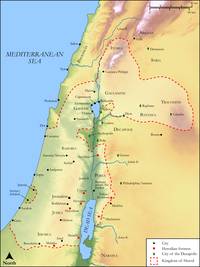 The Kingdom of Herod the Great
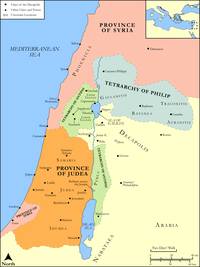 The Land Divided after Herod