to leave I return, retire, withdraw, depart (underlying idea perhaps of taking refuge from danger or of going into retirement). ἀνα-χωρέω, -ῶ, [in LXX for בּרח, נוּם, etc.;] to go back. to withdraw: Mt 9:24; freq. in sense of avoiding danger (MM, VGT, s.v.), Mt 2:12 (but v. Thayer), 13, 14, 22 4:12 12:15 14:13 15:21 27:5, Mk 3:7, Jo 6:15, Ac 23:19 26:31.† Scroll for more
then A weak adversative particle, generally placed second in its clause; but, on the other hand, and. δέ (before vowels δ’; on the general neglect of the elision in NT, v. WH, App., 146; Tdf., Pr., 96), post-positive conjunctive particle; copulative, but, in the next place, and, now (Abbott, JG, 104): Mt 1:2 ff., II Co 6:15, 16, II Pe 1:5-7; in repetition for emphasis, Ro 3:21, 22, 9:30, I Co 2:6, Ga 2:2, Phl 2:8; in transition to something new, Mt 1:18 2:19, Lk 13:1, Jo 7:14, Ac 6:1, Ro 8:28, I Co 7:1 8:1, al.; in explanatory parenthesis or addition, Jo 3:19, Ro 5:8, I Co 1:12, Eph 2:4 5:32, al.; ὡς δέ, Jo 2:9; καὶ... δέ, but also, Mt 10:18, Lk 1:76, Jo 6:51, Ro 11:23, al.; καὶ ἐὰν δέ, yea even if, Jo 8:16. Adversative, but, on the other hand, prop., answering to a foregoing μέν (q.v.), and distinguishing a word or clause from one preceding (in NT most freq. without μέν; Bl., §77, 12): ἐὰν δέ, Mt 6:14, 23, al.; ἐγὼ ( σὺ, etc.) δέ, Mt 5:22 6:6, Mk 8:29, al.; ὁ δέ, αὐτὸς δέ, Mk 1:45, Lk 4:40, al.; after a negation, Mt 6:19, 20, Ro 3:4, I Th 5:21, al. Scroll for more
it/s/he He, she, it, they, them, same. αὐτός, -ή, -ό, determinative pron., in late Gk. much more freq. than in cl. (WM, 178 f.; Jannaris, HGG, §1399). Emphatic (so always in nom. exc. when preceded by the art., v. infr., iii); self ( ipse ), expressing opposition, distinction, exclusion, etc., αὐ. ἐκχυθήσεται, Lk 5:37; αὐ. ἐγινώσκεν, Jo 2:25; αὐ. ὑμεῖς, Jo 3:28; καὶ αὐ. ἐγώ, Ro 15:14; αὐ. Ἰησοῦς, Jo 2:24; αὐ. καὶ οἱ μετ’ αὐτοῦ, Mk 2:25; ὑμεῖς αὐ., Mk 6:31; esp. (as freq in cl.) αὐ. ὁ, Mt 3:4, Mk 6:17, Jo 16:27, I Th 3:11, al.; in late Gk., sometimes weakened, ἐν αὐτῇ τ. ὥρᾳ, in that hour, Lk 10:21 (M, Pr., 91; MM, s.v.); emphatic, he, she, it (M, Pr., 86; Bl., § 48, 1, 2, 7), Mt 1:21 12:50, Lk 6:35, al.; pointing to some one as master (cl.), Mt 8:24, Mk 4:38, al.; αὐ., καὶ αὐ. = οὗτος, ὁ δε (Bl., § 48, 1), Mt 14:2, Mk 14:15, 44, Lk 1:22 2:28, al. In oblique cases (cl.), for the simple pron. of 3rd pers., he, she, it, Mt 7:9, 10:12, 26:44, al.; with ptcp. in gen. absol., Mt 9:18, Mk 13:1, al. (for irreg. constructions, V. Bl., § 74, 5); pleonastically after the relative (cf. Heb. אֲשֶׁר לֹו; WM, 184 ff.; Bl., § 50, 4; MM, s.v.), Mk 7:25, Re 3:8, 7:2, al.; in constr. ad sensum, without proper subject expressly indicated, Mt 4:23, Ac 8:5, II Co 2:13, al.; gen. αὐτοῦ = ἐκείνου, Ro 11:11, I Th 2:19, Tit 3:5, He 2:4. ὁ, ἡ, τὸ αὐ., the same: He 1:12, 13:8; τὸ αὐ., ποιεῖν, Mt 5:46, 47, al.; φρονεῖν, Ro 12:16 15:5, Phl 2:2, al.; τὰ αὐ., Ac 15:27, Ro 2:1, al.; κατὰ τὸ ( τὰ ) αὐ. (MM, s.v.), Ac 14:1, Lk 6:23, al.; ἐπὶ τὸ αὐ., together (MM, s.v.), Mt 22:34, Ac 1:15, al.; ἓν κ. τὸ αὐ., I Co 11:5, 12:11; c. dat. (cl.), I Co 11:5; with a noun, λόγος, Mk 14:39; μέτρος, Phl 1:30; πνεῦμα, I Co 12:4. Scroll for more
look! See! Lo! Behold! Look!. ἰδού, [in LXX chiefly for הִנֵּה,] prop. imperat. 2 aor. mid. of ὁράω, used as a demonstrative particle, with frequency much greater in LXX and NT than in cl. (v. M, Pr., 11), lo, behold, see: Mt 10:16 11:8 13:3, Mk 3:32, Lk 2:48, I Co 15:51, Ja 5:9, Ju 14, Re 1:7, al.; after gen. absol., Mt 1:20 2:1, 13 12:46, al.; καὶ ἰδού, Mt 2:9 (and freq.), Lk 1:20 10:25, Ac 12:7, al.; in elliptical sentences, taking the place of copula or predicate (like הִנֵּה in Heb.), Mt 3:17, Lk 5:12 22:31, 47, Ac 8:27, 36 al. Scroll for more
angel A messenger, generally a (supernatural) messenger from God, an angel, conveying news or behests from God to men. ἄγγελος, -ου, ὁ, [in LXX chiefly for מַלְאָךְ;] a messenger, one sent: Mt 11:10, Ja 22:25. As in LXX, in the special sense of angel, a spiritual, heavenly being, attendant upon God and employed as his messenger to men, to make known his purposes, as Lk 1:11, or to execute them, as Mt 4:6. The ἄ. in Re 1:20 2:1, al., is variously understood as a messenger or delegate, a bishop or ruler, a guardian angel, the prevailing spirit of each church, i.e. the Church itself. (Cf. Swete, Ap )., in l.; DB, iv, 991; Thayer, s.v.; Cremer, 18; MM, VGT, s.v.) Scroll for more
lord: God Lord, master, sir; the Lord. κύριος, -α, -ον (also -ος, -ον ), [in LXX (subst.) chiefly for יהוה, also for אָדוֹן, בַּעַל, etc.;] having power ( κῦρος ) or authority; as subst., ὁ κ., lord, master; in general: c. gen. rei, Mt 9:38 20:8, Mk 12:9 13:35, Lk 19:33; τ. σαββάτου, Mt 12:8, Mk 2:28, Lk 6:5; c. gen. pers., δούλου, etc., Mt 10:24, Lk 14:21, Ac 16:16, al.; absol., opp. to οἱ δοῦλοι, Eph 6:5, 9, al.; of the Emperor (Deiss., LAE, 161), Ac 25:26; θεοὶ πολλοὶ καὶ κ. πολλοί, I Co 8:5; of a husband, I Pe 3:6; in voc., as a title of respect to masters, teachers, magistrates, etc., Mt 13:27 16:22 27:63, Mk 7:28, Lk 5:12, Jo 4:11, Ac 9:5, al. As a divine title (freq. in π.; Deiss., LAE, 353 ff.); in NT, of God: ὁ κ., Mt 5:33, Mk 5:19, Lk 1:6, Ac 7:33, He 8:2, Ja 4:15, al.; anarth. (Bl., § 46, 6), Mt 21:9, Mk 13:20, Lk 1:17, He 7:21, I Pe 1:25, al.; κ. τ. οὐρανοῦ καὶ τ. γῆς, Mt 11:25; τ. κυριευόντων, I Ti 6:15; κ. ὁ θεός, Mt 4:7, 10 al.; id. seq. ὁ παντοκράτωρ, Re 4:8; κ. σαβαώθ, Ro 9:29; ( ὁ ) ἄγγελος κυρίου, Mt 1:20 2:13, Lk 1:11, al.; πνεῦμα κυρίου, Lk 4:18, Ac 8:39; of the Christ: Mt 21:3, Mk 11:3, Lk 1:43 20:44, al.; of Jesus after his resurrection (Dalman, Words, 330), Ac 10:36, Ro 14:8, I Co 7:22, Eph 4:5, al.; ὁ κ. μου, Jo 20:28; ὁ κ. Ἰησοῦς, Ac 1:21, I Co 11:23, al.; id. seq. Χριστός, Eph 1:2, al.; ὁ κ. ἡμῶν, I Ti 1:14, He 7:14, al.; id. seq. Ἰησοῦς, I Th 3:11, He 13:20, al.; Χριστός, Ro 16:18; Ἰ Χ., I Co 1:2, I Th 1:3, al.; Ἰ. Χ. ( Χ. Ἰ ) ὁ κ. ( ἡμῶν ), Ro 1:4, Col 2:6, Eph 3:11, al.; ὁ κ. καὶ ὁ σωτὴρ, II Pe 3:2; id. seq. Ἰ. Χ., II Pe 3:18; anarth., I Co 7:22, 25, Ja 5:4, al.; κ. κυρίων, Re 19:16; c. prep., ἀπὸ ( κατὰ, πρὸς, σὺν, etc.) κ., Col 3:24, al. SYN: v.s. δεσπότης. Scroll for more
to shine/appear (a) act: I shine, shed light, (b) pass: I shine, become visible, appear, (c) I become clear, appear, seem, show myself as. φαίνω [in LXX for אור hi., ראה ni., etc.;] Act., to bring to light, cause to appear (so most freq. in cl.). Absol., to give light, shine (Hom., Plat., al.): Jo 1:5 5:35, II Pe 1:19, I Jn 2:8, Re 1:16 8:12 18:23 21:23. Pass., to come to light, appear, be manifest: Mt 2:7 13:26 24:27, 30, Lk 9:8, Phl 2:15, He 11:3, I Pe 4:18 (LXX); opp. to ἀφανίζεσθαι, Ja 4:14; c. dat. pers. (Bl. § 54, 4), Mt 1:20 2:13, 19, Mk 16:9; c. nom. pred., Mt 23:27, 28, Ro 7:13, II Co 13:7; id. c. dat. pers., Mt 6:5, 16, 18 (seq. nom. ptcp., but not as in cl.; v. Bl., § 73, 4); impers., Mt 9:33; of the mind and judgment (= δοκεῖ, q.v.), Mk 14:64 (cf. I Es 2:21 ), Lk 24:11.† SYN.: v.s. δοκέω Scroll for more
according to Gen: against, down from, throughout, by; acc: over against, among, daily, day-by-day, each day, according to, by way of. κατά (bef. a vowel κατ’, καθ’; on the freq. neglect of elision, v. Tdf., Pr., 95; WH, App., 146 a ), prep. c. gen., acc., down, downwards. C. gen. (WM, § 47, k; Bl., § 42, 2). C. gen. rei, in local sense; down, down from: Mt 8:32, Mk 5:13, Lk 8:33, I Co 11:4; throughout (late usage; Bl., § 42, 2): κ. ὅλης κ.τ.λ., Lk 4:14 23:5, Ac 9:31 10:37; in a peculiar adjectival phrase: ἡ κ. βάθους πτωχεία, deep or extreme poverty, II Co 8:2. C. gen. pers., usually in hostile sense; against (in cl. only after verbs of speaking, witnessing, etc.): opp. to ὑπέρ, Mk 9:40; μετά, Mt 12:30; after ἐπιθυμεῖν, Ga 5:17; λαλεῖν, Ac 6:13; διδάσκειν, Ac 21:28; ψεύδεσθαι, Ja 3:14; after verbs of accusing, etc., Mt 5:23, Lk 23:14, Ro 8:33, al.; verbs of fighting, prevailing, etc., Mt 10:35, Ac 14:2, I Co 4:6, al.; of swearing, by: ὄμνυμι κ. (Bl., § 34, 1), He 6:13, 16, cf. Mt 26:63. C. acc. (WM, § 49 d; Bl., § 42, 2). Of motion or direction; through, throughout: Lk 8:39 9:6 10:4, Ac 8:1, 36, al.; to, towards, over against: Lk 10:32 (Field, Notes, 62), Ac 2:10 16:7, Ga 2:11, Phl 3:14, al.; in adverbial phrases, at, in, by, of: κατ’ οἶκον, at home, Ac 2:46; κατ’ ἰδίαν (v.s. ἴδιος ); καθ’ ἑαυτόν, Ac 28:16, Ro 14:22, Ja 2:17; c. pron. pers., Ac 17:28 18:15, Ro 1:15, Eph 1:15, al. Of time, at, during, about: Ac 8:26 12:1 19:23, Ro 9:9, He 1:10, al. Distributive; of place: κ. τόποὐς, Mt 24:7, al.; κ. πόλιν, Lk 8:1, 4, al.; κ. ἐκκλησίαν, Ac 14:23; of time: κ. ἔτος, Lk 2:41; ἑορτήν, Mt 27:15, al.; of numbers, etc.: καθ’ ἕνα πάντες, I Co 14:31 (on καθ’ εἷς, v.s. εἷς ); κ. ἑκατόν, Mk 6:40; κ. μέρος, He 9:5; κ. ὄνομα, Jo 10:3. Of fitness, reference, conformity, etc.; in relation to, concerning: Ro 1:3, 4 7:22 9:3, 5, I Co 1:26 10:18, Phl 1:12; κ. πάντα, Ac 17:22, Col 3:20, 22, He 2:17 4:15; according to, after, like: Mk 7:5, Lk 2:27, 29, Jo 7:24, Ro 8:4 14:15, Eph 2:2, Col 2:8, Ja 2:8, al. In composition, κ. denotes, down, down from ( καταβαίνω, etc.), hence, metaph.; victory or rule over ( καταδουλόω, -κυριεύω, etc.); "perfective" action (M, Pr., 111 ff.). under ( κατακαλύπτω, etc.). in succession ( καθεξῆς ). after, behind ( καταλείπω ). Hostility, against ( καταλαλέω ). Scroll for more
dream A dream. * ὄναρ, τό, indecl., used only in nom, and acc. sing. (the other cases are supplied by ὄνειρος ), a dream: κατ’ ὄ. (in later writers only), in a dream, Mt 1:20 2:12, 13, 19, 22 27:19.† Scroll for more
the/this/who The, the definite article. ὁ, ἡ, τό, the prepositive article ( ἄρθρον προτακτικόν ), originally a demonstr. pron. (so usually in Hom.), in general corresponding to the Eng. definite article. As demonstr. pron. As freq. in Hom., absol., he ( she, it ), his (etc.): Ac 17:28 (quoted from the poet Aratus). Distributive, ὁ μὲν... ὁ δέ, the one... the other: I Co 7:7, Ga 4:22; pl., Ac 14:4, 17:32, Phl 1:16, al.; οἱ μὲν... ἄλλοι δέ, Mt 16:14, Jo 7:12; οἱ μεν̀... ὁ δέ, He 7:21, 23. In narration (without ὁ μὲν preceding), ὁ δέ, but he: Mt 2:14, Mk 1:45, Lk 8:21, Jo 9:38, al. mult. As prepositive article, the, prefixed, to nouns unmodified: ὁ θεός, τὸ φῶς, etc.; to abstract nouns, ἡ σοφία, etc., to pl. nouns which indicate a class, οἱ ἀλώπεκες, foxes, Mt 8:20, al.; to an individual as representing a class, ὁ ἐργάτης, Lk 10:7; c. nom. = voc. in addresses, Mt 11:26, Jo 19:3, Ja 5:1, al.; to things which pertain to one, ἡ χεῖρ, his hand, Mk 3:1; to names of persons well known or already mentioned; usually to names of countries (originally adjectives), ἡ Ἰουδαία, etc. To modified nouns: c. pers. pron. gen., μοῦ, σοῦ, etc.; c. poss. pron., ἐμός, σός, etc.; c. adj. between the art. and the noun, ὁ ἀγαθὸς ἄνθρωπος, Mt 12:35; the noun foll. by adj., both c. art., ὁ ποιμὴν ὁ καλός, Jo 10:11 (on ὁ ὄχλος πολύς, Jo 12:9, v. M, Pr., 84); before adjectival phrases, ἡ κατ’ ἐκλογὴν πρόθεσις, Ro 9:11. To Other parts of speech used as substantives; neuter adjectives: τ. ἀγαθόν, etc.; cardinal numerals: ὁ εἶς, οἷ δύο, etc.; participles: ὁ βαπτίζων (= ὁ Βαπτιστής, Mt 14:2 ), Mk 6:14; πᾶς ὁ, c. ptcp., every one who, etc.; adverbs: τὸ πέραν, τὰ νῦν, ὁ ἔσω ἄνθρωπος; infinitives: nom., τὸ θέλειν, Ro 7:18, al.; gen., τοῦ, after adjectives, ἄξιον τοῦ πορεύεσθαι, I Co 16:4; verbs, ἔλαχεν τοῦ θυμιᾶσαι, Lk 1:9; and freq. in a final sense, ἐξῆλθεν ὁ σπείρειν, Mt 13:3 (on the artic. inf., v. Bl., § 71). In the neut. to sentences, phrases or single words treated as a quotation: τὸ Ἐι δύνῃ, Mk 9:23; τὸ ἔτι ἅπαξ, He 12:27; τὸ ἀνέβη, Eph 4:9, al. To prepositional phrases: οἱ ἀπὸ Ἰταλίας, He 13:24; οἱ ἐκ νόμου, Ro 4:14; neut. acc. absol., in adverbial phrases, τὸ καθ’ ἡμέραν, daily, Lk 11:3; τὸ κατὰ σάρκα, as regards the flesh, Ro 9:5. To nouns in the genitive, denoting kinship, association, etc.: ὁ τοῦ, the son of (unless context indicates a different relationship), Mt 10:2, al.; τὰ τοῦ θεοῦ, the things that pertain to God, Mt 16:23; τὰ τῆς εἰρήνης, Ro 14:19 (cf. M, Pr., 81 ff.; Bl, §§ 46, 47). Scroll for more
Joseph Joseph, a proper name. Ἰωσήφ, indecl. (FlJ, Ἰώσηπος, -ου ), ὁ (Heb. יוֹסֵף ), Joseph; the Son of Jacob: Jo 4:5, Ac 7:9, 13, 14, 18, He 11:21, 22, Re 7:8. In the genealogy of our Lord, the son of Matthias: Lk 3:24; the son Joram: Lk 3:30. The husband of Mary, the Lord's mother: Mt 1:16 ff., Lk 1:27, Jo 1:46, al. One of the brethren of our Lord (v.s. ἀδελφός ): Mt 13:55. Son of Mary: Mt 27:56 ( -σῆς, WH, mg., RV). Joseph of Arimatbæa: Mt 27:57, 59, Mk 15:43, 45, Lk 23:50, Jo 19:38. v.s. Βαρνάβας. v.s. Βαρσαβᾶς. Scroll for more
to say (denoting speech in progress), (a) I say, speak; I mean, mention, tell, (b) I call, name, especially in the pass., (c) I tell, command. λέγω, [in LXX very freq., chiefly for אמר; λέγει for נְאֻם, Ge 22:16, al.;] in Hom., to pick out, gather, reckon, recount. In Hdt. and Att., to say, speak, affirm, declare: absol., Ac 13:15 24:10; seq. orat. dir., Mt 9:34, Mk 3:11, Jo 1:29, al.; seq. ὅτι recit., Mk 3:21, Lk 1:24, Jo 6:14, al.; acc. et. inf., Lk 11:18, Jo 12:29, al.; after another verb of speaking, προσφωνεῖν κ. λέγειν, Mt 11:17, al.; ἀπεκρίθη ( ἐλάλησεν ) λέγων ( καὶ λέγει; Dalman, Words, 24 ff.), Mt 25:9, Mk 3:33, 7:28, Lk 24:6, 7, al.; of unspoken thought, λ. ἐν ἑαυτῷ, Mt 3:9, Lk 3:8, al.; of writing, II Co 8:8, Phl 4:11, al.; λέγει ἡ γραφή, Ro 4:3, Ja 2:23, al.; c. acc. rei, Lk 8:8 9:33, Jo 5:34, al.; σὺ λέγεις (a non-committal phrase; Swete, Mk., 359, 369 f.), Mt 27:11, Mk 15:2, Lk 23:3, Jo 18:37; c. dat. pers., seq. orat. dir., Mt 8:20, Mk 2:17, al. mult.; id. seq. ὅτι, Mt 3:9, al.; c. prep., πρός, μετά, περί, etc., Mk 4:41, Jo 11:56, He 9:5, al.; to mean (cl.), Mk 14:71, Jo 6:71, I Co 10:29, al.; to call, name, Mk 10:18; pass., Mt 9:9, Mk 15:7, al (cf. ἀντι-, δια- ( -μαι ), προ-, συλ-λέγω ). SYN.: λαλέω, which refers to the utterance, as λέγω to the meaning of what is said, its correspondence with thought (Tr., Syn., Ixxvi; Thayer, s.v. λαλέω ). Scroll for more
to arise (a) I wake, arouse, (b) I raise up. ἐγείρω, [in LXX for קוּם, etc.;] trans. (imperat. ἔγειρε used intransitively, Mt 9:5, Mk 2:11, al.); to awaken, arouse from sleep: Mk 4:38, Ac 12:7; metaph., of spiritual awakening, Ro 13:11 (pass.), Eph 5:14; pass., to be aroused, wake up: Mt 25:7, Mk 4:27; ἀπὸ τ. ὕπνου, Mt 1:24. Freq. in NT, to raise from the dead: νεκρούς, Jo 5:21, Ac 26:8, II Co 1:9; ἐκ νεκρῶν, Jo 12:1, Ac 3:15, Ro 8:11, al.; pass., rise from death: Mt 11:5, Lk 7:22, Jo 2:22, Ro 6:9, al.; ἀπὸ τ. νεκρῶν, Mt 14:2, al. In late Gk., to raise, from sitting, lying, sickness; mid. and pass., to rise: Mt 9:5, 7, Mk 1:31 9:27 10:49, al.; redundant, like Heb. קוּם, Mt 2:15 9:19, Re 11:1 (v. Dalman, 23f.); to raise up, cause to appear: Ac 13:22 (cf. Jg 2:18 ); τέκνα, Mt 3:9; pass., to appear: Mt 11:11, Mk 13:22, al. to rouse, stir up; pass., to rise against: Mt 24:7, Mk 13:8. Of buildings, to raise: τ. ναόν, Jo 2:19, 20 (cf. De 16:22, Si 49:13 ); (cf. δι-, ἐξ-, ἐπ-, συν-εγείρω, and V. Cremer, 224). Scroll for more
to take I take from, receive from, or: I take to, receive (apparently not used of money), admit, acknowledge; I take with me. παρα-λαμβάνω, [in LXX chiefly for לקח, also for ירשׁ, etc.;] c. acc. rei, like παραδέχομαι, correl. to παραδίδωμι, to receive from another: Col 4:17, He 12:28; of the mind, I Co 11:23 15:1, 3, Ga 1:9, Phl 4:9; c. inf., Mk 7:4; seq. παρά, c. gen., Ga 1:12, I Th 2:13 4:1, II Th 3:6; τ. Χριστόν (Lft., in l.), Col 2:6. C. acc. pers., to take to or with oneself: Mt 2:13, 14, 20, 21 17:1 26:37, Mk 4:36 5:40 9:2 10:32, Lk 9:10, 28 11:26 18:31 Jo 19:16, Ac 15:39 23:18; γυναῖκα, Mt 1:20, 24; μεθ’ ἑαυτοῦ, Mt 12:45 18:16, Mk 14:33; seq. εἰς, Mt 4:5, 8 27:27; κατ’ ἰδίαν, Mt 20:17; mid., seq. πρὸς ἐμαυτόν, Jo 14:3; pass., Mt 24:40, 41, Lk 17:34-36; ptcp., prefixed to other verbs (Bl, § 74, 2), Ac 16:33 21:24, 26, 32; metaph., Jo 1:11.† Scroll for more
the/this/who The, the definite article. ὁ, ἡ, τό, the prepositive article ( ἄρθρον προτακτικόν ), originally a demonstr. pron. (so usually in Hom.), in general corresponding to the Eng. definite article. As demonstr. pron. As freq. in Hom., absol., he ( she, it ), his (etc.): Ac 17:28 (quoted from the poet Aratus). Distributive, ὁ μὲν... ὁ δέ, the one... the other: I Co 7:7, Ga 4:22; pl., Ac 14:4, 17:32, Phl 1:16, al.; οἱ μὲν... ἄλλοι δέ, Mt 16:14, Jo 7:12; οἱ μεν̀... ὁ δέ, He 7:21, 23. In narration (without ὁ μὲν preceding), ὁ δέ, but he: Mt 2:14, Mk 1:45, Lk 8:21, Jo 9:38, al. mult. As prepositive article, the, prefixed, to nouns unmodified: ὁ θεός, τὸ φῶς, etc.; to abstract nouns, ἡ σοφία, etc., to pl. nouns which indicate a class, οἱ ἀλώπεκες, foxes, Mt 8:20, al.; to an individual as representing a class, ὁ ἐργάτης, Lk 10:7; c. nom. = voc. in addresses, Mt 11:26, Jo 19:3, Ja 5:1, al.; to things which pertain to one, ἡ χεῖρ, his hand, Mk 3:1; to names of persons well known or already mentioned; usually to names of countries (originally adjectives), ἡ Ἰουδαία, etc. To modified nouns: c. pers. pron. gen., μοῦ, σοῦ, etc.; c. poss. pron., ἐμός, σός, etc.; c. adj. between the art. and the noun, ὁ ἀγαθὸς ἄνθρωπος, Mt 12:35; the noun foll. by adj., both c. art., ὁ ποιμὴν ὁ καλός, Jo 10:11 (on ὁ ὄχλος πολύς, Jo 12:9, v. M, Pr., 84); before adjectival phrases, ἡ κατ’ ἐκλογὴν πρόθεσις, Ro 9:11. To Other parts of speech used as substantives; neuter adjectives: τ. ἀγαθόν, etc.; cardinal numerals: ὁ εἶς, οἷ δύο, etc.; participles: ὁ βαπτίζων (= ὁ Βαπτιστής, Mt 14:2 ), Mk 6:14; πᾶς ὁ, c. ptcp., every one who, etc.; adverbs: τὸ πέραν, τὰ νῦν, ὁ ἔσω ἄνθρωπος; infinitives: nom., τὸ θέλειν, Ro 7:18, al.; gen., τοῦ, after adjectives, ἄξιον τοῦ πορεύεσθαι, I Co 16:4; verbs, ἔλαχεν τοῦ θυμιᾶσαι, Lk 1:9; and freq. in a final sense, ἐξῆλθεν ὁ σπείρειν, Mt 13:3 (on the artic. inf., v. Bl., § 71). In the neut. to sentences, phrases or single words treated as a quotation: τὸ Ἐι δύνῃ, Mk 9:23; τὸ ἔτι ἅπαξ, He 12:27; τὸ ἀνέβη, Eph 4:9, al. To prepositional phrases: οἱ ἀπὸ Ἰταλίας, He 13:24; οἱ ἐκ νόμου, Ro 4:14; neut. acc. absol., in adverbial phrases, τὸ καθ’ ἡμέραν, daily, Lk 11:3; τὸ κατὰ σάρκα, as regards the flesh, Ro 9:5. To nouns in the genitive, denoting kinship, association, etc.: ὁ τοῦ, the son of (unless context indicates a different relationship), Mt 10:2, al.; τὰ τοῦ θεοῦ, the things that pertain to God, Mt 16:23; τὰ τῆς εἰρήνης, Ro 14:19 (cf. M, Pr., 81 ff.; Bl, §§ 46, 47). Scroll for more
child A little child, an infant, little one. παιδίον, -ου, τό, dimin, of παῖς, [in LXX chiefly for יֶלֶד, also for נַעַר, בֵּן, etc., freq. in To in ref. to full-grown youth;] a young child, a little one: Mt 2:8, 9, 11, ff., Lk 1:59, 66, 76, 80 2:17, 27, 40, Jo 16:21, He 11:23; of older children, Mt 18:2, 4, 5, Mk 5:39-41 7:30 9:24, 36, Lk 9:47, 48 18:17, Jo 4:49; in pl., Mt 11:16 14:21 15:38 18:3 19:13, 14, Mk 7:28 10:13 ff., Lk 7:32 11:7 18:16, He 2:13, 14 Metaph., I Co 14:20. Colloq. in familiar address (as Eng. colloq., "lads"—v. M, Pr., 170 n —and Irish use of "boys"): Jo 21:5, I Jn 2:13, 18 3:7.† SYN.: v.s. παῖς. Scroll for more
and And, even, also, namely. καί, conj., and. Copulative. Connecting single words; in general: Mt 2:18 16:1, Mk 2:15, Lk 8:15, He 1:1, al. mult.; repeated before each of the terms in a series, Mt 23:23, Lk 14:21, Ro 7:12 9:4, al.; connecting numerals (WM, § 37, 4): Jo 2:20, Ac 13:20; joining terms which are not mutually exclusive, as the part with the whole: Mt 8:33 26:59, Mk 16:17, Ac 5:29, al. Connecting clauses and sentences: Mt 3:12, Ac 5:21, al. mult.; esp. where, after the simplicity of the popular language, sentences are paratactically joined (WM, § 60, 3; M, Pr., 12; Deiss., LAE, 128 ff.): Mt 1:21 7:25, Mk 9:5, Jo 10:3, al.; joining affirmative to negative sentences: Lk 3:14, Jo 4:11, III Jo 10; consecutive, and so: Mt 5:15 23:32, He 3:19, al.; after imperatives, Mt 4:19, Lk 7:7, al.; = καίτοι, and yet: Mt 3:14 6:26, Mk 12:12, Lk 18:7 (Field, Notes, 72), I Co 5:2, al.; beginning an apodosis (= Heb. וְ; so sometimes δέ in cl.), then: Lk 2:21 7:12, Ac 1:10; beginning a question (WM, § 53, 3a): Mk 10:26, Lk 10:29, Jo 9:36. Epexegetic, and, and indeed, namely (WM, § 53, 3c): Lk 3:18, Jo 1:16, Ac 23:6, Ro 1:5, I Co 3:5, al. In transition: Mt 4:23, Mk 5:1, 21, Jo 1:19, al.; so, Hebraistically, καὶ ἐγένετο ( וַיְהִי; also ἐγένετο δέ ), Mk 1:9 (cf. Lk 5:1; V. Burton, §§ 357-60; M, Pr., 14, 16). καὶ... καί, both... and (for τε... καί, v.s. τε ); connecting single words: Mt 10:28, Mk 4:41, Ro 11:33, al.; clauses and sentences: Mk 9:13, Jo 7:28, I Co 1:22, al. Adjunctive, also, even, still: Mt 5:39, 40, Mk 2:28, al. mult.; esp. c. pron., adv., etc., Mt 20:4, Jo 7:47, al; ὡς κ., Ac 11:17; καθὼς κ., Ro 15:7; οὕτω κ., Ro 6:11; διὸ κ., Lk 1:35; ὁ κ. (Deiss., BS, 313ff.), Ac 13:9; pleonastically, μετὰ κ.. (Bl., §77, 7; Deiss., BS, 265 f,), Phl 4:3; τί κ., 1 Co 15:29; ἀλλὰ κ., Lk 14:22, Jo 5:18, al.; καίγε (M, Pr., 230; Burton, § 437), Ac 17:27; καίπερ, He 5:8; κ. ἐάν, v.s. ἐάν. Scroll for more
the/this/who The, the definite article. ὁ, ἡ, τό, the prepositive article ( ἄρθρον προτακτικόν ), originally a demonstr. pron. (so usually in Hom.), in general corresponding to the Eng. definite article. As demonstr. pron. As freq. in Hom., absol., he ( she, it ), his (etc.): Ac 17:28 (quoted from the poet Aratus). Distributive, ὁ μὲν... ὁ δέ, the one... the other: I Co 7:7, Ga 4:22; pl., Ac 14:4, 17:32, Phl 1:16, al.; οἱ μὲν... ἄλλοι δέ, Mt 16:14, Jo 7:12; οἱ μεν̀... ὁ δέ, He 7:21, 23. In narration (without ὁ μὲν preceding), ὁ δέ, but he: Mt 2:14, Mk 1:45, Lk 8:21, Jo 9:38, al. mult. As prepositive article, the, prefixed, to nouns unmodified: ὁ θεός, τὸ φῶς, etc.; to abstract nouns, ἡ σοφία, etc., to pl. nouns which indicate a class, οἱ ἀλώπεκες, foxes, Mt 8:20, al.; to an individual as representing a class, ὁ ἐργάτης, Lk 10:7; c. nom. = voc. in addresses, Mt 11:26, Jo 19:3, Ja 5:1, al.; to things which pertain to one, ἡ χεῖρ, his hand, Mk 3:1; to names of persons well known or already mentioned; usually to names of countries (originally adjectives), ἡ Ἰουδαία, etc. To modified nouns: c. pers. pron. gen., μοῦ, σοῦ, etc.; c. poss. pron., ἐμός, σός, etc.; c. adj. between the art. and the noun, ὁ ἀγαθὸς ἄνθρωπος, Mt 12:35; the noun foll. by adj., both c. art., ὁ ποιμὴν ὁ καλός, Jo 10:11 (on ὁ ὄχλος πολύς, Jo 12:9, v. M, Pr., 84); before adjectival phrases, ἡ κατ’ ἐκλογὴν πρόθεσις, Ro 9:11. To Other parts of speech used as substantives; neuter adjectives: τ. ἀγαθόν, etc.; cardinal numerals: ὁ εἶς, οἷ δύο, etc.; participles: ὁ βαπτίζων (= ὁ Βαπτιστής, Mt 14:2 ), Mk 6:14; πᾶς ὁ, c. ptcp., every one who, etc.; adverbs: τὸ πέραν, τὰ νῦν, ὁ ἔσω ἄνθρωπος; infinitives: nom., τὸ θέλειν, Ro 7:18, al.; gen., τοῦ, after adjectives, ἄξιον τοῦ πορεύεσθαι, I Co 16:4; verbs, ἔλαχεν τοῦ θυμιᾶσαι, Lk 1:9; and freq. in a final sense, ἐξῆλθεν ὁ σπείρειν, Mt 13:3 (on the artic. inf., v. Bl., § 71). In the neut. to sentences, phrases or single words treated as a quotation: τὸ Ἐι δύνῃ, Mk 9:23; τὸ ἔτι ἅπαξ, He 12:27; τὸ ἀνέβη, Eph 4:9, al. To prepositional phrases: οἱ ἀπὸ Ἰταλίας, He 13:24; οἱ ἐκ νόμου, Ro 4:14; neut. acc. absol., in adverbial phrases, τὸ καθ’ ἡμέραν, daily, Lk 11:3; τὸ κατὰ σάρκα, as regards the flesh, Ro 9:5. To nouns in the genitive, denoting kinship, association, etc.: ὁ τοῦ, the son of (unless context indicates a different relationship), Mt 10:2, al.; τὰ τοῦ θεοῦ, the things that pertain to God, Mt 16:23; τὰ τῆς εἰρήνης, Ro 14:19 (cf. M, Pr., 81 ff.; Bl, §§ 46, 47). Scroll for more
mother A mother. μήτηρ, gen., μητρός, ἡ, [in LXX chiefly for אֵם;] mother: Mt 1:18 2:11, al.; fig., of one who takes the place of a mother, ἰδοὺ, ἡ μ. μου, Mt 12:49 (cf. Mt 12:50, Mk 3:35, Jo 19:27, Ro 16:13, I Ti 5:2 ); of a city, ἥτις ἐσὶν μ. ἡμῶν, Ga 4:26; symbolically of Babylon, ἡ μ. τ. πορνῶν, Re 17:5. Scroll for more
it/s/he He, she, it, they, them, same. αὐτός, -ή, -ό, determinative pron., in late Gk. much more freq. than in cl. (WM, 178 f.; Jannaris, HGG, §1399). Emphatic (so always in nom. exc. when preceded by the art., v. infr., iii); self ( ipse ), expressing opposition, distinction, exclusion, etc., αὐ. ἐκχυθήσεται, Lk 5:37; αὐ. ἐγινώσκεν, Jo 2:25; αὐ. ὑμεῖς, Jo 3:28; καὶ αὐ. ἐγώ, Ro 15:14; αὐ. Ἰησοῦς, Jo 2:24; αὐ. καὶ οἱ μετ’ αὐτοῦ, Mk 2:25; ὑμεῖς αὐ., Mk 6:31; esp. (as freq in cl.) αὐ. ὁ, Mt 3:4, Mk 6:17, Jo 16:27, I Th 3:11, al.; in late Gk., sometimes weakened, ἐν αὐτῇ τ. ὥρᾳ, in that hour, Lk 10:21 (M, Pr., 91; MM, s.v.); emphatic, he, she, it (M, Pr., 86; Bl., § 48, 1, 2, 7), Mt 1:21 12:50, Lk 6:35, al.; pointing to some one as master (cl.), Mt 8:24, Mk 4:38, al.; αὐ., καὶ αὐ. = οὗτος, ὁ δε (Bl., § 48, 1), Mt 14:2, Mk 14:15, 44, Lk 1:22 2:28, al. In oblique cases (cl.), for the simple pron. of 3rd pers., he, she, it, Mt 7:9, 10:12, 26:44, al.; with ptcp. in gen. absol., Mt 9:18, Mk 13:1, al. (for irreg. constructions, V. Bl., § 74, 5); pleonastically after the relative (cf. Heb. אֲשֶׁר לֹו; WM, 184 ff.; Bl., § 50, 4; MM, s.v.), Mk 7:25, Re 3:8, 7:2, al.; in constr. ad sensum, without proper subject expressly indicated, Mt 4:23, Ac 8:5, II Co 2:13, al.; gen. αὐτοῦ = ἐκείνου, Ro 11:11, I Th 2:19, Tit 3:5, He 2:4. ὁ, ἡ, τὸ αὐ., the same: He 1:12, 13:8; τὸ αὐ., ποιεῖν, Mt 5:46, 47, al.; φρονεῖν, Ro 12:16 15:5, Phl 2:2, al.; τὰ αὐ., Ac 15:27, Ro 2:1, al.; κατὰ τὸ ( τὰ ) αὐ. (MM, s.v.), Ac 14:1, Lk 6:23, al.; ἐπὶ τὸ αὐ., together (MM, s.v.), Mt 22:34, Ac 1:15, al.; ἓν κ. τὸ αὐ., I Co 11:5, 12:11; c. dat. (cl.), I Co 11:5; with a noun, λόγος, Mk 14:39; μέτρος, Phl 1:30; πνεῦμα, I Co 12:4. Scroll for more
and And, even, also, namely. καί, conj., and. Copulative. Connecting single words; in general: Mt 2:18 16:1, Mk 2:15, Lk 8:15, He 1:1, al. mult.; repeated before each of the terms in a series, Mt 23:23, Lk 14:21, Ro 7:12 9:4, al.; connecting numerals (WM, § 37, 4): Jo 2:20, Ac 13:20; joining terms which are not mutually exclusive, as the part with the whole: Mt 8:33 26:59, Mk 16:17, Ac 5:29, al. Connecting clauses and sentences: Mt 3:12, Ac 5:21, al. mult.; esp. where, after the simplicity of the popular language, sentences are paratactically joined (WM, § 60, 3; M, Pr., 12; Deiss., LAE, 128 ff.): Mt 1:21 7:25, Mk 9:5, Jo 10:3, al.; joining affirmative to negative sentences: Lk 3:14, Jo 4:11, III Jo 10; consecutive, and so: Mt 5:15 23:32, He 3:19, al.; after imperatives, Mt 4:19, Lk 7:7, al.; = καίτοι, and yet: Mt 3:14 6:26, Mk 12:12, Lk 18:7 (Field, Notes, 72), I Co 5:2, al.; beginning an apodosis (= Heb. וְ; so sometimes δέ in cl.), then: Lk 2:21 7:12, Ac 1:10; beginning a question (WM, § 53, 3a): Mk 10:26, Lk 10:29, Jo 9:36. Epexegetic, and, and indeed, namely (WM, § 53, 3c): Lk 3:18, Jo 1:16, Ac 23:6, Ro 1:5, I Co 3:5, al. In transition: Mt 4:23, Mk 5:1, 21, Jo 1:19, al.; so, Hebraistically, καὶ ἐγένετο ( וַיְהִי; also ἐγένετο δέ ), Mk 1:9 (cf. Lk 5:1; V. Burton, §§ 357-60; M, Pr., 14, 16). καὶ... καί, both... and (for τε... καί, v.s. τε ); connecting single words: Mt 10:28, Mk 4:41, Ro 11:33, al.; clauses and sentences: Mk 9:13, Jo 7:28, I Co 1:22, al. Adjunctive, also, even, still: Mt 5:39, 40, Mk 2:28, al. mult.; esp. c. pron., adv., etc., Mt 20:4, Jo 7:47, al; ὡς κ., Ac 11:17; καθὼς κ., Ro 15:7; οὕτω κ., Ro 6:11; διὸ κ., Lk 1:35; ὁ κ. (Deiss., BS, 313ff.), Ac 13:9; pleonastically, μετὰ κ.. (Bl., §77, 7; Deiss., BS, 265 f,), Phl 4:3; τί κ., 1 Co 15:29; ἀλλὰ κ., Lk 14:22, Jo 5:18, al.; καίγε (M, Pr., 230; Burton, § 437), Ac 17:27; καίπερ, He 5:8; κ. ἐάν, v.s. ἐάν. Scroll for more
to flee I flee, escape, shun. φεύγω [in LXX chiefly for נוּס, also for בּרח, etc.;] to flee from or away, take flight: absol., Mt 8:33 26:56, Mk 5:14 14:50, Lk 8:34, Jo 10:12, Ac 7:29; seq. εἰς, Mt 2:13 10:23 24:16 (WH, txt.), Mk 13:14, Lk 21:21, Re 12:6; ἐπί, c. acc. loc., Mt 24:16 (WH, mg.); ἐκ, Ac 27:30; ἀπό, c. gen. loc. (cl.), Mk 16:8; id. c. gen. pers. (as in Heb.), Jo 10:5, Ja 4:7. Metaph.: absol., Re 16:20; c. acc. rei, I Co 6:18, He 11:34 (v. M, Pr., 116); opp. to διώκειν, I Ti 6:11, II Ti 2:22; seq. ἀπό, c. gen. pers., Re 9:6; ἀπὸ τ. προσώπου, Re 20:11; c. gen. rei, Mt 3:7 (M, Pr., l.c.) 23:33, Lk 3:7, I Co 10:14 (cf. ἀπο-, δια-, ἐκ-, κατα-φεύγω ).† Scroll for more
toward Into, in, unto, to, upon, towards, for, among. εἰς, prep. c. acc., expressing entrance, direction, limit, into, unto, to, upon, towards, for, among (Lat. in, c. acc.). Of place. After verbs of motion; of entrance into: Mt 8:23 9:7, Mk 1:45, Lk 2:15 8:31, al.; of approach, to or towards: Mk 11:1, Lk 6:8 19:28, Jo 11:31 21:6, al.; before pl. and collective nouns, among: Mk 4:7 8:19, 20, Lk 11:49, Jo 21:23, al.; Of a limit reached, unto, on, upon: Mt 8:18, 21:1, Mk 11:1 13:16, Lk 14:10, Jo 6:3 11:32, al.; c. acc. pers. (as in Ep. and Ion.), Ac 23:15, Ro 5:12 16:19, II Co 10:14; elliptical: ἐπιστολαὶ εἰς Δαμασκόν, Ac 9:2; ἡ διακονία μου ἡ εἰς Ἱ., Ro 15:31; metaph., of entrance into a certain state or condition, or of approach or direction towards some end (Thayer, B, i, 1; ii, 1), εἰς τ. ὄνομα, M, Pr., 200. Of direction; after verbs of seeing: Mt 6:26, Mk 6:41, Lk 9:16, 62, Jo 13:22, al.; metaph., of the mind, He 11:26 12:2, al.; after verbs of speaking: Mt 13:10 14:9, I Th 2:9, al. After verbs of rest; in "pregnant" construction, implying previous motion (cl.; v. WM, 516; Bl., §39, 3; M, Pr., 234f.): Mt 2:23 4:13, II Th 2:4, II Ti 1:11, He 11:9, al.; by an assimilation general in late Gk (v. Bl., M, Pr., ll. c.) = ἐν: Lk 1:44 4:23, Ac 20:16 21:17, Jo 1:18 (but v. Westc, in l.), al. Of time, for, unto; accentuating the duration expressed by the acc.: εἰς τ. αἰῶνα, Mt 21:19; εἰς γενεὰς καὶ γ., Lk 1:50; εἰς τ. διηνεκές, He 7:3, al. Of a point or limit of time, unto, up to, until: Mt 6:34, Ac 4:3 25:21, Phl 1:10 2:16, I Th 4:15, II Ti 1:12; of entrance into a future period, εις τὸ μέλλον (v.s. μέλλω ), next (year), Lk 13:9 (but c. ICC, in l.); εἰς τ. μεταξὺ σάββατον, on the next Sabbath, Ac 13:42; εἰς τὸ πάλιν (v.s. πάλιν, II Co 13:2. Of result, after verbs of changing, joining, dividing, etc.: στρέφειν εἰς, Re 11:6; μετας-, Ac 2:20, Ja 4:9; μεταλλάσσειν, Ro 1:26; σχίζειν εἰς δύο, Mt 27:51, al.; predicatively with εἴναι, Ac 8:23. Of relation, to, towards, for, in regard to (so in cl., but more freq. in late Gk., εἰς encroaching on the simple dat., which it has wholly displaced in MGr.; Jannaris, Gr., §1541; Robertson, Gr., 594; Deiss., BS, 117f.): Lk 7:30, Ro 4:20 15:2, 26, I Co 16:1, Eph 3:16, al.; ἀγάπη εἰς, Ro 5:8, al.; χρηστός, Eph 4:32; φρονεῖν εἰς, Ro 12:16; θαρρεῖν, II Co 10:1. Of the end or object: εὔθετος εἰς, Lk 14:34; σόφος, Ro 16:19; ἰσχύειν, Mt 5:13; εἰς τοῦτο, Mk 1:38, al.; ἀφορίζειν εἰς, Ro 1:1; indicating purpose, εἰς φόβον, Ro 8:15; εἰς ἔνδειξιν, Ro 3:25; εἰς τό, c. inf. (= ἵνα or ὥστε; Bl., §71, 5; M, Pr., 218ff.): Mt 20:19, Ro 1:11, I Co 9:18, al. Adverbial phrases: εἰς τέλος, εἰς τὸ πάλιν, etc (v.s. τέλος, πάλιν, etc.). Scroll for more
Egypt Egypt. Αἴγυπτος, ου, ἡ, Egypt: Mt 2:13-15, 19, Ac 2:10 7:9-39, He 3:16 11:26, 27; γῆ Αἴ., Ac 7:40 13:17, He 8:9, Ju 5 (cf. Ex 5:12, al.); ἡ Αἴ., Ac 7:11; fig., of Jerusalem as hostile to God, Re 11:8.† Scroll for more
and And, even, also, namely. καί, conj., and. Copulative. Connecting single words; in general: Mt 2:18 16:1, Mk 2:15, Lk 8:15, He 1:1, al. mult.; repeated before each of the terms in a series, Mt 23:23, Lk 14:21, Ro 7:12 9:4, al.; connecting numerals (WM, § 37, 4): Jo 2:20, Ac 13:20; joining terms which are not mutually exclusive, as the part with the whole: Mt 8:33 26:59, Mk 16:17, Ac 5:29, al. Connecting clauses and sentences: Mt 3:12, Ac 5:21, al. mult.; esp. where, after the simplicity of the popular language, sentences are paratactically joined (WM, § 60, 3; M, Pr., 12; Deiss., LAE, 128 ff.): Mt 1:21 7:25, Mk 9:5, Jo 10:3, al.; joining affirmative to negative sentences: Lk 3:14, Jo 4:11, III Jo 10; consecutive, and so: Mt 5:15 23:32, He 3:19, al.; after imperatives, Mt 4:19, Lk 7:7, al.; = καίτοι, and yet: Mt 3:14 6:26, Mk 12:12, Lk 18:7 (Field, Notes, 72), I Co 5:2, al.; beginning an apodosis (= Heb. וְ; so sometimes δέ in cl.), then: Lk 2:21 7:12, Ac 1:10; beginning a question (WM, § 53, 3a): Mk 10:26, Lk 10:29, Jo 9:36. Epexegetic, and, and indeed, namely (WM, § 53, 3c): Lk 3:18, Jo 1:16, Ac 23:6, Ro 1:5, I Co 3:5, al. In transition: Mt 4:23, Mk 5:1, 21, Jo 1:19, al.; so, Hebraistically, καὶ ἐγένετο ( וַיְהִי; also ἐγένετο δέ ), Mk 1:9 (cf. Lk 5:1; V. Burton, §§ 357-60; M, Pr., 14, 16). καὶ... καί, both... and (for τε... καί, v.s. τε ); connecting single words: Mt 10:28, Mk 4:41, Ro 11:33, al.; clauses and sentences: Mk 9:13, Jo 7:28, I Co 1:22, al. Adjunctive, also, even, still: Mt 5:39, 40, Mk 2:28, al. mult.; esp. c. pron., adv., etc., Mt 20:4, Jo 7:47, al; ὡς κ., Ac 11:17; καθὼς κ., Ro 15:7; οὕτω κ., Ro 6:11; διὸ κ., Lk 1:35; ὁ κ. (Deiss., BS, 313ff.), Ac 13:9; pleonastically, μετὰ κ.. (Bl., §77, 7; Deiss., BS, 265 f,), Phl 4:3; τί κ., 1 Co 15:29; ἀλλὰ κ., Lk 14:22, Jo 5:18, al.; καίγε (M, Pr., 230; Burton, § 437), Ac 17:27; καίπερ, He 5:8; κ. ἐάν, v.s. ἐάν. Scroll for more
you should be εἰμί, with various uses and significations, like the English verb to be. As substantive verb. Of persons and things, to be, exist: Ac 17:28, Jo 1:1 8:58 17:5, al; ὁ ὢν καὶ ὁ ἦν (for past ptcp.), Re 1:4, 8 4:8 11:17 16:5 (v. Swete, Ap., 5; M, Pr., 228); τὰ (μὴ) ὄντα, Ro 4:17, I Co 1:28. Of times, events, etc., to be, happen, take place: Mt 24:3, Mk 14:2 15:42, Lk 21:23, Jo 4:6, 23 5:10, al. to be present, be in a place, have come: Mt 2:13, 15, Mk 1:45 5:21 15:40, Lk 1:80 5:29, Jo 7:30, al.; seq. εἰς, Mk 2:1; seq. ἐκ, (ἐξ), Mt 1:20 21:25, Mk 11:30, Jo 3:31, al. Impers., ἔστι, ἦν, etc.; there is (Fr. il y a ), was, etc.: Mt 16:28, Lk 16:19, Jo 3:1 5:2, Ro 3:10, al.; c. dat. (of the possessor; Bl., §37, 3), Mt 16:22, Lk 1:7, Jo 18.10, Ro 9:2, al.; ἔστιν ὅς, ὅστις (chiefly in pl), Mt 16:28 19:2, Mk 9:1, al.; c. inf., = ἔξεστιν (q.v.), it is possible: He 9:5, I Co 11:20, RV (but v. ICC, in l.). As copula uniting subject and predicate. Expressing simply identity or equivalence: Mt 5:13 14:15, Lk 1:18, 19, Jo 1:1 4:19, Re 3:9, al. mult. Explicative, as in parable, figure, type, etc.: Mt 13:19, I Co 9:2, 10:4, 11:25, Ga 4:24, Re 17:15, al.; τοῦτ’ ἔστιν, Mt 27:46, Mk 7:2, Ro 7:18 al.; ὅ ἐστιν, Mk 3:17, Col 1:24, He 7:2, al.; akin to this is the sacramental usage: Mt 26:26-28, Mk 14:22, 24, Lk 22:19, I Co 11:24 (v. ICC on Mk, I Co, ll. c.; DB, iii, 148 f.). C. gen.: qual., etc., Mk 5:42, Lk 3:23, I Co 14:33, He 12:11, al.; part., I Ti 1:20, II Ti 1:15; poss., Mt 5:3, 10, Mk 12:7, Lk 4:7; of service or partisanship, Ro 8:9, I Co 1:12, II Co 10:7, II Ti 2:19. C. dat. (BL, §37, 3): Ac 1:8 9:15, Ro 4:12, I Co 1:18 2:14, Re 21:7, al. C. ptcp., as a periphrasis for the simple verb (Bl., §62, 1, 2; M, Pr., 225 ff.); c. ptcp. pf. (cl.): Mt 10:30, Lk 9:32, Jo 3:24, Ac 21:35, I Co 15:19, al; c. ptcp. pr. (esp. in impf., as in Heb. and Aram.; Dalman, Words, 35 f.), Mt 7:29, Mk 1:22, Lk 4:31 14:1, Ac 1:10, al. mult., id. for imper. (M, Pr., 180f., 182f.), with ellipsis of εἰμί, Ro 12:9, 10, He 13:5, al.; c. ptcp. aor. (cl), Lk 23:9. Seq. εἰς (cf. Heb. הָיָה לְ ), a vernac. usage (M, Pr., 71): Mt 19:5, Mk 10:8, He 8:10, al. C. adv.: Mt 19:20, Mk 4:26, Lk 18:11, al. Ellipses; of the copula (Bl., §30, 3): Mt 8:29 24:32, Jo 21:22, 23, He 6:4, al.; of the predicate: ἐγώ εἰμί, Mt 14:27, Mk 6:50, al.; absol. (cf. De 32:39; אֲנִי הוּא ), Mk 13:6, Jo 4:26, al. (cf. ἄπ-, ἔν-, πάρ-, συμ-πάρ-, σύν-ειμι ). Scroll for more
there (a) there, yonder, in that place, (b) thither, there. ἐκεῖ adv., [in LXX chiefly for שָׁם;] properly, of place, there: Mt 2:13 5:24, al.; οἱ ἐ., Mt 26:71; οὗ... ἐ., Mt 6:21 18:20 24:28, Mk 6:10, Lk 12:34; pleonastic, ὅπου... ἐ. (= שָׁם אֲשֶׁר, De 4:5, al.), Re 12:6, 14 (cf. Bl., § 50, 4). As often in cl. (Hdt., Thuc., al.), with verbs of motion, for ἐκεῖσε, thither: Mt 2:22 17:20 24:28 26:36, Mk 6:33, Lk 12:18 17:37 21:2, Jo 11:8 18:2, 3, Ro 15:24 Scroll for more
until (a) conj: until, (b) prep: as far as, up to, as much as, until.
if An untranslatable word (under the circumstances, in that case, anyhow), the general effect of which is to make a statement contingent, which would otherwise be definite: it is thus regularly used with the subjunctive mood. ἄν, conditional particle, which cannot usually be separately translated in English, its force depending on the constructions which contain it (see further, LS, s.v.; WM, §xlii; M, Pr., 165 ff.; MM, VGT, s.v.). In apodosis, c. indic, impf. or aor., expressing what would be or would have been if ( εἰ c. impf., aor. or plpf.) some condition were or had been fulfilled: Lk 7:39 17:6, Jo 5:46, Ga 1:10, Mt 12:7 24:43, I Co 2:8, Ac 18:14, I Jo 2:19, al. The protasis is sometimes understood (as also in cl.): Mt 25:27, Lk 19:23. In hypothetical sentences, expressing unreality, ἄν (as often in late writers, more rarely in cl.) is omitted: Jo 8:39 15:24 19:11, Ro 7:7, Ga 4:15; c. opt., inf., ptcp. (cl.; v. LS, s.v.; M, Int., §275; M, Pr., 167:4). In combination with conditional, relative, temporal, and final words; as in cl., c. subj., in protasis with εἰ, in Attic contr. ἐάν, q.v.; in conditional, relative, and temporal clauses (coalescing with ὅτε, ἐπεί, etc.; v.s. ὅταν, ἐπάν, etc.), ever, soever; c. pres., ἡνίκα, II Co 3:15; ὃς ἄν, Ro 9:15 (LXX) 16:2, al.; ὅσοι ἄν, Lk 9:5; ὡς ἄν, Ro 15:24 (M, Pr., 167); c. aor., ὃς ἄν, Mt 5:21, 22, 31; ἕως ἄν, until, Mt 2:13, Mk 6:10, al.; ὡς ἄν, as soon as (M, Pr., 167), I Co 11:34, Phl 2:23. On the freq. use of ἐάν for ἄν with the foregoing words, v.s. ἐάν; in late Gk., when some actual fact is spoken of, c. indic.: ὅταν (q.v.); ὅπου ἄν, Mk 6:56 (M, Pr., 168); καθότι ἄν, Ac 2:45 4:35; ὡς ἄν, I Co 12:2. in iterative construction, c. impf. and aor. indic. (M, Pr., 167): Ac 2:45 4:35, I Co 12:2. c. optat., giving a potential sense to a question or wish: Ac 8:31 26:29. Elliptical constructions: εἰ μή τι ἄν (M, Pr., 169), I Co 7:5; ὡς ἄν, c. inf., as it were (op. cit. 167), II Co 10:9. Scroll for more
to say λέγω, [in LXX very freq., chiefly for אמר; λέγει for נְאֻם, Ge 22:16, al.;] in Hom., to pick out, gather, reckon, recount. In Hdt. and Att., to say, speak, affirm, declare: absol., Ac 13:15 24:10; seq. orat. dir., Mt 9:34, Mk 3:11, Jo 1:29, al.; seq. ὅτι recit., Mk 3:21, Lk 1:24, Jo 6:14, al.; acc. et. inf., Lk 11:18, Jo 12:29, al.; after another verb of speaking, προσφωνεῖν κ. λέγειν, Mt 11:17, al.; ἀπεκρίθη ( ἐλάλησεν ) λέγων ( καὶ λέγει; Dalman, Words, 24 ff.), Mt 25:9, Mk 3:33, 7:28, Lk 24:6, 7, al.; of unspoken thought, λ. ἐν ἑαυτῷ, Mt 3:9, Lk 3:8, al.; of writing, II Co 8:8, Phl 4:11, al.; λέγει ἡ γραφή, Ro 4:3, Ja 2:23, al.; c. acc. rei, Lk 8:8 9:33, Jo 5:34, al.; σὺ λέγεις (a non-committal phrase; Swete, Mk., 359, 369 f.), Mt 27:11, Mk 15:2, Lk 23:3, Jo 18:37; c. dat. pers., seq. orat. dir., Mt 8:20, Mk 2:17, al. mult.; id. seq. ὅτι, Mt 3:9, al.; c. prep., πρός, μετά, περί, etc., Mk 4:41, Jo 11:56, He 9:5, al.; to mean (cl.), Mk 14:71, Jo 6:71, I Co 10:29, al.; to call, name, Mk 10:18; pass., Mt 9:9, Mk 15:7, al (cf. ἀντι-, δια- ( -μαι ), προ-, συλ-λέγω ). SYN.: λαλέω, which refers to the utterance, as λέγω to the meaning of what is said, its correspondence with thought (Tr., Syn., Ixxvi; Thayer, s.v. λαλέω ). Scroll for more
you αὐτός, -ή, -ό, determinative pron., in late Gk. much more freq. than in cl. (WM, 178 f.; Jannaris, HGG, §1399). Emphatic (so always in nom. exc. when preceded by the art., v. infr., iii); self ( ipse ), expressing opposition, distinction, exclusion, etc., αὐ. ἐκχυθήσεται, Lk 5:37; αὐ. ἐγινώσκεν, Jo 2:25; αὐ. ὑμεῖς, Jo 3:28; καὶ αὐ. ἐγώ, Ro 15:14; αὐ. Ἰησοῦς, Jo 2:24; αὐ. καὶ οἱ μετ’ αὐτοῦ, Mk 2:25; ὑμεῖς αὐ., Mk 6:31; esp. (as freq in cl.) αὐ. ὁ, Mt 3:4, Mk 6:17, Jo 16:27, I Th 3:11, al.; in late Gk., sometimes weakened, ἐν αὐτῇ τ. ὥρᾳ, in that hour, Lk 10:21 (M, Pr., 91; MM, s.v.); emphatic, he, she, it (M, Pr., 86; Bl., § 48, 1, 2, 7), Mt 1:21 12:50, Lk 6:35, al.; pointing to some one as master (cl.), Mt 8:24, Mk 4:38, al.; αὐ., καὶ αὐ. = οὗτος, ὁ δε (Bl., § 48, 1), Mt 14:2, Mk 14:15, 44, Lk 1:22 2:28, al. In oblique cases (cl.), for the simple pron. of 3rd pers., he, she, it, Mt 7:9, 10:12, 26:44, al.; with ptcp. in gen. absol., Mt 9:18, Mk 13:1, al. (for irreg. constructions, V. Bl., § 74, 5); pleonastically after the relative (cf. Heb. אֲשֶׁר לֹו; WM, 184 ff.; Bl., § 50, 4; MM, s.v.), Mk 7:25, Re 3:8, 7:2, al.; in constr. ad sensum, without proper subject expressly indicated, Mt 4:23, Ac 8:5, II Co 2:13, al.; gen. αὐτοῦ = ἐκείνου, Ro 11:11, I Th 2:19, Tit 3:5, He 2:4. ὁ, ἡ, τὸ αὐ., the same: He 1:12, 13:8; τὸ αὐ., ποιεῖν, Mt 5:46, 47, al.; φρονεῖν, Ro 12:16 15:5, Phl 2:2, al.; τὰ αὐ., Ac 15:27, Ro 2:1, al.; κατὰ τὸ ( τὰ ) αὐ. (MM, s.v.), Ac 14:1, Lk 6:23, al.; ἐπὶ τὸ αὐ., together (MM, s.v.), Mt 22:34, Ac 1:15, al.; ἓν κ. τὸ αὐ., I Co 11:5, 12:11; c. dat. (cl.), I Co 11:5; with a noun, λόγος, Mk 14:39; μέτρος, Phl 1:30; πνεῦμα, I Co 12:4. Scroll for more
to ensue I intend, am about to; I delay, linger. μέλλω, [in LXX: Jb 3:8 ( עָתִיד ) 19:25 ( אַחֲרוֹן ); elsewhere for fut., and freq. in Wi, II, IV Mac;] to be about to be or do; c. inf. (Bl., § 62, 4; 68, 2; M, Pr., 114); of intending or being about to do of one's own free will: c. inf. praes., Mt 2:13, Lk 10:1, Ac 3:3 5:35, He 8:5, II Pe 1:12 (Field, Notes, 240), al.; c. inf. aor. (Bl., § 58, 3), Ac 12:6, Re 3:16; of compulsion, necessity or certainty: c. inf. praes., Mt 16:27, Lk 9:31, Jo 6:71, Ro 4:24, al.; c. inf. aor., Ro 8:18, Ga 3:23, Re 3:2 12:4. Ptcp., ὁ μέλλων: absol., Ro 8:38, I Co 3:22; τὰ μ., Col 2:17; εἰς τὸ μ. (Field, Notes, 65); c. subst., Mt 3:7 12:32 ( ὁ αἰὼν ὁ μ.; LXX for עַד ), Ac 24:25, I Ti 4:8, He 2:5, al. Scroll for more
for For. γάρ, co-ordinating particle, contr. of γε ἄρα, verily then, hence, in truth, indeed, yea, then, why, and when giving a reason or explanation, for, the usage in NT being in general accord with that of cl.; explicative and epexegetic: Mt 4:18 19:12, Mk 1:16 5:42 16:4, Lk 11:30, Ro 7:1, I Co 16:5, al. Conclusive, in questions, answers and exclamations: Mt 9:5 27:23, Lk 9:25 22:27, Jo 9:30, Ac 8:31 16:37 19:35, Ro 15:26, I Co 9:10, Phl 1:18 (Ellic., in l.), I Th 2:20, al. Causal: Mt 1:21 2:2, 5, 6, 3:23, Mk 1:22, 9:6, Lk 1:15, 18, Jo 2:25, Ac 2:25, Ro 1:9, 11, I Co 11:5, Re 1:3, al.; giving the reason for a command or prohibition, Mt 2:20 3:9, Ro 13:11, Col 3:3, I Th 4:3, al.; where the cause is contained in an interrog. statement, Lk 22:27, Ro 3:3 4:3, I Co 10:29; καὶ γάρ, for also, Mk 10:45, Lk 6:32, I Co 5:7, al. id. as in cl. = etenim, where the καί loses its connective force (Bl., §78, 6; Kühner 3, ii, 854f.), Mk 14:70, Lk 1:66 22:37, II Co 13:4. The proper place of γάρ is after the first word in a clause, but in poets it often comes third or fourth, and so in late prose: II Co 1:19. Yet "not the number but the nature of the word after which it stands is the point to be noticed" (v. Thayer, s.v.). Scroll for more
Herod Herod; four persons are called by this name: Herod the Great, Herod Antipas, Herod Agrippa, and Herod Agrippa the younger. Ἡρῴδης (Rec. -ώδης ), -ου, ὁ, Herod; Herod the Great: Mt 2, Ac 23:35. Herod Antipas ( ὁ τετραάρχης, Mt 14:1 ): Mt 14:1, 3, 6, Mk 6 8:15, Lk 1:5 3:1, 19 8:3 9:7, 9 13:31 23, Ac 4:27 13:1. Herod Agrippa I: Ac 12:1, 6, 11, 19, 21 (cf. Ἀγρίππας (II)).† Scroll for more
to seek I seek, search for, desire, require, demand. ζητέω, -ῶ, [in LXX chiefly for בּקשׁ pi., also for דּרשׁ, etc.;] to seek, seek for: Mt 7:7, 8, Lk 11:9, 10; c. acc. pers., Mk 1:37, Lk 2:48, Jo 6:24, al.; id. seq. ἐν, Ac 9:11; c. acc. rei, Mt 13:45, Lk 19:10; seq. ἐν, Lk 13:6, 7; ψυχήν, of plotting against one's life ( Ex 4:19, al.), Mt 2:20, Ro 11:3 (LXX). Metaph., to seek by thinking, search after, inquire into: Mk 11:18, Lk 12:28, Jo 16:19; τ. θεόν, Ac 17:27. to seek or strive after, desire: Mt 12:46, Mk 12:12, Lk 9:9, Jo 5:18, Ro 10:3, al.; τ. θάνατον, Re 9:6; τ. βασιλείαν τ. θεοῦ, Mt 6:33 (Dalman, Words, 121 f.); τὰ ἄνω, Col 3:1; εἰρήνην, I Pe 3:11 (LXX). to require, demand: c. acc. rei, Mk 8:12, Lk 11:29, I Co 1:22, II Co 13:3; seq. παρά, Mk 8:11, al.; ἵνα, I Co 4:2 (cf. ἀνα-, ἐκ-, ἐπι-, συν-ζητέω ). Scroll for more
the/this/who The, the definite article. ὁ, ἡ, τό, the prepositive article ( ἄρθρον προτακτικόν ), originally a demonstr. pron. (so usually in Hom.), in general corresponding to the Eng. definite article. As demonstr. pron. As freq. in Hom., absol., he ( she, it ), his (etc.): Ac 17:28 (quoted from the poet Aratus). Distributive, ὁ μὲν... ὁ δέ, the one... the other: I Co 7:7, Ga 4:22; pl., Ac 14:4, 17:32, Phl 1:16, al.; οἱ μὲν... ἄλλοι δέ, Mt 16:14, Jo 7:12; οἱ μεν̀... ὁ δέ, He 7:21, 23. In narration (without ὁ μὲν preceding), ὁ δέ, but he: Mt 2:14, Mk 1:45, Lk 8:21, Jo 9:38, al. mult. As prepositive article, the, prefixed, to nouns unmodified: ὁ θεός, τὸ φῶς, etc.; to abstract nouns, ἡ σοφία, etc., to pl. nouns which indicate a class, οἱ ἀλώπεκες, foxes, Mt 8:20, al.; to an individual as representing a class, ὁ ἐργάτης, Lk 10:7; c. nom. = voc. in addresses, Mt 11:26, Jo 19:3, Ja 5:1, al.; to things which pertain to one, ἡ χεῖρ, his hand, Mk 3:1; to names of persons well known or already mentioned; usually to names of countries (originally adjectives), ἡ Ἰουδαία, etc. To modified nouns: c. pers. pron. gen., μοῦ, σοῦ, etc.; c. poss. pron., ἐμός, σός, etc.; c. adj. between the art. and the noun, ὁ ἀγαθὸς ἄνθρωπος, Mt 12:35; the noun foll. by adj., both c. art., ὁ ποιμὴν ὁ καλός, Jo 10:11 (on ὁ ὄχλος πολύς, Jo 12:9, v. M, Pr., 84); before adjectival phrases, ἡ κατ’ ἐκλογὴν πρόθεσις, Ro 9:11. To Other parts of speech used as substantives; neuter adjectives: τ. ἀγαθόν, etc.; cardinal numerals: ὁ εἶς, οἷ δύο, etc.; participles: ὁ βαπτίζων (= ὁ Βαπτιστής, Mt 14:2 ), Mk 6:14; πᾶς ὁ, c. ptcp., every one who, etc.; adverbs: τὸ πέραν, τὰ νῦν, ὁ ἔσω ἄνθρωπος; infinitives: nom., τὸ θέλειν, Ro 7:18, al.; gen., τοῦ, after adjectives, ἄξιον τοῦ πορεύεσθαι, I Co 16:4; verbs, ἔλαχεν τοῦ θυμιᾶσαι, Lk 1:9; and freq. in a final sense, ἐξῆλθεν ὁ σπείρειν, Mt 13:3 (on the artic. inf., v. Bl., § 71). In the neut. to sentences, phrases or single words treated as a quotation: τὸ Ἐι δύνῃ, Mk 9:23; τὸ ἔτι ἅπαξ, He 12:27; τὸ ἀνέβη, Eph 4:9, al. To prepositional phrases: οἱ ἀπὸ Ἰταλίας, He 13:24; οἱ ἐκ νόμου, Ro 4:14; neut. acc. absol., in adverbial phrases, τὸ καθ’ ἡμέραν, daily, Lk 11:3; τὸ κατὰ σάρκα, as regards the flesh, Ro 9:5. To nouns in the genitive, denoting kinship, association, etc.: ὁ τοῦ, the son of (unless context indicates a different relationship), Mt 10:2, al.; τὰ τοῦ θεοῦ, the things that pertain to God, Mt 16:23; τὰ τῆς εἰρήνης, Ro 14:19 (cf. M, Pr., 81 ff.; Bl, §§ 46, 47). Scroll for more
child A little child, an infant, little one. παιδίον, -ου, τό, dimin, of παῖς, [in LXX chiefly for יֶלֶד, also for נַעַר, בֵּן, etc., freq. in To in ref. to full-grown youth;] a young child, a little one: Mt 2:8, 9, 11, ff., Lk 1:59, 66, 76, 80 2:17, 27, 40, Jo 16:21, He 11:23; of older children, Mt 18:2, 4, 5, Mk 5:39-41 7:30 9:24, 36, Lk 9:47, 48 18:17, Jo 4:49; in pl., Mt 11:16 14:21 15:38 18:3 19:13, 14, Mk 7:28 10:13 ff., Lk 7:32 11:7 18:16, He 2:13, 14 Metaph., I Co 14:20. Colloq. in familiar address (as Eng. colloq., "lads"—v. M, Pr., 170 n —and Irish use of "boys"): Jo 21:5, I Jn 2:13, 18 3:7.† SYN.: v.s. παῖς. Scroll for more
the/this/who The, the definite article. ὁ, ἡ, τό, the prepositive article ( ἄρθρον προτακτικόν ), originally a demonstr. pron. (so usually in Hom.), in general corresponding to the Eng. definite article. As demonstr. pron. As freq. in Hom., absol., he ( she, it ), his (etc.): Ac 17:28 (quoted from the poet Aratus). Distributive, ὁ μὲν... ὁ δέ, the one... the other: I Co 7:7, Ga 4:22; pl., Ac 14:4, 17:32, Phl 1:16, al.; οἱ μὲν... ἄλλοι δέ, Mt 16:14, Jo 7:12; οἱ μεν̀... ὁ δέ, He 7:21, 23. In narration (without ὁ μὲν preceding), ὁ δέ, but he: Mt 2:14, Mk 1:45, Lk 8:21, Jo 9:38, al. mult. As prepositive article, the, prefixed, to nouns unmodified: ὁ θεός, τὸ φῶς, etc.; to abstract nouns, ἡ σοφία, etc., to pl. nouns which indicate a class, οἱ ἀλώπεκες, foxes, Mt 8:20, al.; to an individual as representing a class, ὁ ἐργάτης, Lk 10:7; c. nom. = voc. in addresses, Mt 11:26, Jo 19:3, Ja 5:1, al.; to things which pertain to one, ἡ χεῖρ, his hand, Mk 3:1; to names of persons well known or already mentioned; usually to names of countries (originally adjectives), ἡ Ἰουδαία, etc. To modified nouns: c. pers. pron. gen., μοῦ, σοῦ, etc.; c. poss. pron., ἐμός, σός, etc.; c. adj. between the art. and the noun, ὁ ἀγαθὸς ἄνθρωπος, Mt 12:35; the noun foll. by adj., both c. art., ὁ ποιμὴν ὁ καλός, Jo 10:11 (on ὁ ὄχλος πολύς, Jo 12:9, v. M, Pr., 84); before adjectival phrases, ἡ κατ’ ἐκλογὴν πρόθεσις, Ro 9:11. To Other parts of speech used as substantives; neuter adjectives: τ. ἀγαθόν, etc.; cardinal numerals: ὁ εἶς, οἷ δύο, etc.; participles: ὁ βαπτίζων (= ὁ Βαπτιστής, Mt 14:2 ), Mk 6:14; πᾶς ὁ, c. ptcp., every one who, etc.; adverbs: τὸ πέραν, τὰ νῦν, ὁ ἔσω ἄνθρωπος; infinitives: nom., τὸ θέλειν, Ro 7:18, al.; gen., τοῦ, after adjectives, ἄξιον τοῦ πορεύεσθαι, I Co 16:4; verbs, ἔλαχεν τοῦ θυμιᾶσαι, Lk 1:9; and freq. in a final sense, ἐξῆλθεν ὁ σπείρειν, Mt 13:3 (on the artic. inf., v. Bl., § 71). In the neut. to sentences, phrases or single words treated as a quotation: τὸ Ἐι δύνῃ, Mk 9:23; τὸ ἔτι ἅπαξ, He 12:27; τὸ ἀνέβη, Eph 4:9, al. To prepositional phrases: οἱ ἀπὸ Ἰταλίας, He 13:24; οἱ ἐκ νόμου, Ro 4:14; neut. acc. absol., in adverbial phrases, τὸ καθ’ ἡμέραν, daily, Lk 11:3; τὸ κατὰ σάρκα, as regards the flesh, Ro 9:5. To nouns in the genitive, denoting kinship, association, etc.: ὁ τοῦ, the son of (unless context indicates a different relationship), Mt 10:2, al.; τὰ τοῦ θεοῦ, the things that pertain to God, Mt 16:23; τὰ τῆς εἰρήνης, Ro 14:19 (cf. M, Pr., 81 ff.; Bl, §§ 46, 47). Scroll for more
to destroy (a) I kill, destroy, (b) I lose, mid: I am perishing (the resultant death being viewed as certain). ἀπ-όλλυμι and ἀπολλύω, [in LXX for אבד, etc. (38 words in all)]. Act., to destroy utterly, destroy, kill: Mk 1:24, 9:22, al.; τ. ψνχήν, Mt 10:28, al.; to lose utterly: Mt 10:42, al.; metaph., of failing to save, Jo 6:39 18:9. Mid., to perish; of things: Mt 5:29, Jo 6:12, He 1:11 (LXX), al.; of persons: Mt 8:26, al. Metaph., of loss of eternal life, Jo 3:15, 16 10:28 17:12, Ro 2:12, I Co 8:11 15:18, II Pe 3:9. In οἱ ἀπολλύμενοι, the perishing, contrasted in I Co 1:18, al., with οἱ σωζόμενοι, the "perfective" force of the verb, wh. "implies the completion of the process of destruction," is illustrated (v. M, Pr., 114 f.; M, Th., ii, 2:10); to be lost: Lk 15:4 21:18. Metaph., on the basis of the relation between shepherd and flock, of spiritual destitution and alienation from God: Mt 10:6 15:24, Lk 19:10 (MM, s.v.; DCG, i, 191 f., ii, 76, 554; Cremer, 451). Scroll for more
it/s/he He, she, it, they, them, same. αὐτός, -ή, -ό, determinative pron., in late Gk. much more freq. than in cl. (WM, 178 f.; Jannaris, HGG, §1399). Emphatic (so always in nom. exc. when preceded by the art., v. infr., iii); self ( ipse ), expressing opposition, distinction, exclusion, etc., αὐ. ἐκχυθήσεται, Lk 5:37; αὐ. ἐγινώσκεν, Jo 2:25; αὐ. ὑμεῖς, Jo 3:28; καὶ αὐ. ἐγώ, Ro 15:14; αὐ. Ἰησοῦς, Jo 2:24; αὐ. καὶ οἱ μετ’ αὐτοῦ, Mk 2:25; ὑμεῖς αὐ., Mk 6:31; esp. (as freq in cl.) αὐ. ὁ, Mt 3:4, Mk 6:17, Jo 16:27, I Th 3:11, al.; in late Gk., sometimes weakened, ἐν αὐτῇ τ. ὥρᾳ, in that hour, Lk 10:21 (M, Pr., 91; MM, s.v.); emphatic, he, she, it (M, Pr., 86; Bl., § 48, 1, 2, 7), Mt 1:21 12:50, Lk 6:35, al.; pointing to some one as master (cl.), Mt 8:24, Mk 4:38, al.; αὐ., καὶ αὐ. = οὗτος, ὁ δε (Bl., § 48, 1), Mt 14:2, Mk 14:15, 44, Lk 1:22 2:28, al. In oblique cases (cl.), for the simple pron. of 3rd pers., he, she, it, Mt 7:9, 10:12, 26:44, al.; with ptcp. in gen. absol., Mt 9:18, Mk 13:1, al. (for irreg. constructions, V. Bl., § 74, 5); pleonastically after the relative (cf. Heb. אֲשֶׁר לֹו; WM, 184 ff.; Bl., § 50, 4; MM, s.v.), Mk 7:25, Re 3:8, 7:2, al.; in constr. ad sensum, without proper subject expressly indicated, Mt 4:23, Ac 8:5, II Co 2:13, al.; gen. αὐτοῦ = ἐκείνου, Ro 11:11, I Th 2:19, Tit 3:5, He 2:4. ὁ, ἡ, τὸ αὐ., the same: He 1:12, 13:8; τὸ αὐ., ποιεῖν, Mt 5:46, 47, al.; φρονεῖν, Ro 12:16 15:5, Phl 2:2, al.; τὰ αὐ., Ac 15:27, Ro 2:1, al.; κατὰ τὸ ( τὰ ) αὐ. (MM, s.v.), Ac 14:1, Lk 6:23, al.; ἐπὶ τὸ αὐ., together (MM, s.v.), Mt 22:34, Ac 1:15, al.; ἓν κ. τὸ αὐ., I Co 11:5, 12:11; c. dat. (cl.), I Co 11:5; with a noun, λόγος, Mk 14:39; μέτρος, Phl 1:30; πνεῦμα, I Co 12:4. Scroll for more
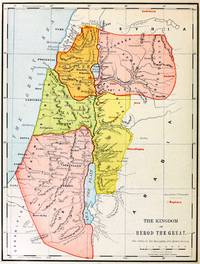 The Kingdom of Herod the Great
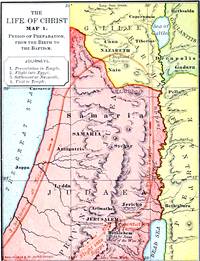 The Life of Jesus, Map 1: His Early Years
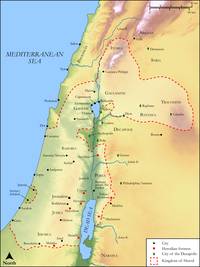 The Kingdom of Herod the Great
 The Birth of Jesus
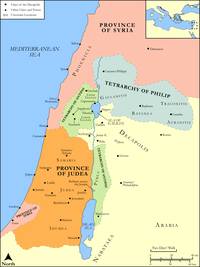 The Land Divided after Herod